An overview of quantitative, qualitative, and mixed-methods research designs in social work, alongside a discussion of core ethical principles such as informed consent, confidentiality, beneficence, and nonmaleficence.
In the field of social work, research is not merely an academic exercise; it is a vital tool for improving human lives and informing policy. To be effective, social workers must understand how to choose the right research design to answer specific questions and, more importantly, how to conduct that research without causing harm to vulnerable populations. This article explores the distinctions between research methodologies and the fundamental ethical principles that govern professional inquiry.
Understanding Research Design
A research design is the strategic framework used to answer a research question. Choosing a design is not a matter of personal preference, but rather a decision driven by the nature of the question being asked. If a researcher wants to measure "how much" or "to what extent," they look toward numbers; if they want to understand "how" or "why," they look toward stories.
Quantitative Research
Quantitative research focuses on objective measurements and the statistical, mathematical, or numerical analysis of data collected through polls, questionnaires, or surveys. This method is ideal for testing theories, looking for correlations, or determining cause-and-effect relationships.
For example, a researcher might ask:
"How does childhood trauma influence the likelihood of developing substance use disorders in adulthood?"
"What is the relationship between work-related stress and burnout among social workers?"
In these cases, the researcher is looking for measurable variables that can be analyzed to find patterns across a large group of people.
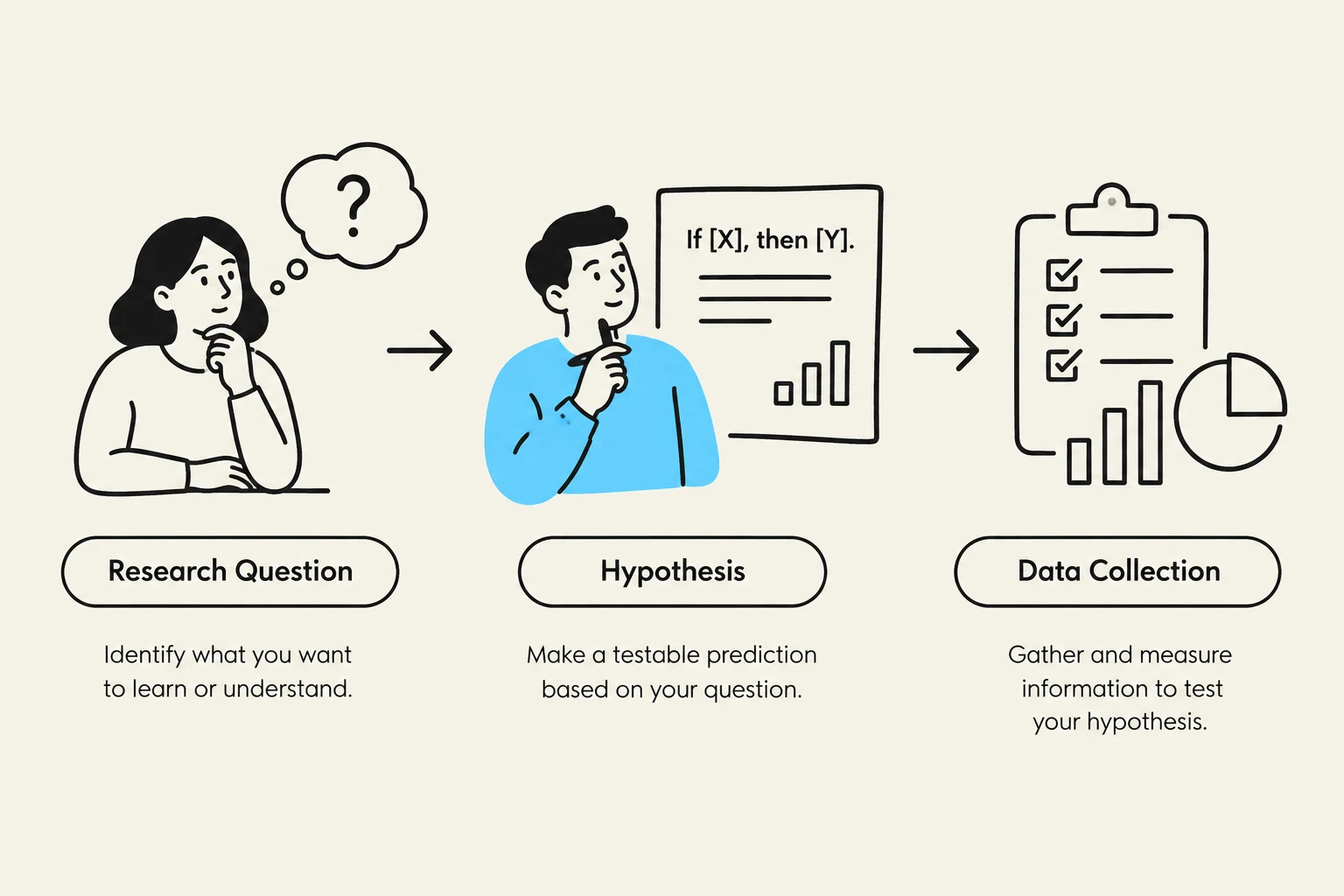
This illustration depicts the scientific method, outlining the steps of formulating a research question, developing a hypothesis, and collecting data.
Qualitative Research
Qualitative research is used to explore the "lived experiences" of individuals. Instead of numbers, this method relies on words, observations, and narratives to understand the complexities of human behavior and social phenomena. It is particularly useful when working with marginalized groups or sensitive topics where a standardized survey might fail to capture the nuance of the situation.
Examples of qualitative questions include:
"How do formerly incarcerated individuals experience the reintegration process into society?"
"What are the challenges faced by immigrant families in accessing mental health services?"
Mixed-Methods Research
Mixed-methods research combines both quantitative and qualitative approaches within a single study. This allows researchers to gain a more comprehensive understanding of a topic by using numbers to show what is happening and narratives to explain why it is happening.
A classic mixed-methods design might look like this:
Quantitative component: Measuring the effectiveness of a mindfulness-based intervention for veterans with PTSD.
Qualitative component: Interviewing those same veterans to understand how they personally perceive the intervention's usefulness.
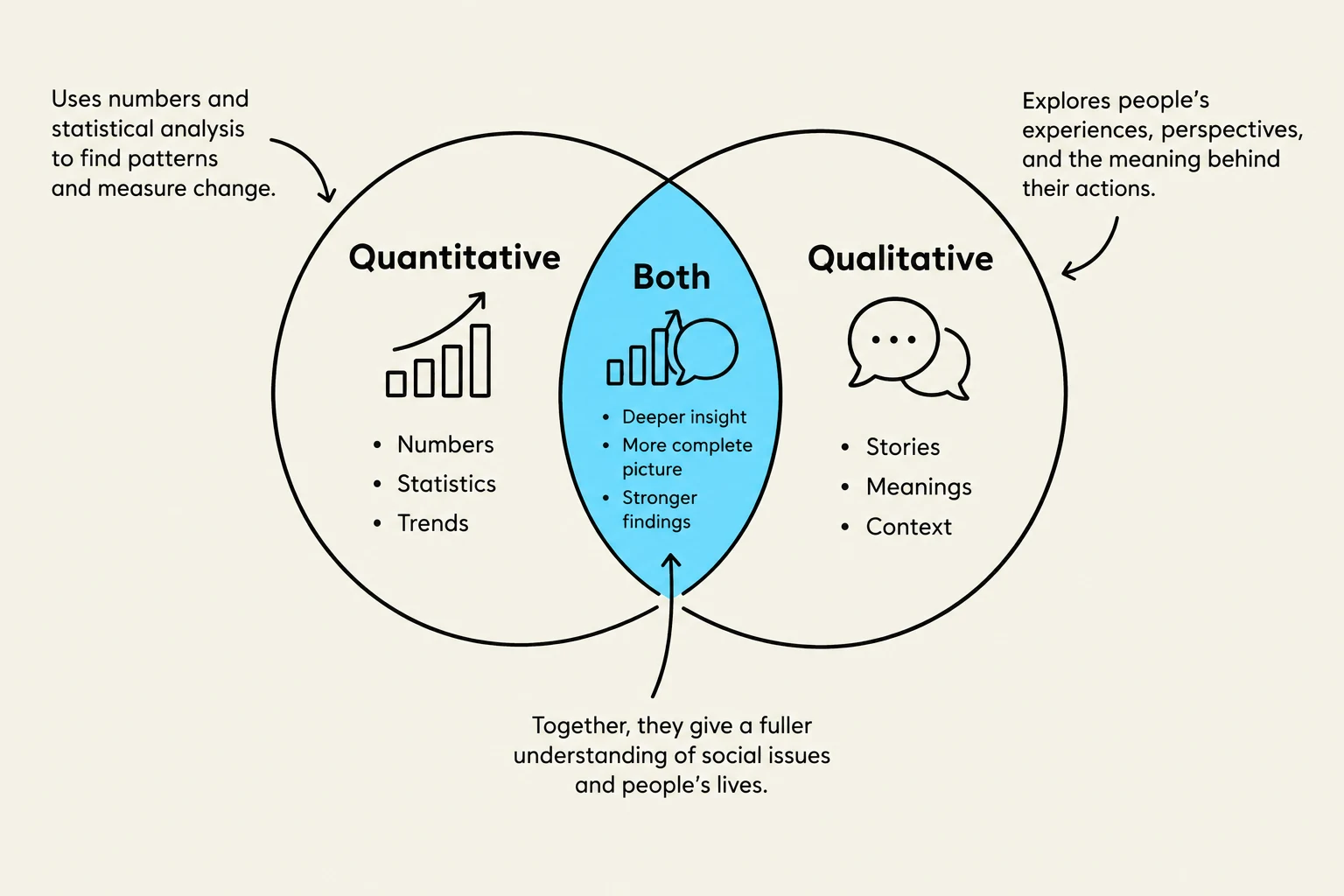
This Venn diagram illustrates the relationship between quantitative and qualitative research methods, highlighting their individual characteristics and their combined benefits for understanding social issues.
Exam Tip: When deciding on a method, always look at the verb in the research question. "Compare," "Measure," or "Impact" often signal Quantitative. "Experience," "Perceive," or "Describe" often signal Qualitative. "Evaluate effectiveness AND perceptions" signals Mixed-Methods.
Ethical Principles in Social Work Research
Because social work research often involves vulnerable populations—such as survivors of domestic violence, foster youth, or those experiencing homelessness—ethical rigor is non-negotiable. Researchers must navigate complex dilemmas where the desire for knowledge may conflict with the safety or privacy of the participant.
The Core Pillars of Ethics
Ethical decision-making in research is guided by several foundational principles:
Informed Consent: Participants must be fully aware of the research purpose, procedures, risks, and benefits before agreeing to participate. They must also know they have the right to withdraw at any time without penalty.
Confidentiality: Researchers are obligated to protect the identity of participants and the privacy of the data collected. This is especially critical when studying illegal activities or stigmatized behaviors.
Beneficence: This principle dictates that research should be designed to maximize potential benefits for the participants and society.
Nonmaleficence: Often summarized as "do no harm," this principle requires researchers to minimize any potential physical, psychological, or social risks to participants.
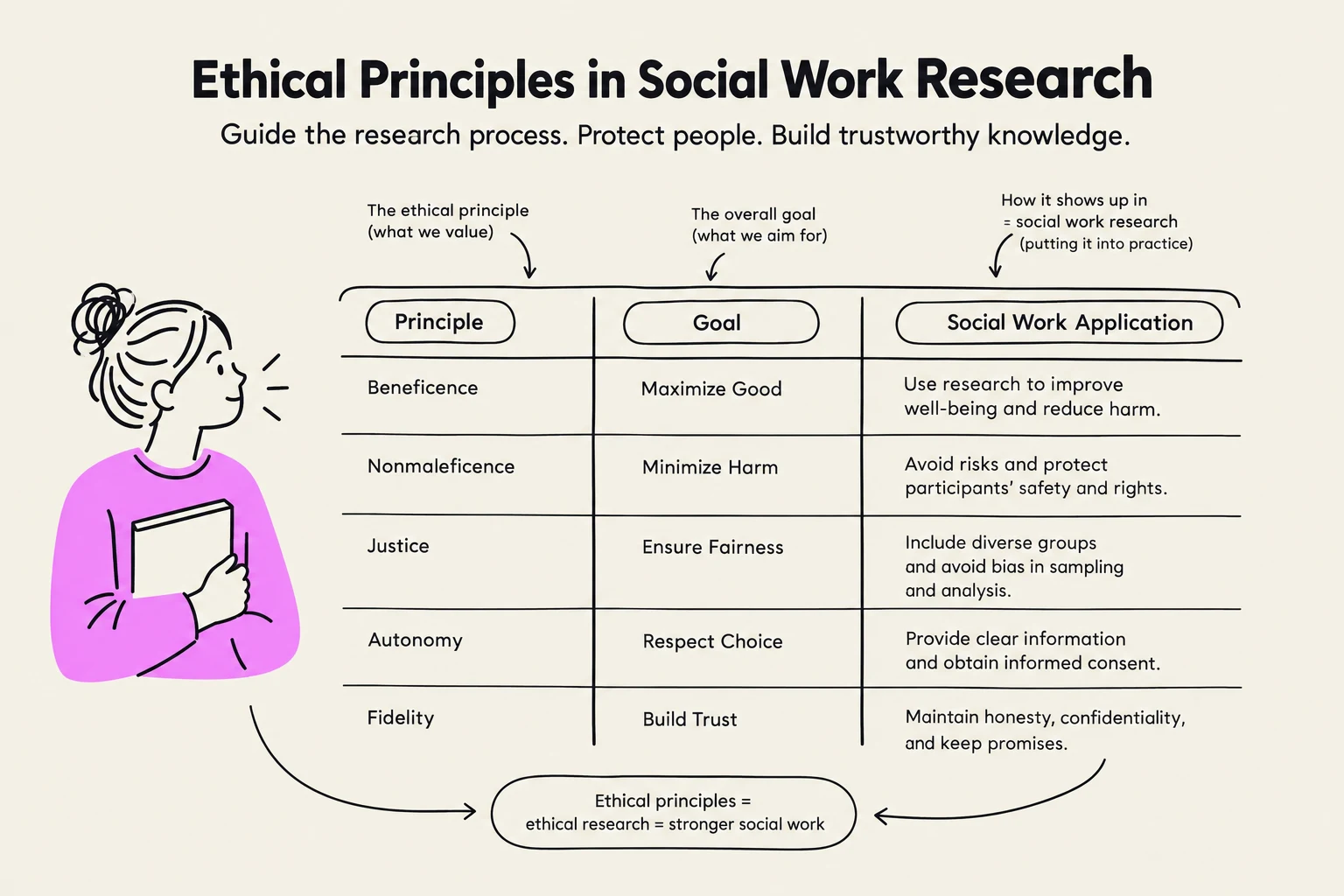
This diagram outlines the ethical principles in social work research, including Beneficence, Nonmaleficence, Justice, Autonomy, and Fidelity, along with their corresponding goals and applications in practice.
Navigating Ethical Dilemmas
In practice, these principles often clash, requiring sophisticated ethical decision-making. Consider these common dilemmas faced by social work researchers:
The Trauma Dilemma: A study asking domestic violence survivors to describe past trauma in detail may provide deep qualitative insights, but it risks re-traumatizing the participant, creating a conflict between beneficence (knowledge gained) and nonmaleficence (potential harm).
The Legal Dilemma: If a researcher interviewing foster youth discovers evidence of illegal activity, they face a conflict between maintaining confidentiality and their legal or professional obligations to report harm.
The Control Group Dilemma: In clinical research, is it ethical to withhold a potentially helpful treatment (like a depression intervention) from a control group just to maintain the scientific integrity of the study?
To resolve these, researchers must consider power dynamics, the vulnerability of the population, and the specific steps required to ensure compliance with ethical standards.
Critical Thinking Prompt: When evaluating a research scenario, ask yourself: "If I were the participant, would I feel safe, informed, and respected?" If the answer is no, the research design likely violates a core ethical principle.
Keep reading for free.
Create an account to finish this reading and make it part of your study routine.