Social Welfare Policy and Political Change in the United States
An overview of the history and evolution of social welfare policy in the United States, examining the influence of political ideologies, landmark legislation like the Social Security Act and the Affordable Care Act, and the challenges faced by the social work profession in pursuing social justice.
Social welfare in the United States is far more than a collection of government programs; it is a reflection of the nation's shifting values, economic realities, and political ideologies. Defined as the array of governmental programs, services, and institutions designed to maintain the stability and well-being of society, social welfare requires a formal arrangement between a government and its people. As the nation evolves, the role of the government in providing for its citizens expands and contracts, driven by the tension between those seeking a robust social safety net and those advocating for smaller government and individual responsibility.
The Ideological Tug-of-War: Liberal vs. Conservative
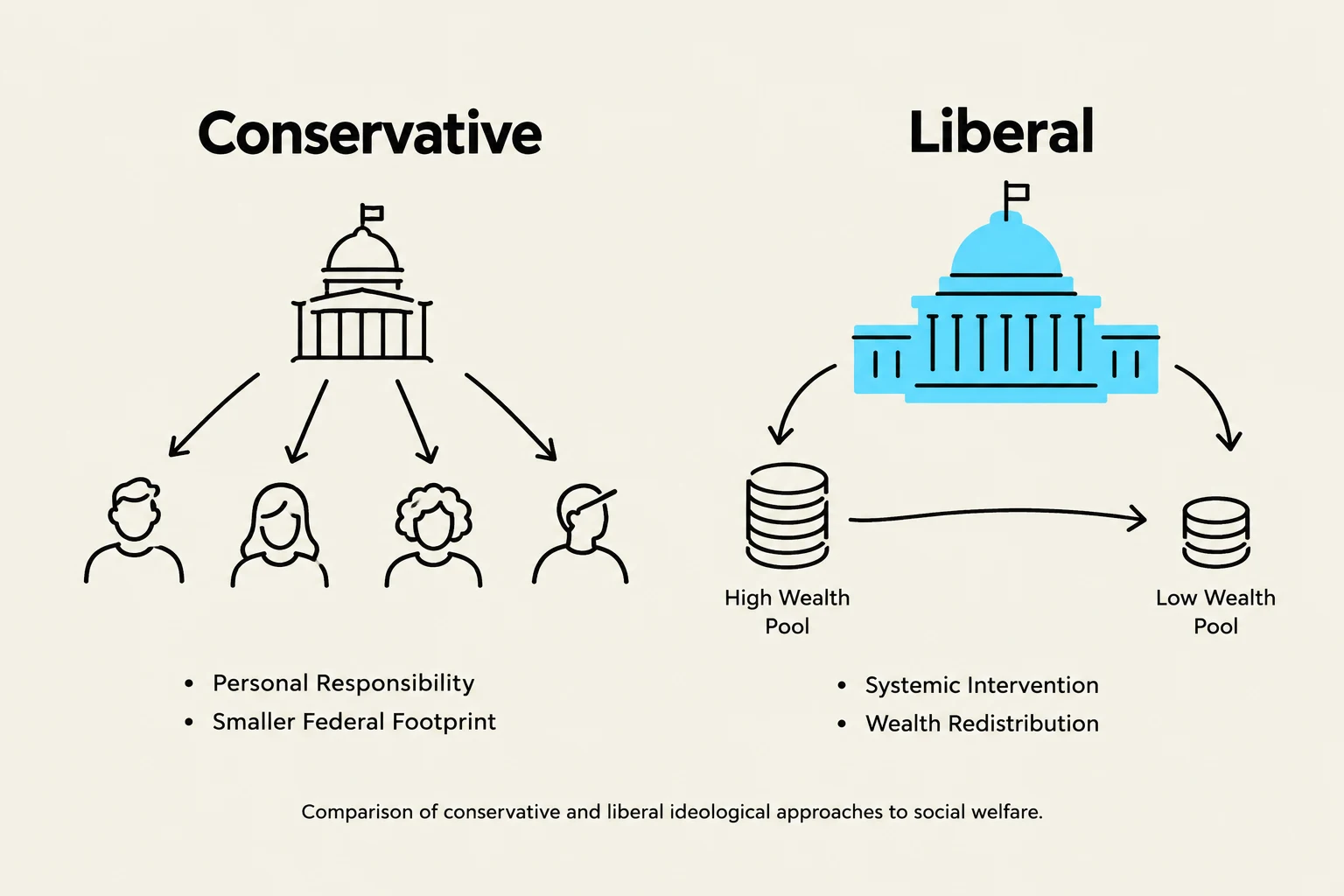
Comparison of conservative and liberal ideological approaches to social welfare.
The trajectory of social welfare policy is often dictated by the prevailing political climate. In the United States, two primary ideological frameworks shape the debate over how resources should be redistributed:
Conservative Ideology: Generally favors personal responsibility and a smaller federal footprint. Conservatives often argue that individuals should be responsible for their own well-being and may view progressive taxation as a burden on the entrepreneurs who drive economic growth.
Liberal Ideology: Typically supports a more robust safety net to address social issues through incremental intervention. Liberals often advocate for tax structures that redistribute wealth to support those at the lower end of the socioeconomic spectrum.
These ideologies influence everything from tax rates to the very existence of certain social services.
Study Tip: When analyzing a new policy, ask yourself: Does this policy emphasize individual responsibility (often conservative) or systemic intervention (often liberal)? This distinction is key to understanding the political motivation behind the legislation.
Landmark Policies and the Expansion of Coverage
Throughout American history, specific eras have been defined by landmark social reforms that fundamentally changed the relationship between the citizen and the state.
The Social Security Act of 1935
Born out of the desperation of the Great Depression, the Social Security Act represented a massive federal response to economic insecurity. It established a foundation for the modern safety net, providing benefits for the elderly, the disabled, and survivors of workers. Over the decades, this act has been amended to include farmworkers, domestic workers, and cost-of-living adjustments to combat inflation.
The Affordable Care Act (ACA)
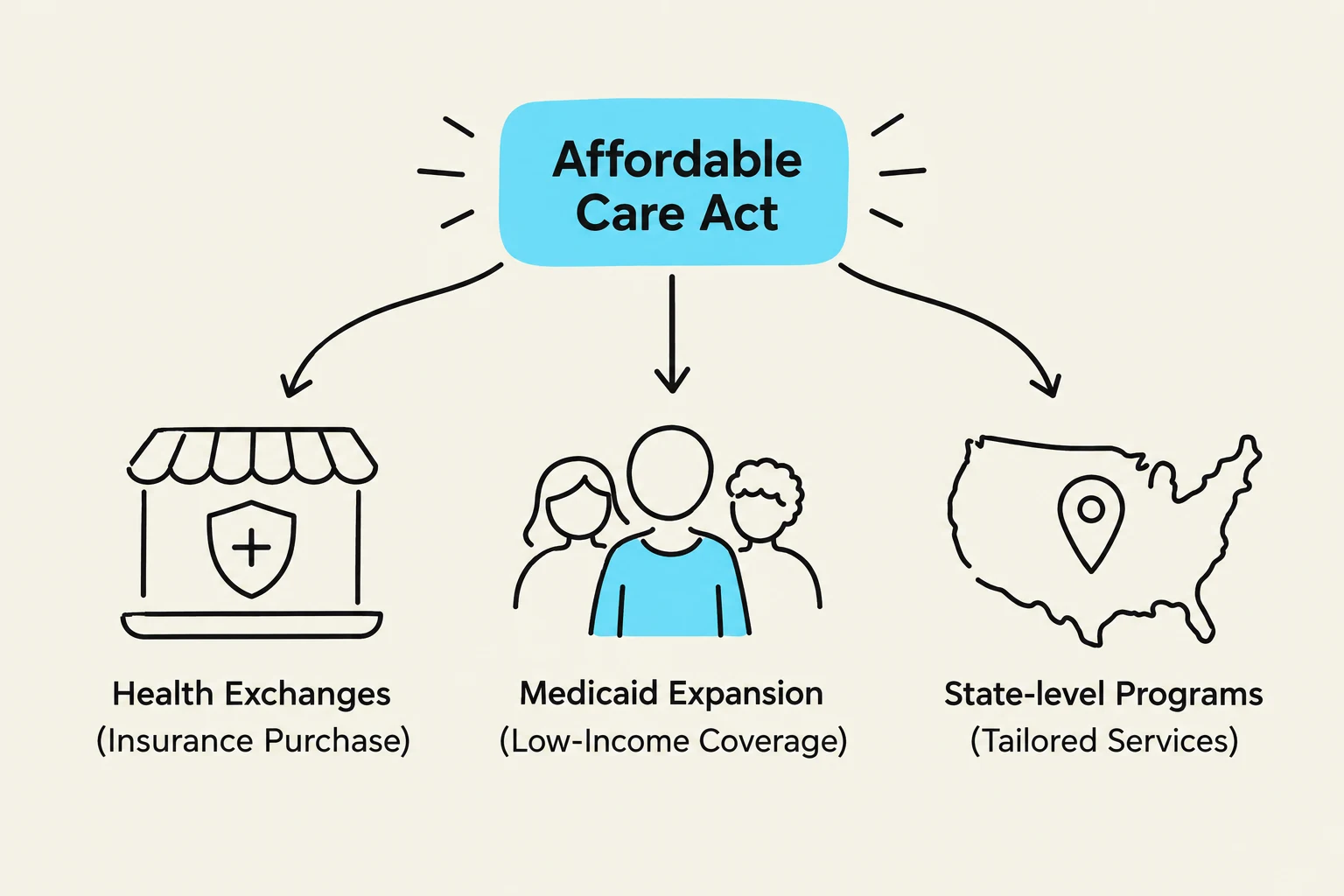
Diagram illustrating the key components of the Affordable Care Act: Health Exchanges for insurance purchase, Medicaid Expansion for low-income coverage, and State-level Programs for tailored services.
A more recent example of significant policy expansion is the Affordable Care Act, signed in 2010. The ACA sought to improve access to affordable health care coverage and increase accountability among insurance companies. It functions through three primary mechanisms:
Health Exchanges: Facilitating the purchase of insurance.
Medicaid Expansion: Increasing the number of low-income individuals covered.
State-level Programs: Allowing states to create basic health programs tailored to their populations.
Political Transitions and Policy Volatility
Because social welfare is tied to the presidency, policy can shift drastically with a change in administration.
The Obama administration's focus on expanding the federal role through the ACA faced significant pushback from Republican lawmakers committed to reducing the national debt and shrinking government. This tension was further exemplified during the Trump administration, which identified the ACA as a major challenge and proposed efforts to repeal and replace it through reconciliation bills. Such shifts create an environment of uncertainty for the vulnerable populations who rely on these services.
The Social Work Profession and the Challenge of Social Justice
For social workers, policy is not just an abstract concept; it defines their clients, the services they can provide, and the duration of their interventions. The profession has a dual history: it is both a "function" (the efficient administration of services) and a "cause" (the pursuit of social reform and justice).
The "Deserving Poor" and Systemic Limitations
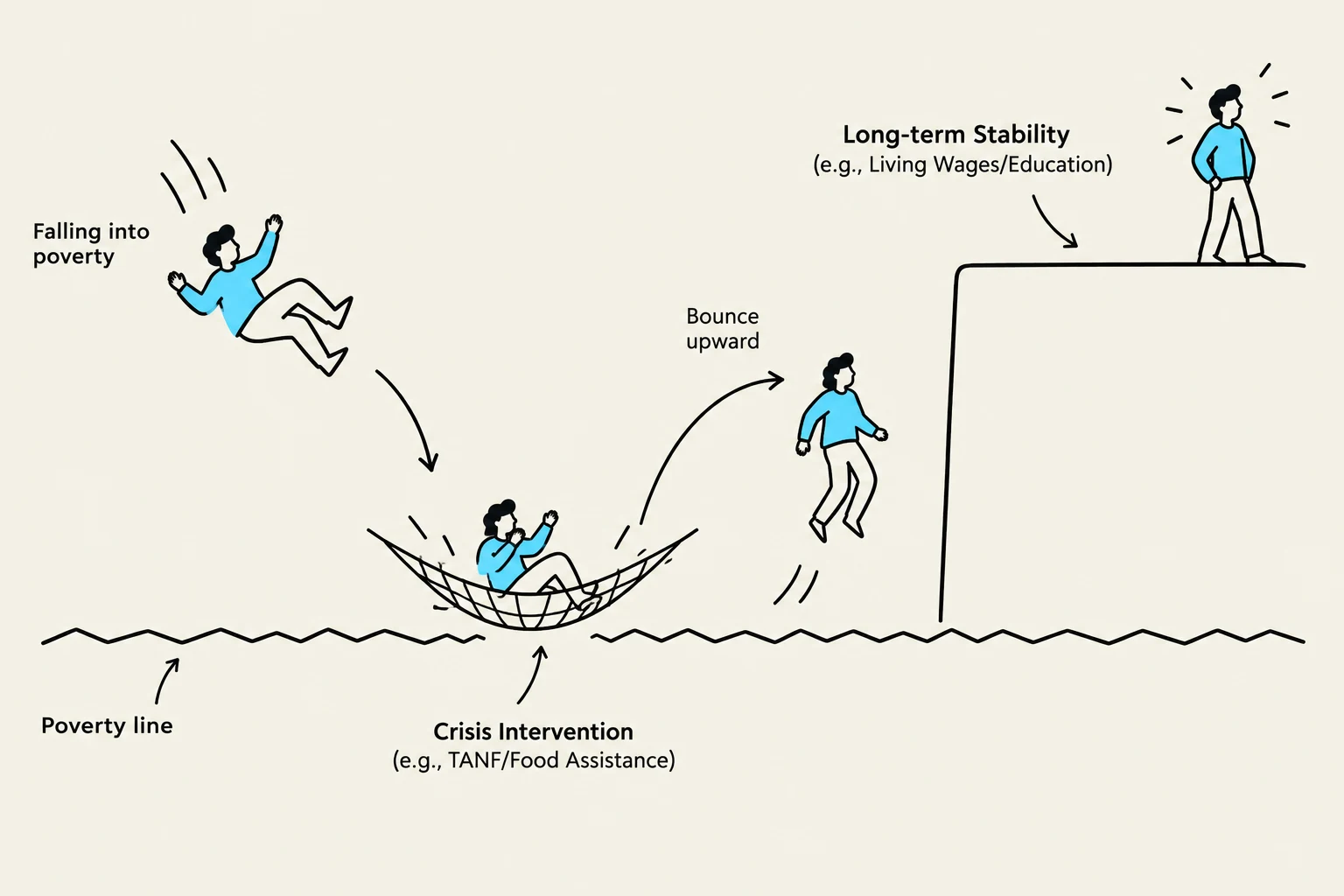
This illustration depicts a conceptual model of poverty, showing a person falling into poverty, receiving crisis intervention, bouncing upward, and achieving long-term stability through factors like living wages and education.
A persistent obstacle to true social justice is the historical concept of the "deserving poor" versus the "nondeserving poor". This distinction, rooted in the Elizabethan Poor Laws, often dictates who is deemed worthy of assistance.
In the modern context, many programs function as crisis interventions rather than preventative measures. For example:
Social Security and Temporary Assistance for Needy Families (TANF) provide essential safety nets, but often focus on meeting only modest basic needs like food and clothing.
Cost Containment: Efforts to limit government spending can result in "means testing" that provides only a temporary "bounce upward" for families, rather than long-term economic stability.
The Gap Between Wealth and Poverty
Despite the United States being a wealthy nation, the prevalence of poverty remains high. Many Americans live paycheck to paycheck, and current social welfare systems often struggle to move people out of poverty and into a living wage. Furthermore, social workers must navigate systemic inequities, including the ways in which racism and social control continue to impact marginalized communities.
Reflective Question: If a social welfare program only addresses immediate needs (like food) but does not address the root causes (like education or living wages), is it truly promoting social justice, or is it merely practicing social control?
Summary
The history of social welfare in the U.S. is a rhythmic cycle of expansion and contraction. Economic shifts, wars, and changing presidential administrations continue to shape the landscape of social services. For students and professionals alike, understanding this history is essential to becoming an effective advocate for those navigating the complexities of the American safety net.
Keep reading for free.
Create an account to finish this reading and make it part of your study routine.