Explore the intricate ways we perceive others through nonverbal cues, including facial expressions, eye contact, body language, and paralanguage. Understand the psychology behind interpreting emotions, recognizing deception, and forming attributions.
In our daily social lives, we are constantly engaged in a complex dance of information exchange. While much of our communication relies on the words we choose, a significant portion of how we understand others comes from what is not said. Social perception—the process of understanding others—is heavily reliant on nonverbal cues to interpret moods, feelings, and intentions. Because people are often unwilling or unable to reveal their true inner feelings through speech, we turn to the "unspoken language" of nonverbal communication to fill in the gaps.
Understanding Nonverbal Communication
Nonverbal communication refers to the information conveyed by cues other than the content of spoken language, as well as our efforts to interpret those cues. These signals are often difficult for individuals to control, making them valuable sources of information about a person's true state.
It is important to note that our social perceptions are not static; they can be influenced by temporary factors such as fatigue, illness, changing moods, or even biological processes. When we observe someone, we are essentially trying to decode these various channels to form a coherent picture of who they are and how they feel.
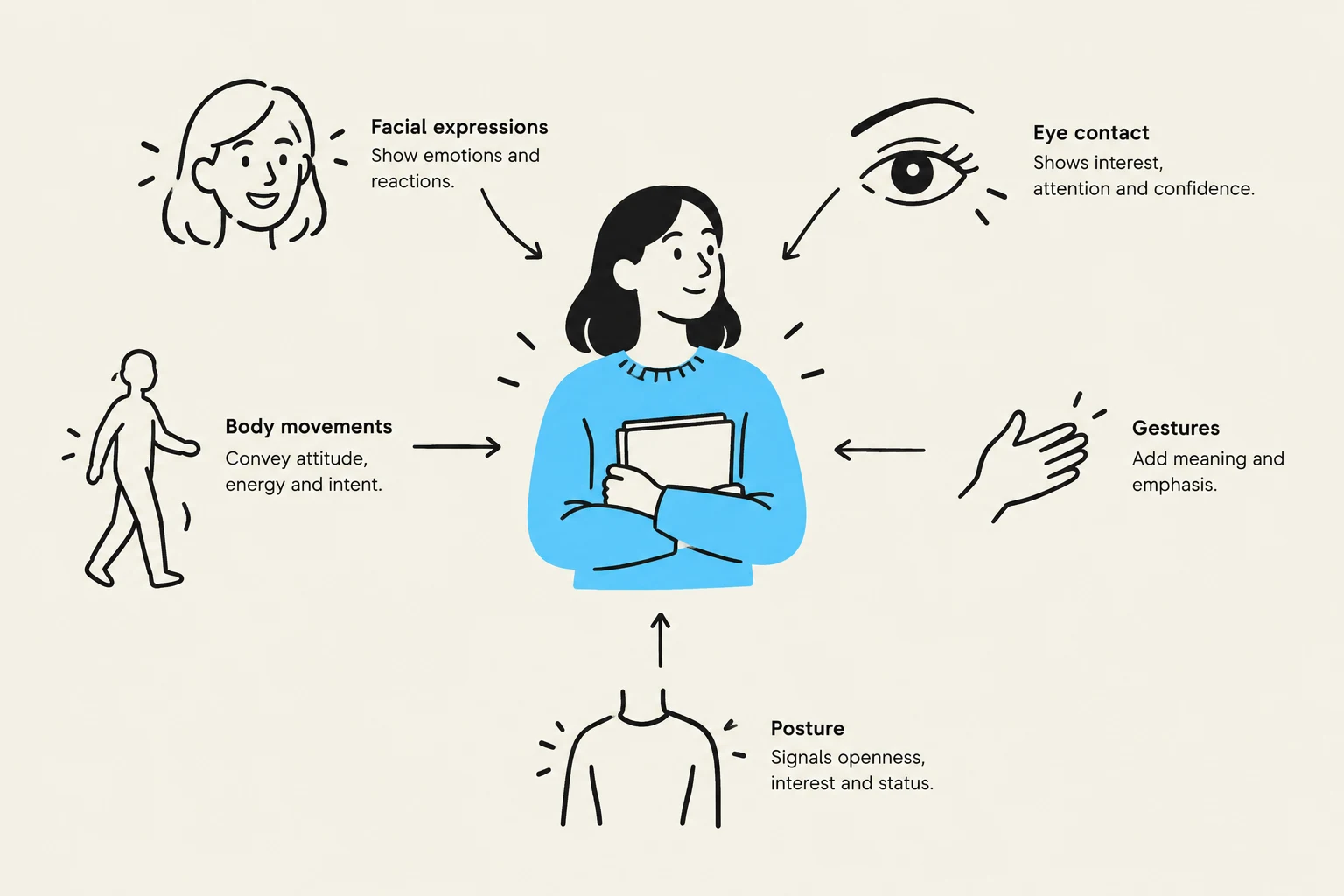
This illustration depicts various non-verbal communication cues, including facial expressions, eye contact, body movements, posture, and gestures, and explains their significance in conveying emotions, attitudes, and meaning.
The Five Basic Channels
Psychologists identify five primary channels through which nonverbal communication flows:
1. Facial Expressions and Basic Emotions
Facial expressions are one of our most potent tools for communicating emotion. Research suggests there are five basic emotions that are largely universal in both their use and recognition: anger, fear, happiness, sadness, and disgust. While "surprise" has been suggested as a sixth, the evidence remains mixed.
It is a common misconception that humans only have a few expressions; in reality, we can combine these basic emotions (e.g., expressing joy and sorrow simultaneously) to create complex nuances. However, our ability to read these faces varies:
Happiness is the most accurately recognized across different cultures.
Fear is often the most difficult to recognize, frequently being confused with surprise.
Cultural Nuance: While expressions are universal, people are generally more accurate at recognizing the facial expressions of members of their own national group.
Exam Tip: Remember that being good at expressing emotions does not necessarily mean you are good at recognizing them in others. Accuracy in reading faces is often tied to how intentionally a person focuses on showing their own emotions.
2. Eye Contact
The way we use our eyes can signal a wide range of social intentions:
High levels of gazing: Often interpreted as a sign of friendliness or liking.
Avoidance of eye contact: May suggest the person is shy, unfriendly, or dislikes us.
Staring: Frequently perceived as a sign of hostility or anger, which most people find disturbing.
3. Body Language and Posture
Our physical movements and the way we hold ourselves reveal significant information about our emotional arousal. For instance, large numbers of movements—such as rubbing, scratching, or fidgeting—are often interpreted as signs of nervousness or even deception.
4. Touching (Haptics)
The meaning of touch is highly contextual. To interpret a touch correctly, one must consider who is doing the touching, the nature of the contact, and the setting. Depending on these factors, touch can communicate anything from affection and friendliness to dominance or aggression.
5. Paralanguage
Communication isn't just about what you say, but how you say it. Paralanguage involves vocal effects that are independent of the actual words used, such as pitch, tone, and speed. For example, certain linguistic styles—like a specific rhythm or pitch pattern—can serve as indicators that a person might be lying.
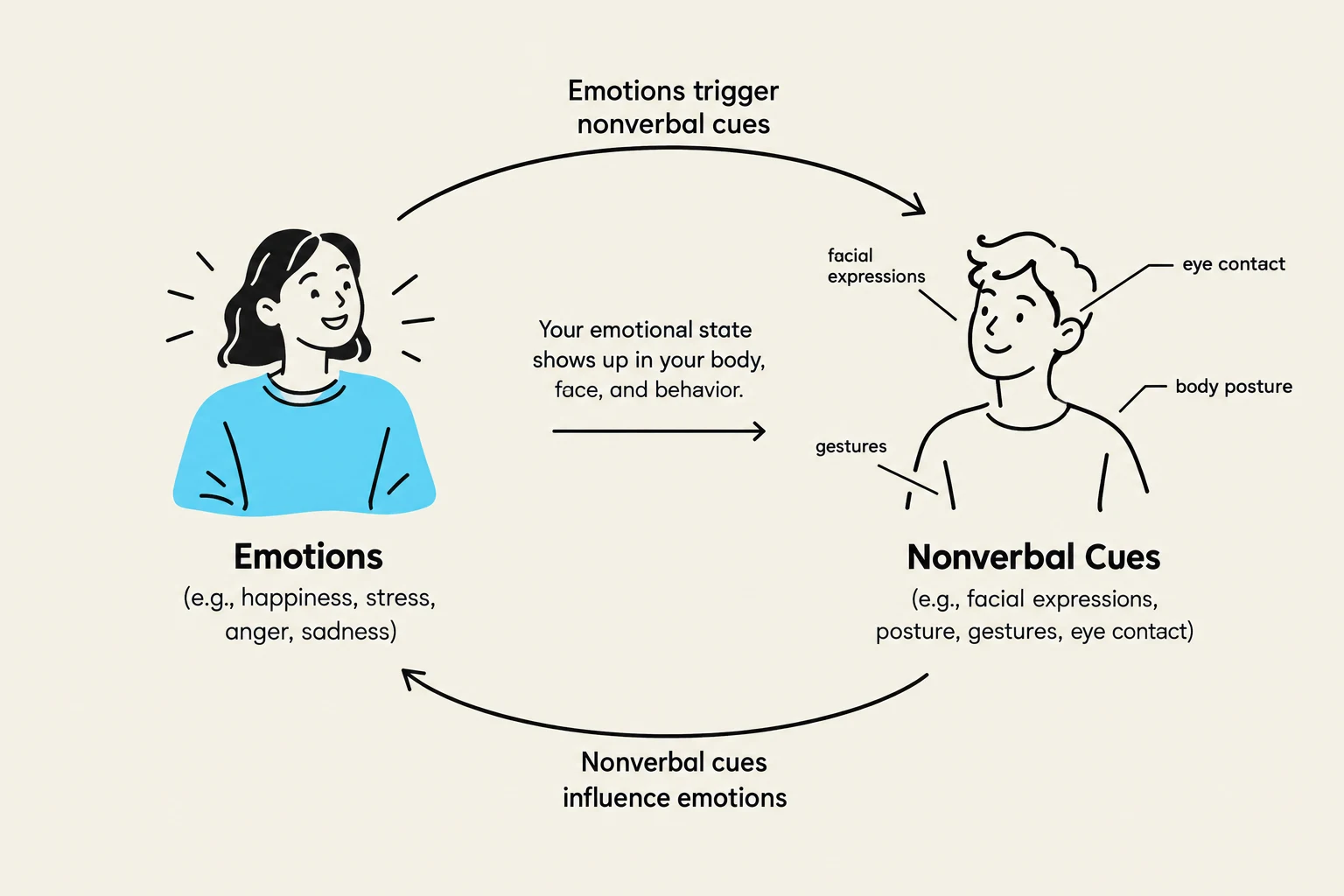
This diagram illustrates the relationship between emotions and nonverbal cues, showing how emotions trigger nonverbal signals and how nonverbal cues can influence emotions.
The Facial Feedback Hypothesis
Interestingly, the relationship between our faces and our feelings is a two-way street. While our emotions drive our facial expressions, our expressions can also influence our internal feelings. This is known as the facial feedback hypothesis, which suggests that the physical act of making a facial expression can actually trigger the corresponding emotion.
Recognizing Deception
Because deception is a frequent part of social interaction—with some estimates suggesting it occurs in nearly 20% of social interactions—learning to spot it is a vital social skill. However, most people are surprisingly poor at detecting lies, often performing no better than chance.
Why are we so bad at it?
The Truth Bias: We tend to assume others are being truthful, so we don't actively look for clues of deception.
Politeness: We often want to be polite, making us reluctant to call out a lie.
Mood Interference: Interestingly, mood affects detection. People in a sad mood are often better at recognizing deception because they pay closer attention to the actual content of the message. In contrast, people in a happy mood may be distracted by irrelevant cues, such as how attractive the speaker is.
When deception is occurring, look for these "red flags":
Microexpressions: Fleeting facial expressions that last only a fraction of a second and are hard to suppress.
Interchannel Discrepancies: When a person's face says one thing, but their body language says another.
Exaggerated Expressions: Over-the-top facial movements used in an attempt to appear convincing.
Attribution: Why Do People Act That Way?
Once we have observed a behavior, we move into attribution—the process of seeking information to understand the causes behind that behavior. We try to decide if an action was caused by a person's stable traits (internal) or by the situation they were in (external).
Theory of Correspondent Inference
We are more likely to believe an action reflects a person's true character (correspondence) when:
The behavior seems freely chosen rather than forced.
The behavior produces noncommon effects (outcomes that only that specific action could cause).
The behavior is low in social desirability (it is out of the ordinary or violates social norms).
Covariation Theory
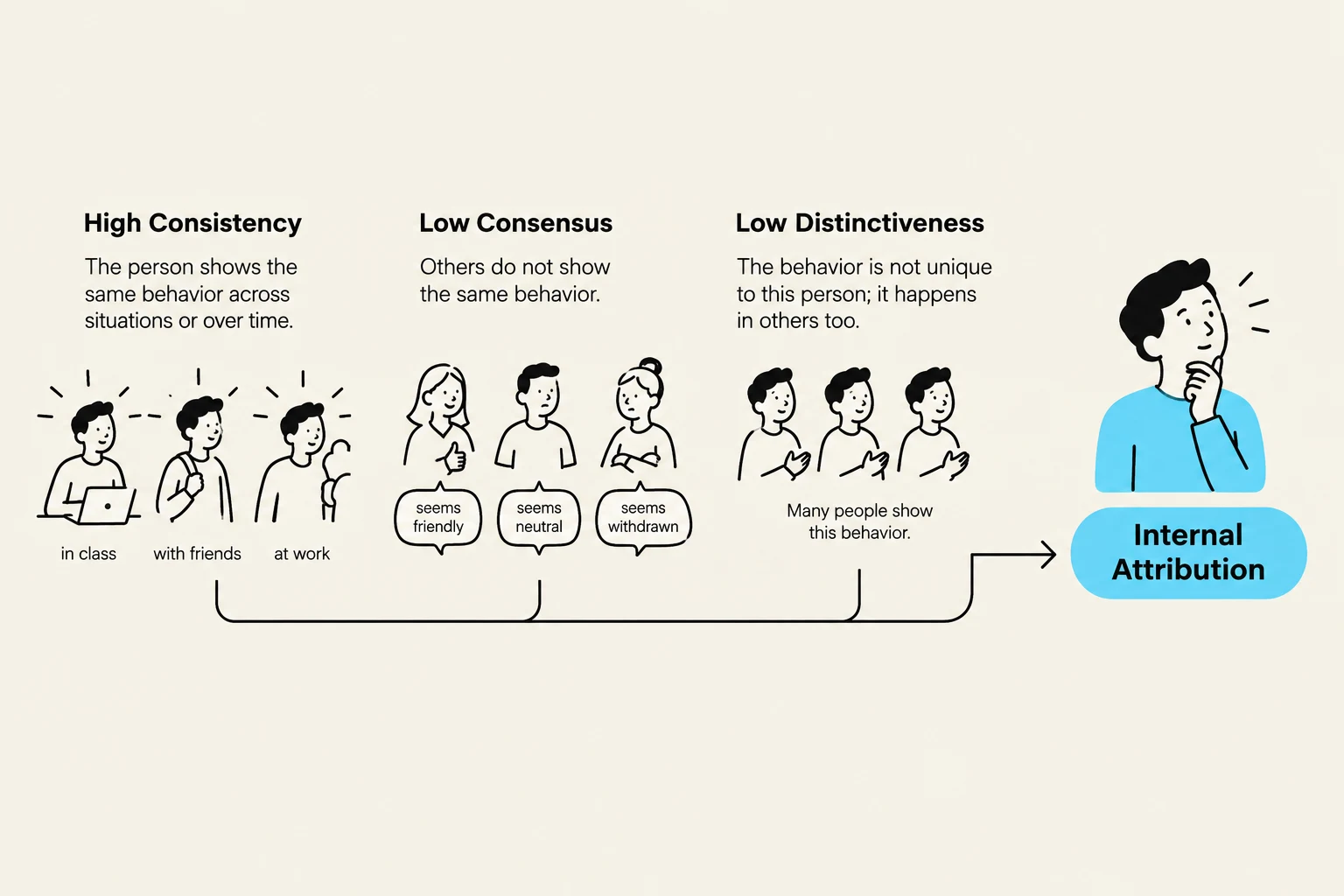
To answer "why" someone acts a certain way, we look at three factors:
Consensus: Do other people react to this stimulus in the same way?
Consistency: Does this person react this way every time this stimulus occurs?
Distinctiveness: Does this person react this way to other, different stimuli?
This diagram illustrates the concept of internal attribution in social psychology, explaining how consistency, consensus, and distinctiveness of behavior influence whether an individual attributes a behavior to internal factors.
Common Errors in Social Perception
Our attempts to understand others are often flawed by cognitive biases:
Correspondence Bias (Fundamental Attribution Error): The tendency to explain others' actions as stemming from their personality/dispositions, even when clear situational causes exist. (e.g., "He's late because he's lazy," ignoring that there was a massive traffic jam).
Actor-Observer Effect: We attribute our own behavior to external causes ("I tripped because the floor was wet") but attribute others' behavior to internal causes ("He tripped because he's clumsy").
Self-Serving Bias: Attributing our own successes to internal traits ("I'm smart") while blaming our failures on external factors ("The test was unfair").
Impression Management
Because first impressions are formed incredibly quickly—often within seconds—people engage in impression management to control how others see them. This includes:
Self-enhancement: Trying to boost one's own appeal.
Other-enhancement: Trying to induce positive moods in others.
While these tactics can be effective, they must be used carefully. If impression management feels forced or overdone, it can backfire, leading others to view the person negatively.
Keep reading for free.
Create an account to finish this reading and make it part of your study routine.