


When we think about "fairness," we often think about individual actions—someone being honest or someone being greedy. However, in the study of social justice, the focus shifts from individual morality to the structural level. Social justice examines how the very frameworks of our society—our legal systems, economic structures, and social institutions—act as the "rules of the game" that determine how advantages and disadvantages are distributed among members of a community.
The Framework of Institutions
Institutions are not just buildings; they are the established laws, customs, and organizations that govern social life. They serve as the mechanisms through which a society organizes itself. These institutions can be categorized into two main types:
- Legal Institutions: These include the judiciary, law enforcement, and legislative bodies that establish formal rules and rights.
- Social Institutions: These include family structures, educational systems, and religious organizations that shape norms and cultural expectations.
The critical question for social justice is whether these institutions are "neutral" or if they inherently favor certain groups while placing barriers in front of others.
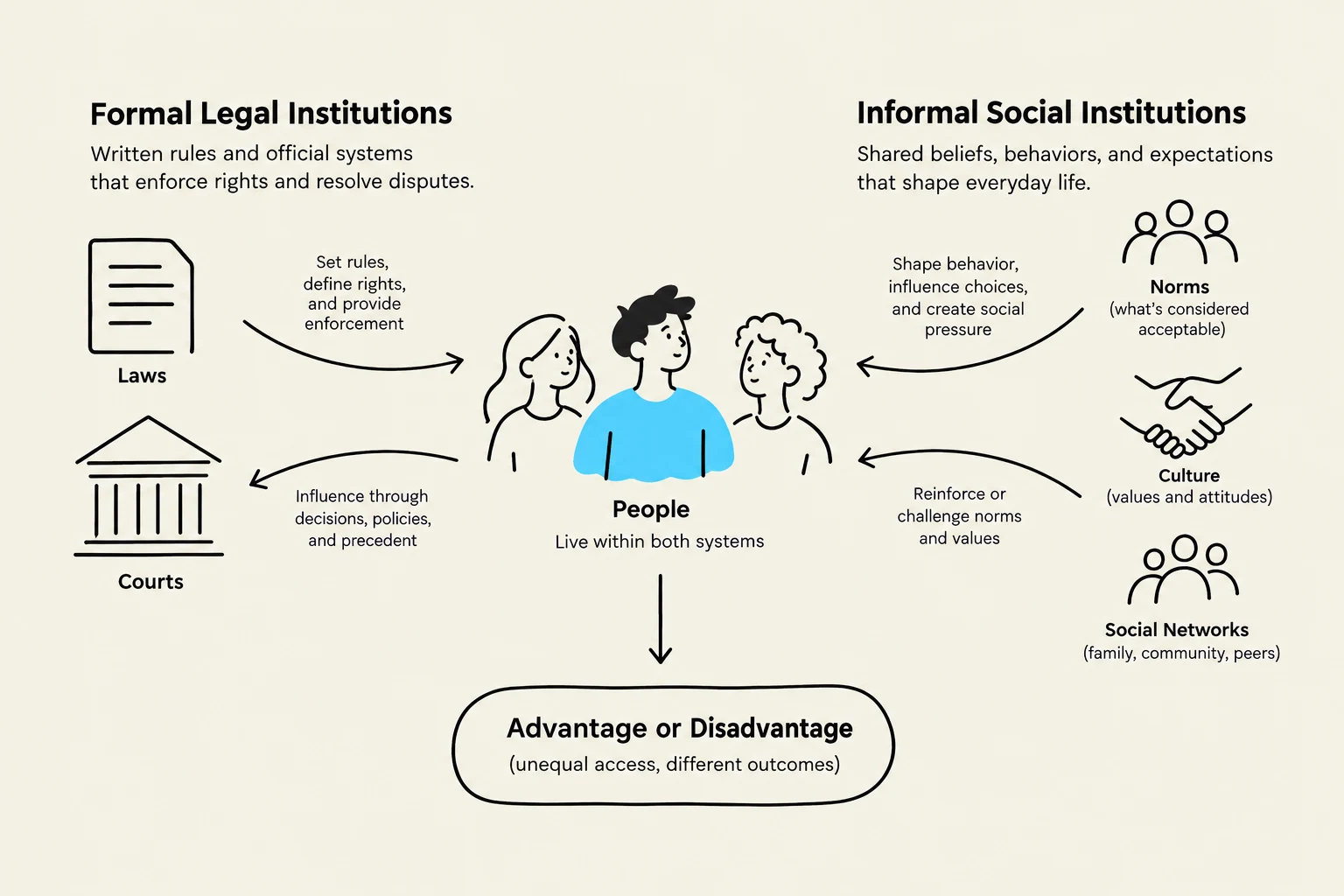
Study Tip: When analyzing a social issue, always distinguish between individual agency (what a person does) and institutional structure (the rules that limit or expand what a person can do). Social justice theory focuses primarily on the latter.
Theoretical Perspectives on Justice
To understand how institutions distribute resources, scholars often look through different theoretical lenses. These perspectives provide the "moral compass" used to judge whether an institution is functioning justly.


Keep reading for free.
Create an account to finish this reading and make it part of your study routine.
Continue reading freeAlready have an account? Log in
Updated