This content explores the concept of social development, emphasizing its importance beyond economic growth. It delves into the multifaceted dimensions of the right to housing, including adequacy, affordability, and the right to enjoyment. The text also examines the principles of equality and discrimination, using the l
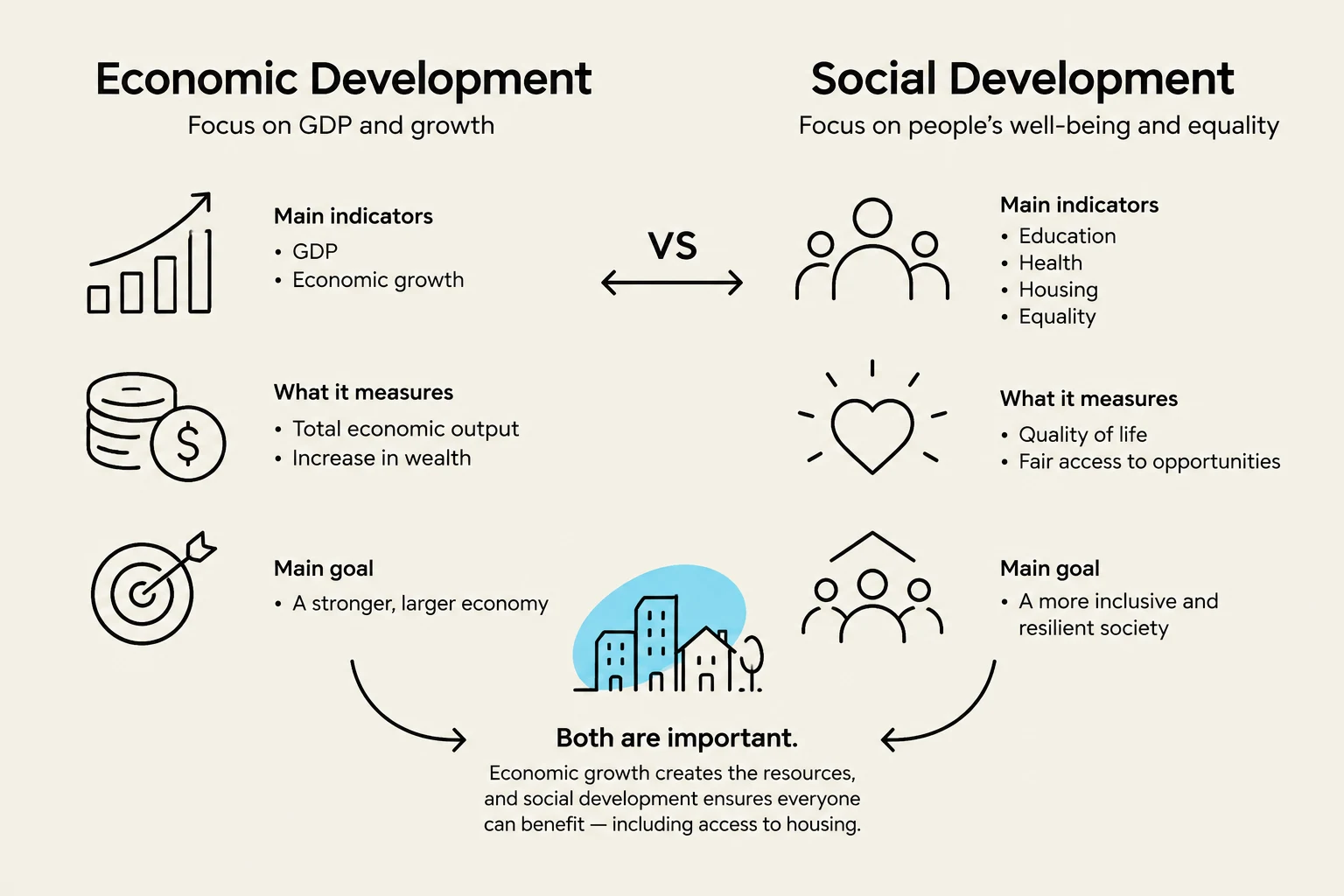
When we discuss the progress of a city like Hong Kong, we often focus on Gross Domestic Product (GDP) and economic growth. However, economic prosperity does not automatically translate into well-being for all citizens. While the city has seen significant growth over the decades, the fruits of this wealth are often distributed unevenly, leading to a glaring contradiction: the expansion of prosperity for some alongside "unspeakable poverty" for others. This gap highlights the necessity of social development, a concept that aims for social justice, solidarity, harmony, and equality. True development requires moving beyond mere economic indicators to address the distribution of income and the protection of human rights.
The Dimensions of the Right to Housing
A fundamental pillar of social development is the right to housing. Under the United Nations International Covenant on Economic, Social and Cultural Rights (UNICESCR), the right to an adequate standard of living—including adequate food, clothing, and housing—is recognized as a socio-economic human right. A "right" is essentially a legitimate claim an individual can make against others based on basic needs. Because adequate housing is essential to human dignity, it is viewed as a fundamental necessity.
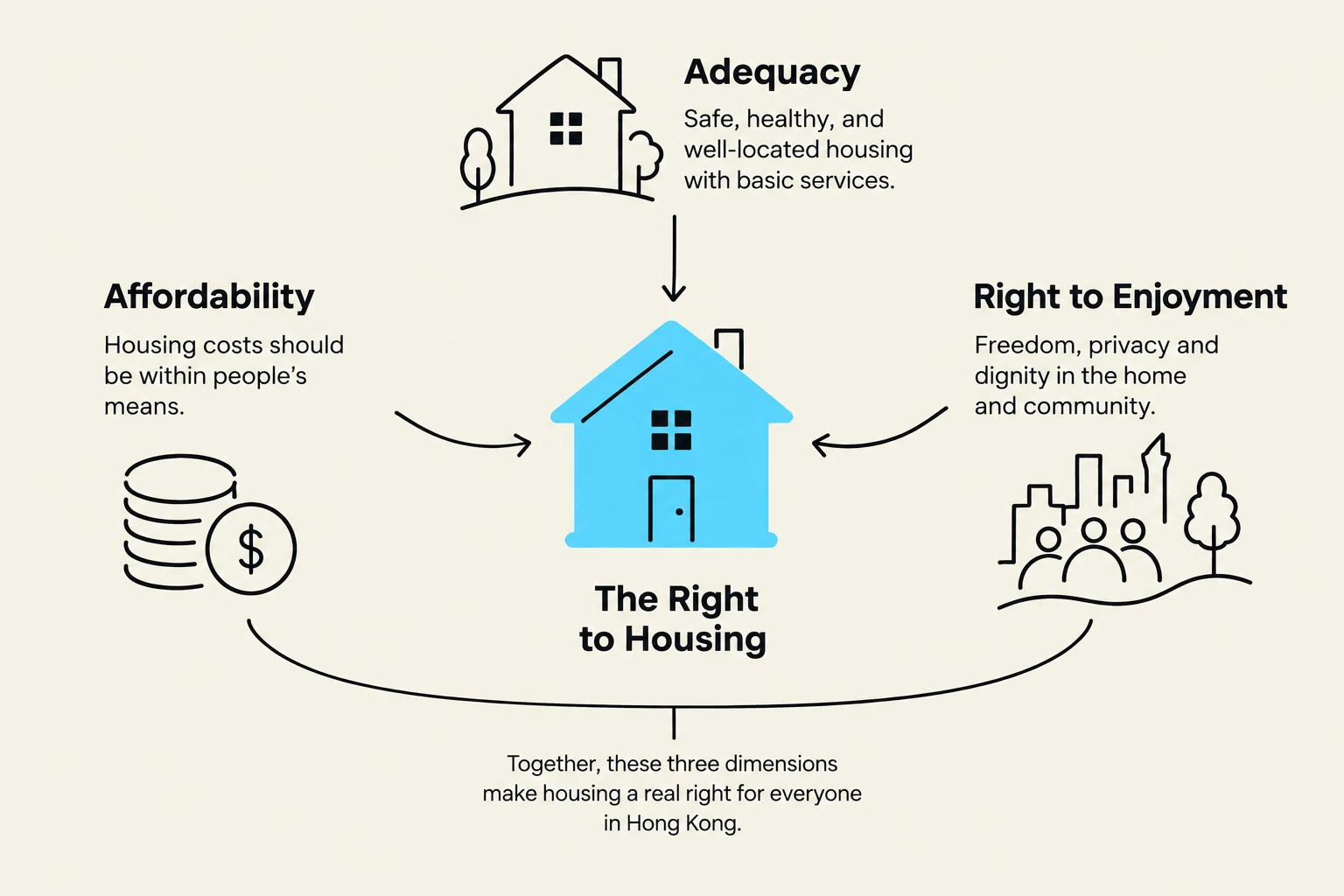
In the context of Hong Kong, the "right to housing" is not a single concept but a triad of indispensable dimensions:
The right to adequate housing: Ensuring the physical structure meets basic needs.
The right to affordable housing: Ensuring the cost of housing does not compromise other basic needs.
The right to enjoy one's housing: The right to live without arbitrary interference.
The government primarily addresses these through Public Rental Housing (PRH). However, a systemic issue arises for those on the PRH waitlist: due to low affordability, they are often "forced" into inadequate private housing. This includes "non-self-contained" units, such as board-partitioned rooms where walls do not reach the ceiling, compromising both privacy and security. Furthermore, such crowded living conditions, including sub-divided units, present significant fire and building safety risks.
The right to housing is composed of three dimensions: affordability, adequacy, and the right to enjoyment, which together ensure housing as a real right for everyone in Hong Kong.
Exam Tip: When discussing the "Right to Housing," always distinguish between the three dimensions. Remember that even if a person has a roof over their head (adequacy), they may still lack the right to housing if the rent is too high (affordability) or if their privacy is constantly violated (right to enjoy).
Understanding Equality and Discrimination
To discuss an "equal" right to housing, we must first define what equality means. In social science, equality is understood in two distinct senses:
Descriptive Equality: This refers to "sameness" in quantity, size, degree, or value (e.g., everyone receiving exactly 3 bars of chocolate).
Normative Equality: This refers to being equal in status or quality. Even though humans are unique in appearance or height, we should normatively treat each other as equals.
Crucially, equality does not always mean "same treatment." To achieve equal opportunity, we may need to treat different individuals differently based on relevant criteria. Following Aristotle’s logic, equals should be treated equally, while non-equals should be treated non-equally. The challenge lies in identifying the correct criterion. For example, in a job promotion, "work performance" is a relevant criterion. However, using race, gender, or sexual orientation as a criterion is arbitrary and results in discrimination.
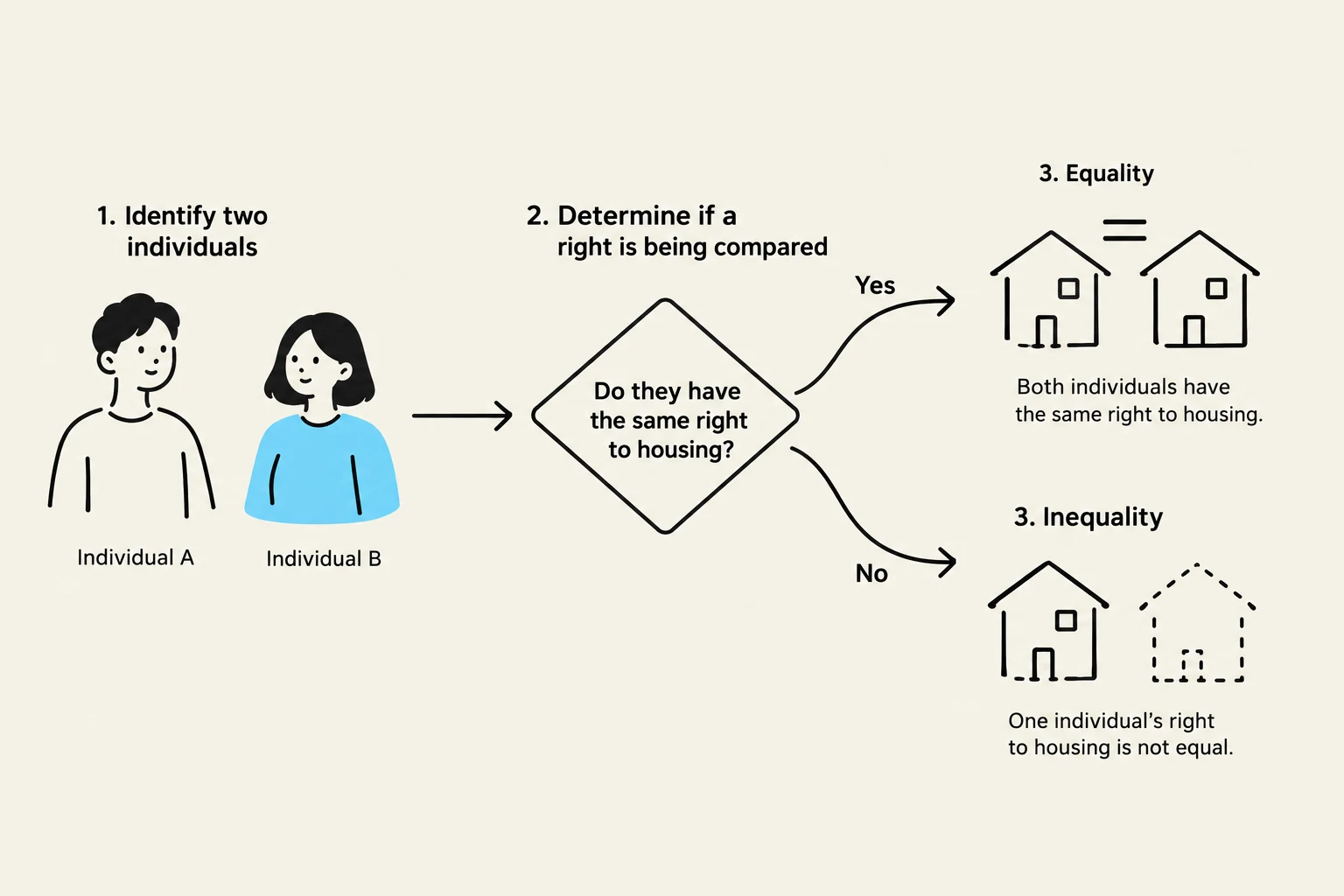
In Hong Kong, an "equal right to housing" implies that both the government and the public must maintain impartial, non-discriminatory attitudes, ensuring that no one is denied housing based on irrelevant personal characteristics.
A flowchart illustrating the concept of housing equality by comparing the rights of two individuals.
Legal Evolution: Same-Sex Couples and Housing Eligibility
A significant test of equality in Hong Kong involves the eligibility of same-sex couples for public housing. Historically, PRH eligibility under the "Ordinary Families" category required applicants to prove legal family relations via marriage or birth certificates. Because marriage was legally defined as between a man and a woman, same-sex couples were effectively excluded from applying as a family unit, often forced to apply only as individuals.
This exclusion led to a landmark legal battle:
2020 Judicial Review: The High Court declared the policy of denying married same-sex couples the right to apply for public housing as unlawful and unconstitutional, noting it placed an "unacceptably harsh burden" on those married overseas.
The Housing Authority's Defense: The Authority argued that protecting "traditional families" was necessary to prevent "competing demand" for limited housing resources.
2023 Court of Final Appeal Decision: The court ruled that while the Basic Law confines marriage to opposite-sex couples, same-sex couples require an alternative legal framework to meet social requirements and achieve a sense of legitimacy.
In response, the Housing Authority implemented administrative changes. Rather than a high-profile announcement, they adopted a "low-profile" approach by updating application forms to replace gender-specific terms like "husband" or "wife" with the neutral term "spouse". This allows same-sex married spouses to be processed under the "ordinary families" category.
Systemic Barriers and the Path to Social Development
The "Equal Right to Housing" requires non-discriminatory attitudes across three sectors: the government (policy), private landlords/agents (service providers), and the public (neighbors). Even with existing laws like the Race, Disability, Sex, and Family Status Discrimination Ordinances, significant barriers remain.
Discrimination manifests in various ways:
In the Neighborhood: Homosexual residents may face extreme nuisances, such as property damage (e.g., kerosene on doors or glue in keyholes) or intense social gossip.
In the Rental Market: South Asians frequently encounter racial discrimination from real estate agents. Interviewees have reported being discouraged from renting because landlords "do not want to rent to South Asians" or due to prejudices regarding the smell of ethnic foods or the number of children in a household.
Ultimately, social development must act as a counterbalance to economic growth. While economic development can lead to uneven wealth distribution, social development ensures that growth brings tangible benefits to ordinary people through the fair distribution of resources, equal access to housing, and robust protections for disadvantaged and minority groups.
This diagram illustrates the key differences and goals of economic development versus social development, highlighting that both are important for societal progress.
Summary Checklist for Students:
Can you define the three dimensions of the right to housing?
Do you understand the difference between descriptive and normative equality?
Can you explain why the Court of Final Appeal ruling was significant for same-sex couples?
Can you identify the three sectors responsible for ensuring an equal right to housing?
Keep reading for free.
Create an account to finish this reading and make it part of your study routine.