An exploration of social cognition, including the role of heuristics as mental shortcuts and schema theory as a framework for organizing social information. It covers how schemas influence attention, encoding, and retrieval, and discusses concepts like priming, cognitive load, and common cognitive distortions.
Every day, we are bombarded with a staggering amount of information from our environment. To prevent ourselves from becoming overwhelmed, our brains do not process every single detail with equal intensity. Instead, we act as "cognitive misers," using mental shortcuts to simplify the complex social world around us. This process of managing and interpreting social information is known as social cognition.
The Role of Heuristics
Because we often lack the time or mental energy for full, systematic processing, we rely on heuristics—low-level mental strategies or shortcuts that allow us to make complex decisions or draw inferences rapidly and seemingly effortlessly. We are particularly prone to using these shortcuts when we face information overload, high levels of stress, or a lack of solid information.
While heuristics can be efficient, they can also lead to systematic errors in judgment. Common examples include:
Representativeness Heuristic: Classifying something based on how much it resembles a typical case or prototype.
Availability Heuristic: Basing judgments on how easily an example comes to mind (e.g., fearing a plane crash because dramatic news reports make them easy to recall).
Anchoring and Adjustment: Using a starting value (an "anchor") and adjusting away from it, though we often fail to adjust sufficiently.
Exam Tip: Remember that heuristics are "low-level" strategies. They are not necessarily "wrong," but they are shortcuts that prioritize speed over absolute accuracy.
Understanding Schema Theory
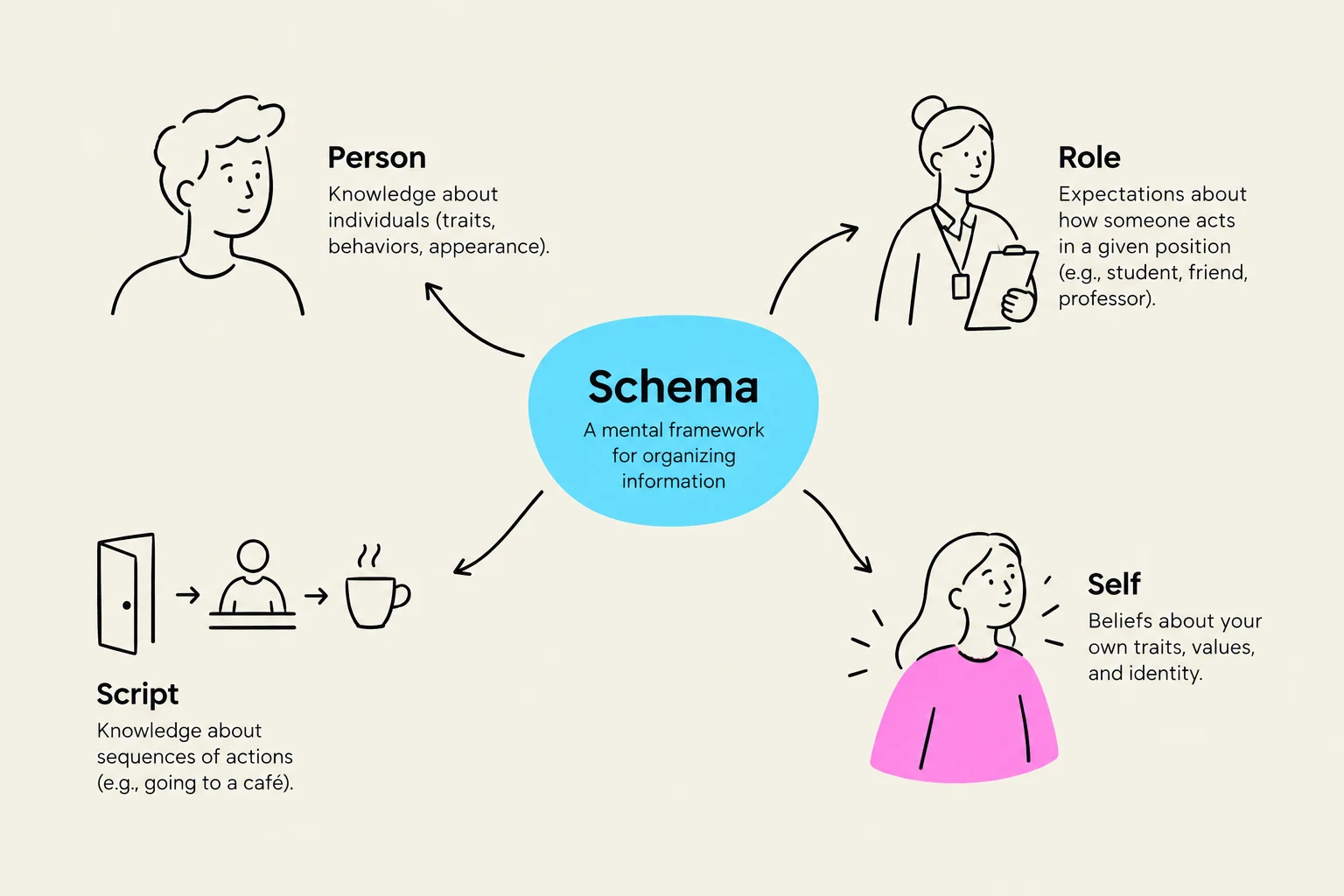
A central component of social cognition is schema theory. Schemas are mental frameworks or structures used to organize knowledge about the social world around specific themes or subjects. Think of them as the "cognitive building blocks" that help us make sense of new experiences by comparing them to what we already know.
Schemas are categorized based on the type of information they organize:
Person schemas: Knowledge about specific individuals.
Role schemas: Expectations regarding social roles (e.g., what a "doctor" or "student" should act like).
Scripts: Knowledge about sequences of events, such as the steps involved in attending a lecture or dining at a restaurant.
Self-schemas: Information regarding oneself.
This diagram illustrates the concept of schema in psychology, which is a mental framework for organizing information. It shows four types of schemas: person schemas (knowledge about individuals), role schemas (expectations about how someone acts in a given position), self schemas (beliefs about one's own traits, values, and identity), and script schemas (knowledge about sequences of actions).
How Schemas Influence Cognition
Schemas are not passive storage units; they actively shape how we interact with the world through three primary processes: attention, encoding, and retrieval.
1. Attention
Schemas act as a filter for our perception. We are more likely to notice information that is consistent with our existing schemas. If information fits our expectations, it enters our consciousness more easily.
2. Encoding
Once information is noticed, it must be stored in memory through encoding. Information that aligns with our schemas is encoded more readily. However, if information is sharply inconsistent with a schema—such as a lecturer performing magic tricks instead of teaching—it may seize our attention and be encoded with a unique "tag" in a separate memory location.
3. Retrieval
Retrieval is the process of recovering information from memory to make judgments. Because we tend to remember schema-consistent information more easily, our subsequent judgments are often heavily biased toward what our schemas predicted.
Activation: Priming and Unpriming
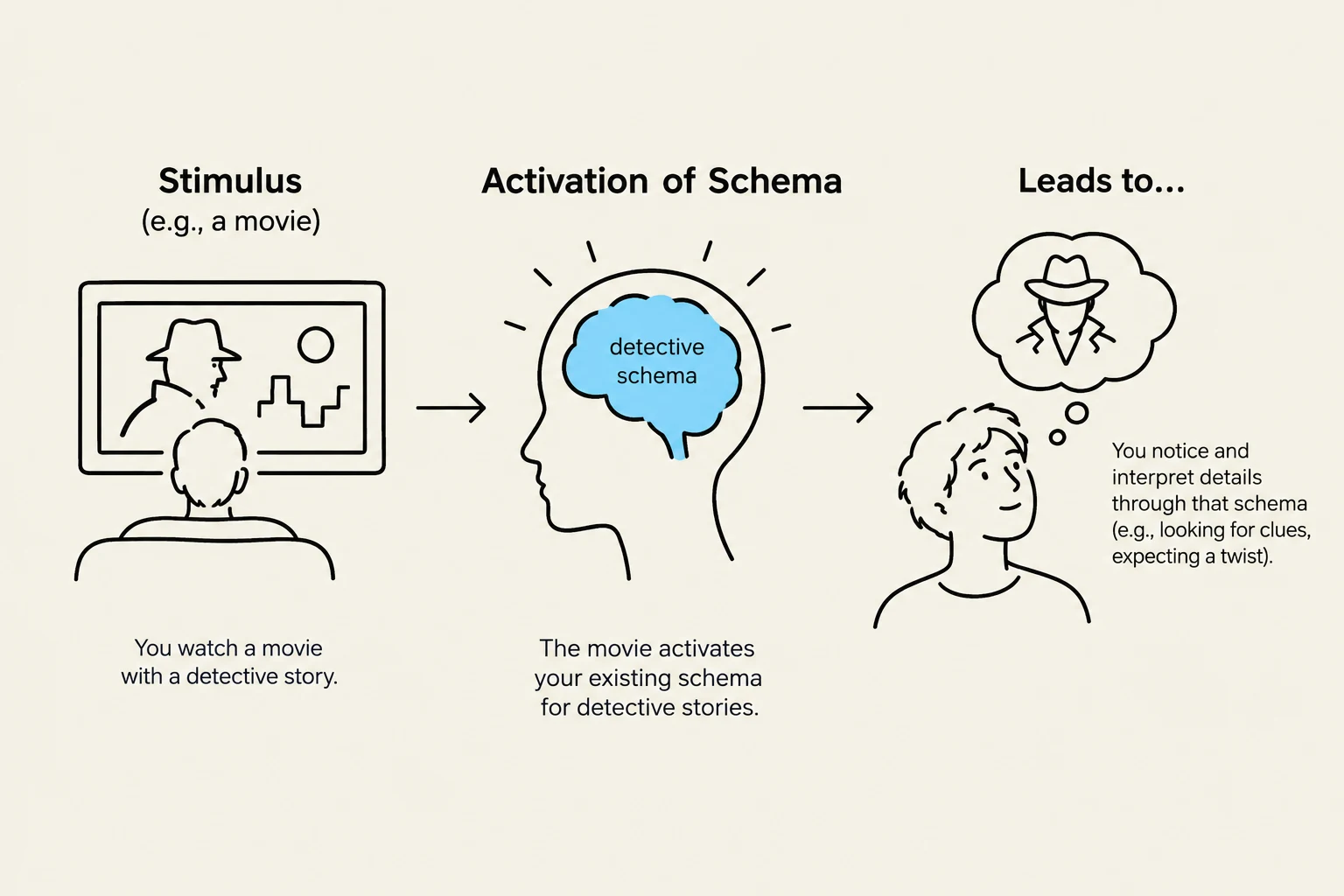
The influence of a schema can fluctuate based on how "active" it is in our minds. This is often driven by priming.
Priming occurs when recent stimuli or experiences increase the availability of specific information in our consciousness. For example, watching a violent movie might prime an "aggression" schema, causing you to perceive a stranger's neutral behavior as aggressive.
The influence of a primed schema persists until it is expressed in thought or behavior. Once it has been expressed, the process of unpriming occurs, and the influence of that specific schema decreases.
This diagram illustrates how a stimulus, such as watching a movie with a detective story, activates a person's existing schema for detective stories, leading them to notice and interpret details through that schema, like looking for clues or expecting a twist.
Cognitive Load and Persistence
We rely most heavily on schemas during periods of high cognitive load—when we are trying to process too much information at once. In these moments, schemas provide the necessary structure to process information efficiently without exhausting our mental resources.
However, because schemas guide our perception so strongly, they can lead to significant cognitive distortions:
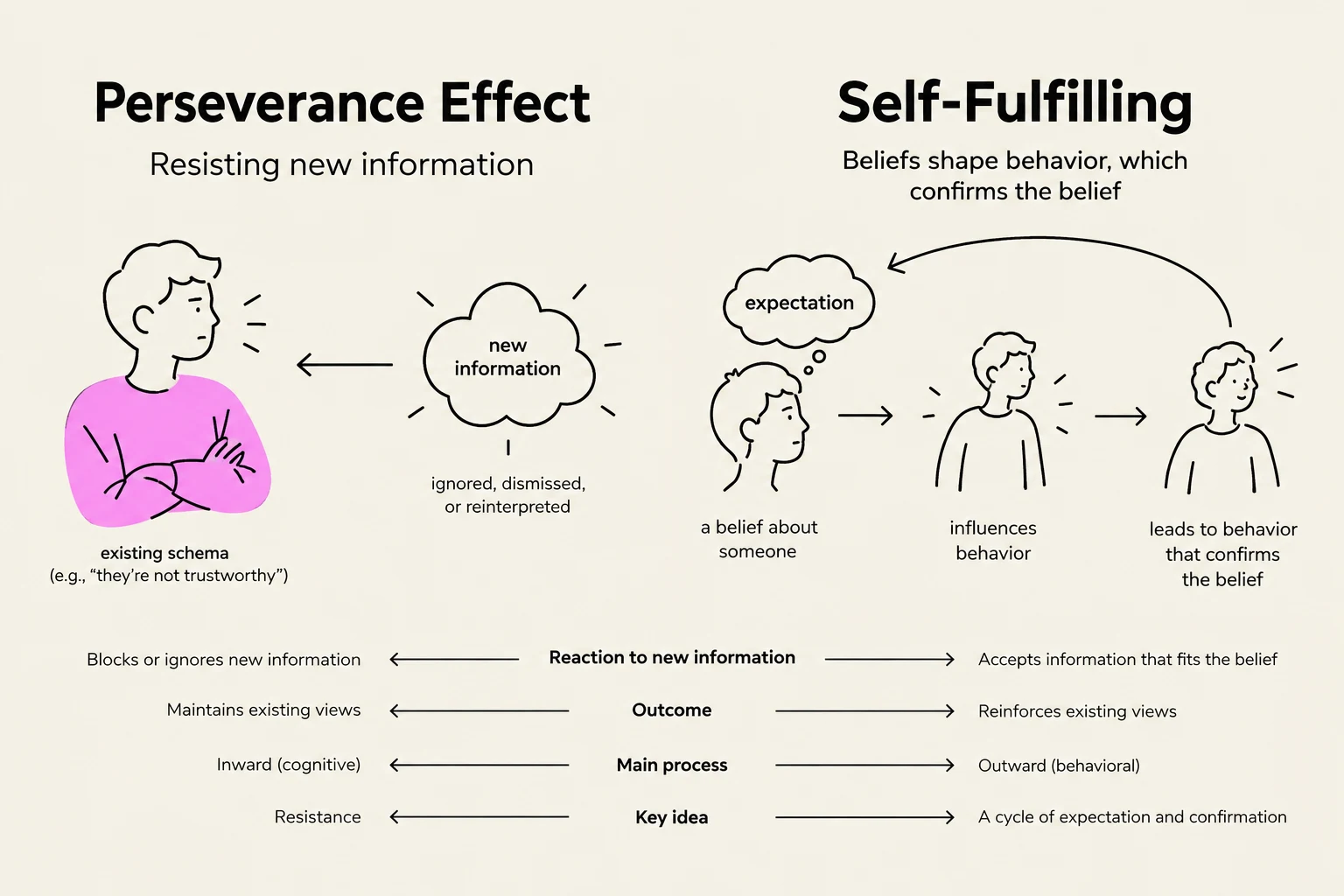
The Perseverance Effect: This is the tendency for beliefs to persist even after they have been discredited by contradictory evidence. Schemas are remarkably resistant to change.
Self-Fulfilling Schemas: Our schemas can influence our behavior in ways that actually cause the social world to become consistent with the schema.
The Halo Effect: A bias where a single desirable characteristic influences our overall impression of a person.
The False Consensus Effect: The tendency to overestimate how much other people share our own views and preferences.
This diagram illustrates the Perseverance Effect, where new information is ignored, dismissed, or reinterpreted due to existing schemas, and the Self-Fulfilling prophecy, where beliefs shape behavior that confirms the initial belief through expectation and reinforcement.
Summary Note: While schemas are essential for navigating a complex world, they can act as "double-edged swords." They provide efficiency and meaning, but they can also trap us in biased perceptions and outdated beliefs.
Keep reading for free.
Create an account to finish this reading and make it part of your study routine.