Explores the role of social and behavioral sciences in public health, including social determinants of health, theories of behavioral change, and practical frameworks like Social Marketing and PRECEDE-PROCEED.
Public health is often associated with vaccines, sanitation, and disease surveillance. However, a critical component of improving population health lies in understanding why people do what they do and how the world around them influences those choices. This is the domain of the social and behavioral sciences. By examining social systems, socioeconomic status, and psychological theories, public health professionals can move beyond simply treating disease to addressing the root causes of health outcomes.
Social Systems and the Determinants of Health
We do not live in a vacuum; we are constantly interacting with social systems composed of our relationships with other people, institutions, communities, and policies. These systems influence health by shaping social norms, enforcing patterns of social control, and either providing or limiting opportunities to engage in healthy behaviors.
Central to this discussion are the Social Determinants of Health (SDOH). These are the conditions in which people are born, grow up, live, learn, work, play, worship, and age, as well as the systems put in place to deal with illnesses that affect health and quality of life. Key components of these social systems include:
Socioeconomic Status (SES): A person's economic and social position in relation to others, which significantly impacts their access to resources.
Culture and Religion: Broad social influences that can affect an individual's response to disease and their health-seeking behaviors.
When these determinants lead to unfair differences in health outcomes, we encounter health and healthcare disparities. The ultimate goal of public health is health equity, which is rooted in social justice—the principle of providing fair treatment and a fair share of society's rewards to all individuals and groups.
The Three Lenses of Intervention: Upstream, Mainstream, and Downstream
To effectively change health outcomes, interventions must target different levels of influence. Public health professionals often categorize these into three "lenses":
Downstream Factors: These involve the individual directly. Interventions here focus on personal behaviors and can often be altered through individual-level changes (e.g., counseling a person to quit smoking).
Mainstream (or Midstream) Factors: These focus on the relationships between an individual and a larger group or population, such as family dynamics or peer influence.
Upstream Factors: These are grounded in changing social structures, laws, and policies to make healthy choices easier for everyone (e.g., implementing a sugar tax or improving urban walkability).
Exam Tip: If a question asks about "social structures" or "policy," think Upstream. If it asks about "individual knowledge" or "attitudes," think Downstream.
Theories of Behavioral Change
While behavior change is possible, it is not always easy. Behaviors with physiological or addictive elements, such as obesity or cigarette smoking, are notoriously difficult to change. However, by using established theories, we can predict and influence how people move toward healthier lifestyles.
Intrapersonal Theories (Downstream)
These theories focus on the individual's internal characteristics, such as knowledge, beliefs, and motivations.
Health Belief Model: This model suggests that people are more likely to take action if they perceive themselves as susceptible to a condition, believe the consequences are serious, and feel that the benefits of acting outweigh the harms.
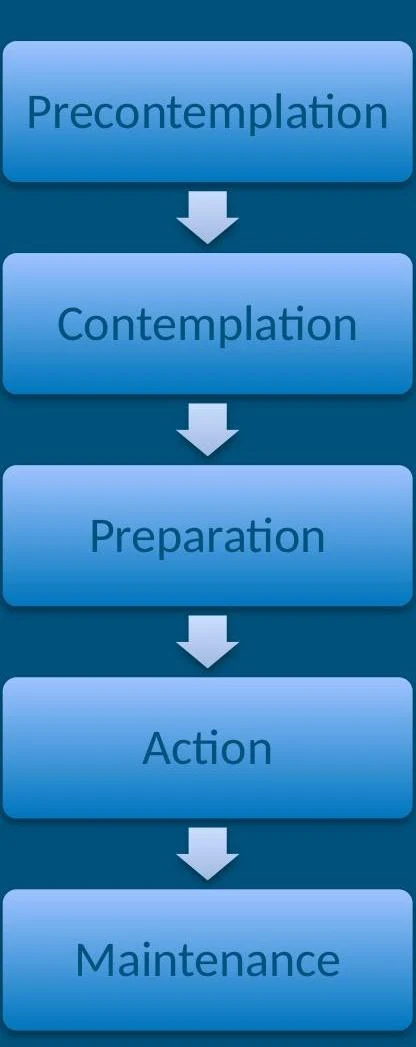
Stages of Change Model: This model posits that behavior change is a process rather than a single event. People move through incremental stages: Precontemplation, Contemplation, Preparation, Action, and Maintenance.
A diagram illustrating the stages of change: Precontemplation, Contemplation, Preparation, Action, and Maintenance.
Interpersonal and Population Theories (Mainstream and Upstream)
Social Cognitive Theory: This theory emphasizes the interaction between people and their environment, often involving concepts like reciprocal determinism.
Theory of Planned Behavior: Focuses on how intentions, shaped by attitudes and social norms, drive behavior.
Diffusion of Innovation: Explains how new ideas, products, or behaviors spread through a social system over time.
Social-Ecological Theory: A comprehensive framework that views health through multiple levels of influence simultaneously.
Putting Theory into Practice
Social Marketing
Public health can borrow principles from commercial marketing to drive behavior change. This is known as Social Marketing. It uses the "Four Ps" to promote healthy behaviors: Product (the behavior), Price (the cost/barrier to change), Place (where the behavior occurs), and Promotion (the branding and communication).
The PRECEDE-PROCEED Framework
For complex health issues, professionals use the PRECEDE-PROCEED model to design, implement, and evaluate programs.
PRECEDE (Diagnostic Phase): This involves assessing the social, epidemiological, behavioral, environmental, educational, and administrative factors of a problem.
PROCEED (Implementation and Evaluation Phase): This involves implementing the intervention and then conducting three types of evaluation: Process (was it done as planned?), Impact (did it change the immediate behaviors/environment?), and Outcome (did it improve the actual health status?).
Example: Addressing Gun Violence
Epidemiological Assessment: Analyzing data to find that most gunshot deaths occur in males under 24.
Behavioral/Environmental Assessment: Identifying gang-related behavior as a risk factor in certain socioeconomic groups.
Implementation: Launching an after-school program for males aged 12–16.
Outcome Evaluation: Measuring if deaths due to gun violence in the community decreased after the program was implemented.
Keep reading for free.
Create an account to finish this reading and make it part of your study routine.