Simple Interest Applications for Promissory Notes and Treasury Bills
This content explains the calculation of simple interest, maturity value, and present value for financial instruments like promissory notes and treasury bills, covering key terminology and formulas.
In the world of business finance, formalizing a debt is a common necessity. Whether a company is borrowing funds from a bank or an individual is investing in government securities, the terms of the repayment must be clearly defined. This is often achieved through instruments known as promissory notes and treasury bills. Understanding how to calculate the value of these instruments—both at the time they are issued and at the time they mature—is a fundamental skill in business mathematics.
Understanding the Promissory Note
A promissory note is a written promise made by one party to pay a specific sum of money to another party. This payment can occur at a specific future date or whenever the note is "on demand." To understand these documents, we must first master the specific terminology used to describe them.
Key Terminology
Maker: The party who makes the promise to pay (the borrower).
Payee: The party to whom the promise to pay is made (the lender).
Face Value (P): The principal amount of money specified in the note.
Rate of Interest (r): The simple annual interest rate based on the face value.
Date of Issue: The date the note is created.
Term: The length of time from the date of issue until the note matures.
Due Date (Maturity Date): The specific date on which the payment must be made.
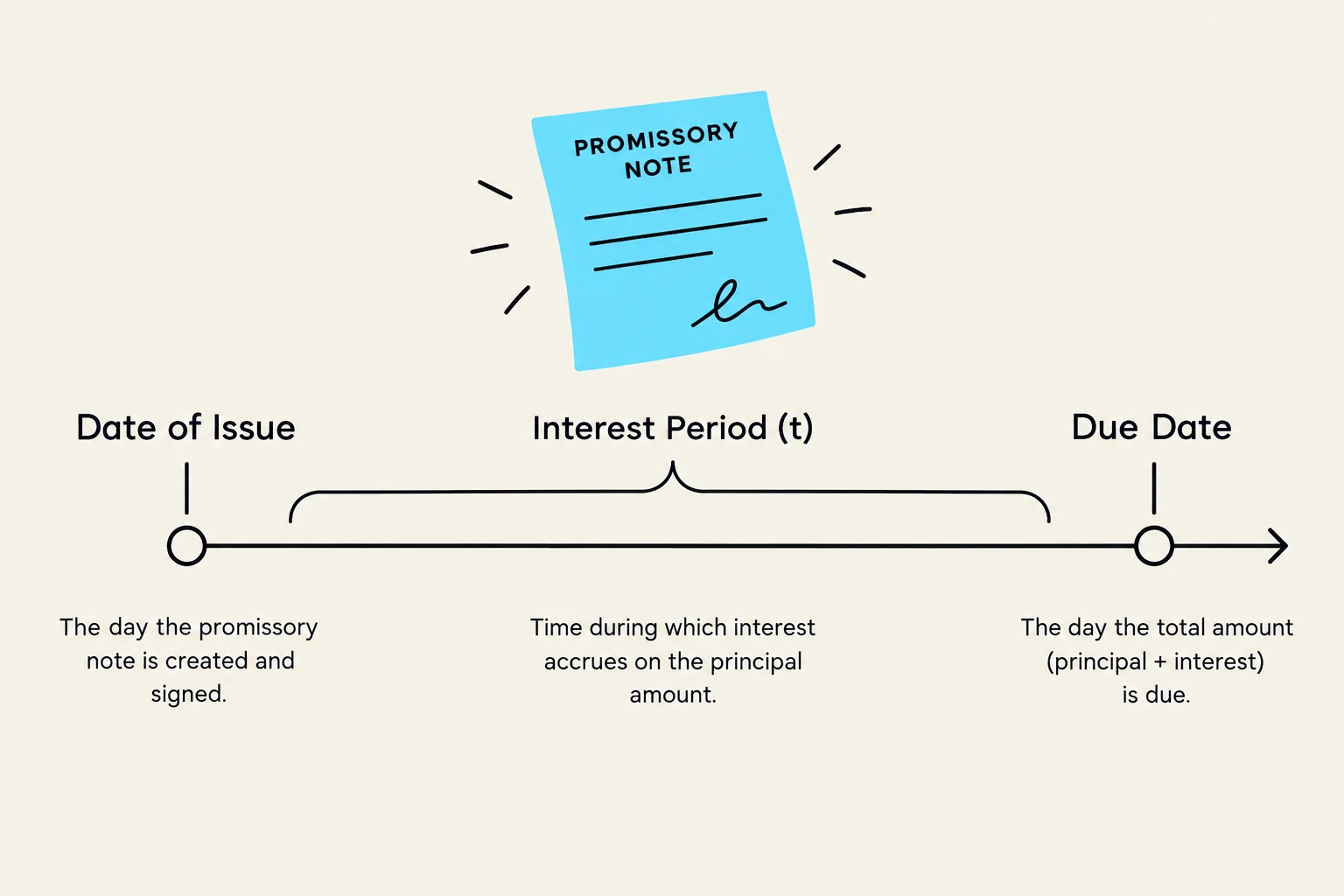
Interest Period (t): The exact number of days between the date of issue and the legal due date.
This diagram illustrates the key dates and periods associated with a promissory note, including the date of issue, the interest period, and the due date.
Interest-Bearing vs. Non-Interest-Bearing Notes
Not all promissory notes function the same way. The distinction lies in how the interest is expressed and how the final payment is calculated.
Interest-Bearing Promissory Notes
In these notes, the rate of interest is explicitly stated on the document. The face value represents the principal amount borrowed, and interest is calculated separately to be added to that principal at the end of the term.
To find the Maturity Value (S), which is the total amount payable on the due date, we use the following formula:
SS=P+I=P(1+rt)
Where:
P = Face value (Principal)
r = Annual interest rate
t = Interest period expressed in years (e.g., 365days)
Non-Interest-Bearing Promissory Notes
In a non-interest-bearing note, no interest rate is stated on the document. While interest may be "implied" in the transaction, the face value of the note is strictly the amount that must be repaid at maturity. In these cases, the "interest" is essentially built into the difference between what the borrower receives today and the face value they pay back later.
Exam Tip: When calculating the interest period (t) in days, always check if the problem requires a 365-day year or a 360-day year. Most standard business math problems use 365 days unless stated otherwise.
Calculating Present Value
Sometimes, you may need to know the value of a note before it reaches its due date. This is known as the Present Value. If you hold a note that matures in the future, its value today depends on the current market interest rate (the "prevailing rate").
To find the present value, you must follow two steps:
Calculate the Maturity Value of the note using its original interest rate.
Discount that Maturity Value back to the current date using the prevailing market interest rate.
Example Scenario:
Imagine a 180-day note for $$2,000$ with $7%$ interest, dated September 18, 2024. If you want to know its value on December 1, 2024, and the market rate is $5%$, you would first find the maturity value using the $7%$ rate, then calculate the present value of that amount using the $5%$ rate for the remaining days until maturity.
Treasury Bills (T-Bills)
Treasury bills are a special type of promissory note issued by federal or provincial governments. Because they are backed by the government, they are considered very safe investments.
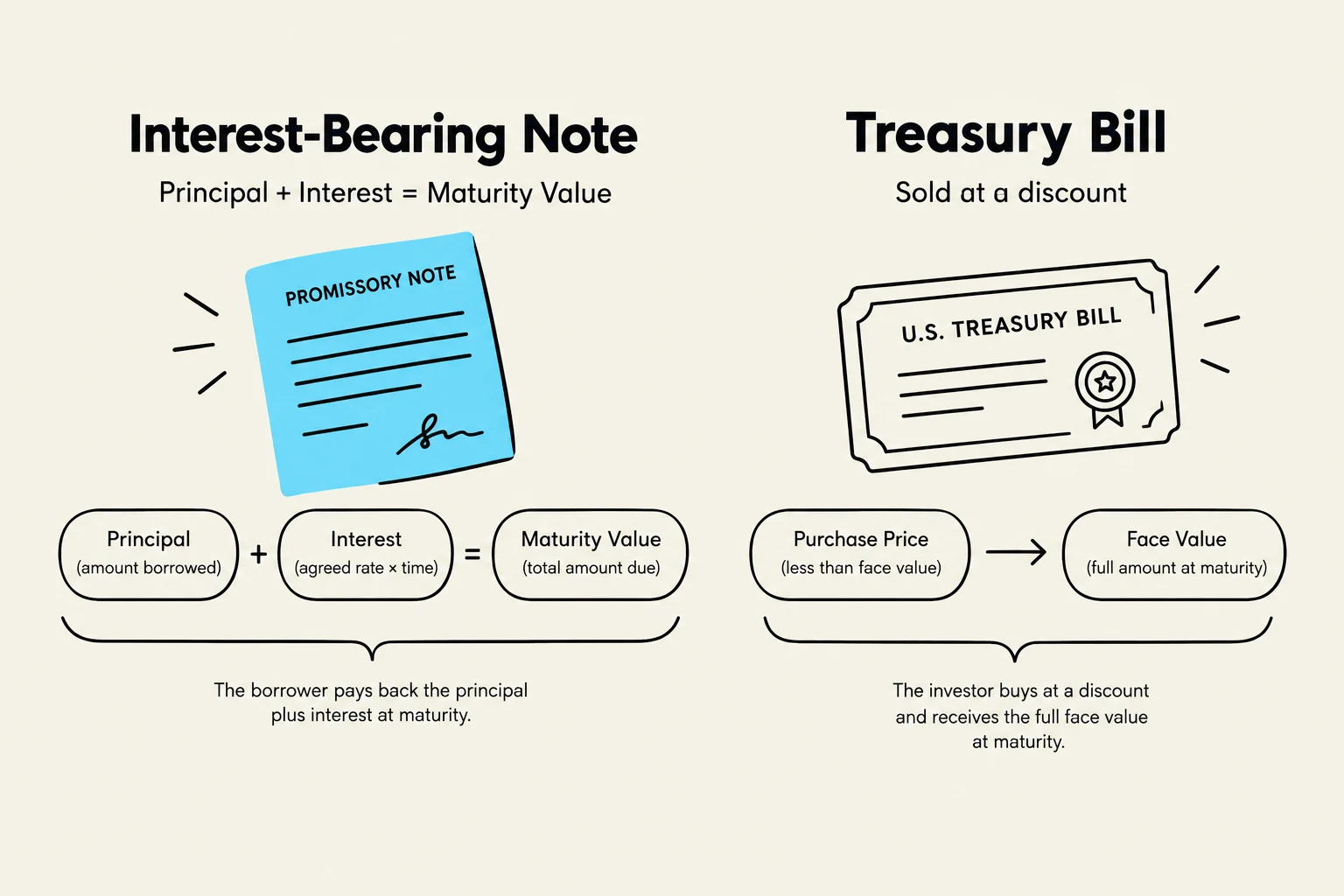
Unlike standard interest-bearing notes, T-bills do not carry an explicit interest rate. Instead, they are sold at a discount. This means an investor buys the T-bill for less than its face value, and the "interest" earned is the difference between the discounted purchase price and the face value received at maturity.
This illustration compares an Interest-Bearing Note, where principal plus interest equals maturity value, with a Treasury Bill, which is sold at a discount and pays its full face value at maturity.
Key Characteristics of T-Bills:
Terms: Common terms include 91, 182, or 364 days.
Issuance: They are auctioned by the Bank of Canada.
Calculation: The purchase price is determined by calculating the Present Value of the T-bill's face value based on current market yields.
For example, if an investor buys a $$100,000$ T-bill with a 182-day term yielding $2.33%$, the purchase price is calculated as:
PV=(1+rt)FV
In this context, the "yield" acts as the interest rate used to discount the face value back to the purchase price.
Keep reading for free.
Create an account to finish this reading and make it part of your study routine.