Designing a cardiorespiratory exercise program is often described as an "art" because it requires balancing physiological science with the unique goals, preferences, and limitations of an individual. Whether the objective is to improve cardiorespiratory fitness (CRF) or to reduce the risk of chronic disease, the prescription must be individualized. A successful program doesn't just throw a client onto a treadmill; it carefully selects the mode of exercise, determines the appropriate intensity, and structures the volume and progression to ensure safety and long-term adherence.
The Foundation: FITT-VP Principles
To create a structured aerobic program, professionals use the FITT-VP principle. This framework ensures that all necessary components of an exercise prescription are addressed:
Frequency: How often the exercise is performed (e.g., 5 days/week for moderate intensity).
Intensity: How hard the body is working (e.g., %VO2R or %HRR).
Time: The duration of the exercise bout (e.g., 20–60 minutes).
Type: The mode of exercise (e.g., walking, swimming, or cycling).
Volume: The total amount of work performed, often measured in MET⋅min⋅wk−1 or weekly caloric expenditure.
Progression: The systematic increase in workload to challenge the body as it adapts.
Exam Tip: When designing a program, remember that "Volume" is a product of Frequency × Intensity × Time.
Selecting the Exercise Mode
The "Type" or mode of exercise is the first decision in the prescription process. Modes can be categorized by the skill level required:
Type A: Minimal skill and fitness required (e.g., walking).
Type B: Vigorous, minimal skill, but requires average fitness (e.g., jogging).
Type C: Requires skill and average fitness (e.g., swimming, soccer).
Type D: Recreational activities that may improve fitness.
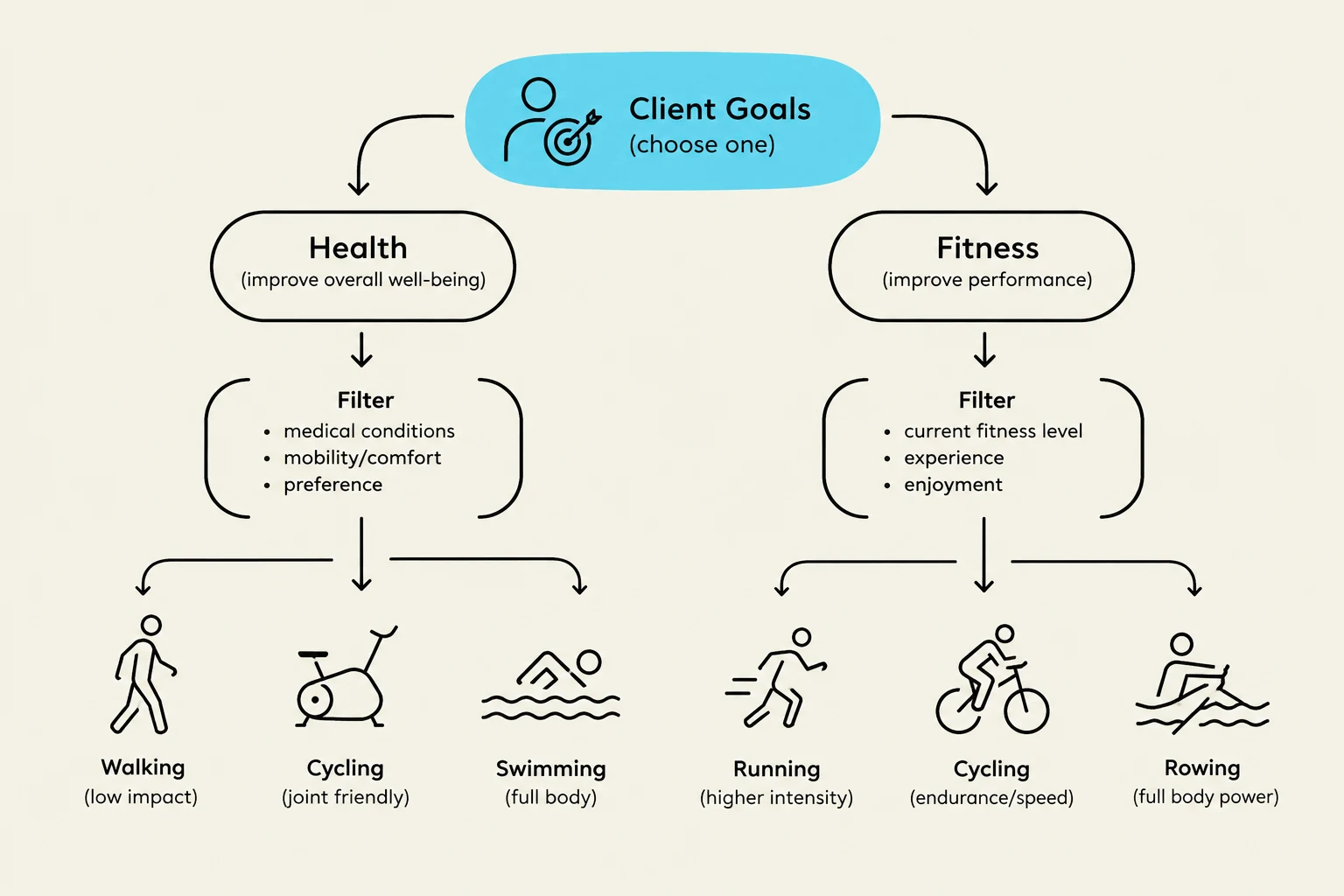
When selecting a mode, you must consider if the workload can be quantified, if the client enjoys it, and if it presents any physiological or musculoskeletal challenges. It is also important to note that steady-state heart rate responses vary by mode; for instance, weight-bearing exercises typically produce a higher heart rate response than non-weight-bearing modalities at the same relative intensity.
This diagram illustrates how client goals for health or fitness can be filtered based on various factors to suggest suitable activities such as walking, cycling, swimming, running, or rowing.
Setting Intensity: VO2R and HRR
Intensity is the most critical variable for achieving specific physiological adaptations. The American College of Sports Medicine (ACSM) recommends using VO2 reserve (%VO2R) or Heart Rate Reserve (%HRR) rather than simple %HRmax, as these methods account for an individual's resting physiological state.
VO2 Reserve (%VO2R)
VO2R represents the difference between a person's maximal oxygen uptake and their resting oxygen uptake.
The formula for calculating target VO2 is:
%VO2R=[target%×(VO2max−VO2rest)]
Note that VO2rest is approximately 3.5 ml/kg/min, which is equivalent to 1 MET.
Heart Rate Reserve (%HRR) and the Karvonen Method
The Karvonen method uses Heart Rate Reserve (HRR) to set intensity. HRR is the difference between the maximum heart rate and the resting heart rate.
The formula to find the target heart rate is:
%HRR=[target%×(HRmax−HRrest)]+HRrest
Note: Using %HRR typically results in a higher target heart rate than using %HRmax, which is why %HRmax is sometimes preferred for older adults to ensure safety.
Target Population
Recommended Intensity (%VO2R or %HRR)
Adults with poor CRF
30% to 59%
Apparently healthy adults
40% to < 90%
To improve CRF
55% to 80%
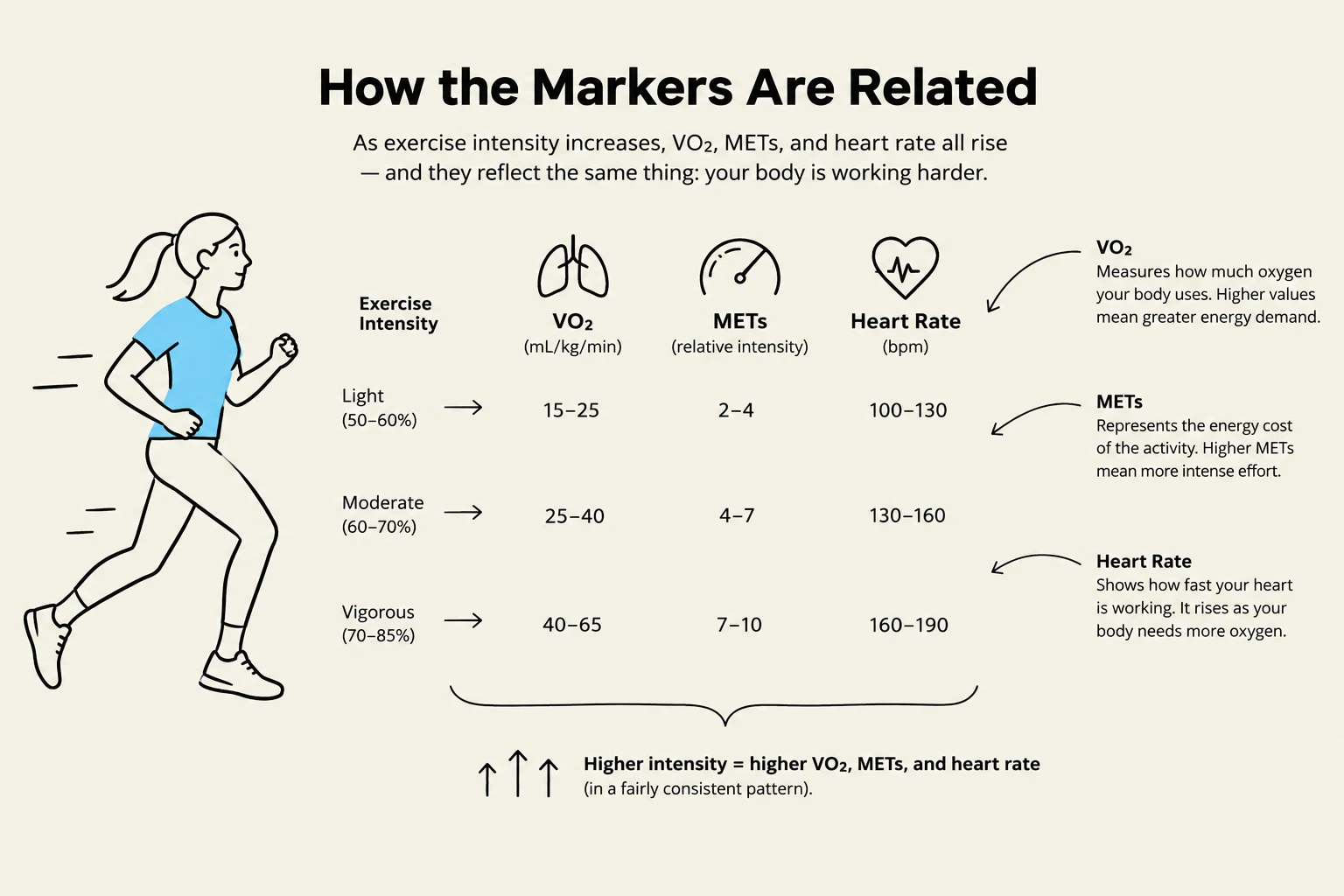
This diagram illustrates the relationship between exercise intensity and physiological markers such as VO2, METs, and heart rate. It shows how these markers increase with higher exercise intensity, indicating greater effort and oxygen demand from the body.
Subjective Monitoring: RPE
While heart rate and VO2 are objective measures, they can be difficult to track in real-time or may be influenced by external factors. The Rating of Perceived Exertion (RPE) provides a subjective way for clients to monitor their own intensity.
Commonly used scales include:
Borg Scale: A 6–20 scale.
OMNI Scale: A 0–10 scale.
RPE is highly correlated with heart rate and VO2, making it an excellent tool for "the talk test" or for clients using multimodal training where heart rate might fluctuate due to the changing nature of the activity.
Personalizing the Program: Stages of Progression
A personalized program must move through three distinct stages to ensure the client transitions from initial activity to long-term fitness maintenance:
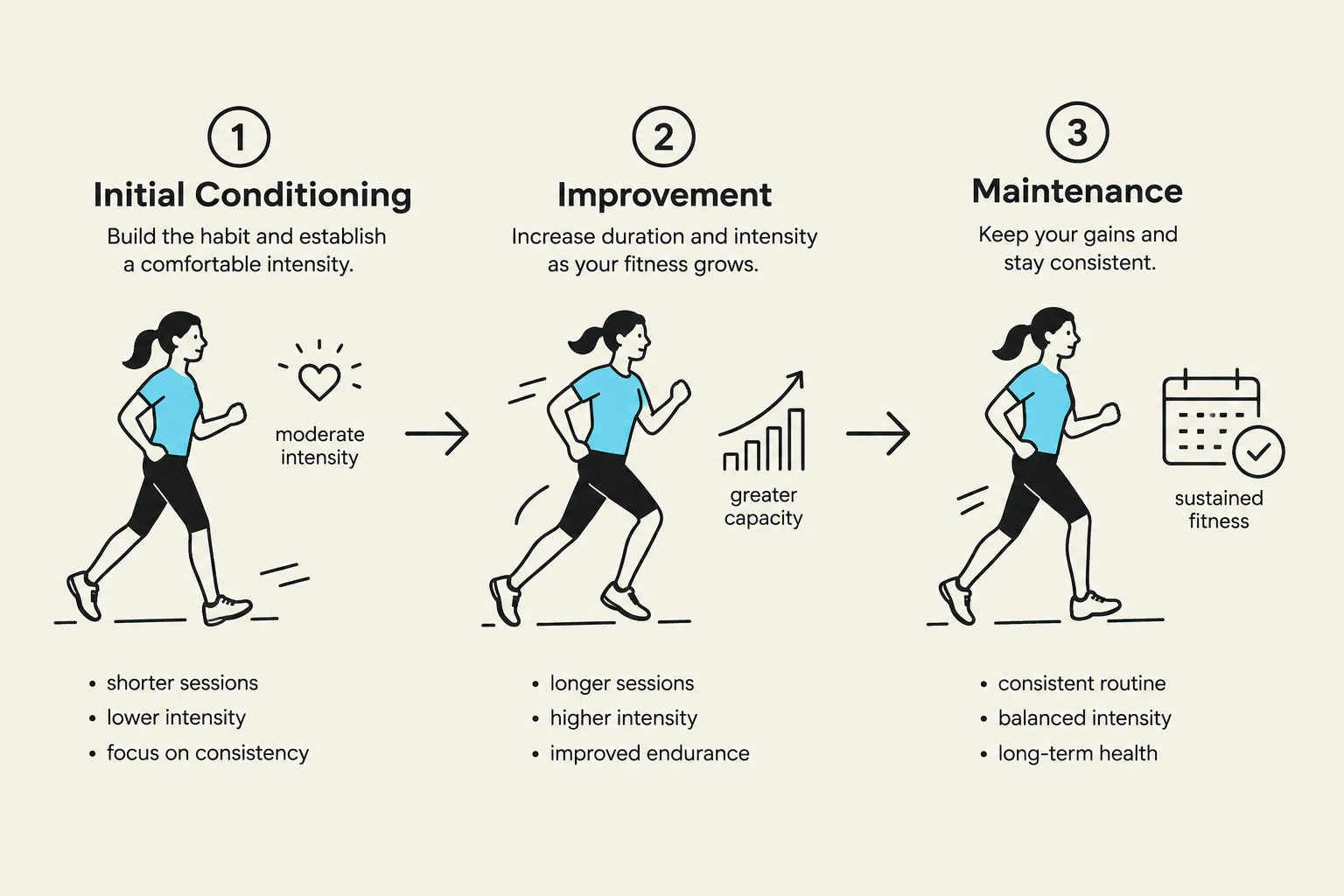
Initial Conditioning (1–6 weeks): The goal is to build a baseline. A common target is 55%–60% HRR for 30 continuous minutes. During this phase, the target caloric expenditure is roughly 752 to 1,040 net kcal/week.
Improvement (4–6 months): The focus shifts to increasing CRF. Clients should progress toward 5 days/week of activity, aiming for 20–60 minutes of moderate-to-vigorous physical activity (MVPA) per session. The target caloric expenditure increases to 1,040 to 1,874 net kcal/week.
Maintenance: Once goals are met, the focus is on sustaining the achieved fitness level and weekly caloric expenditure. Adding variety through multimodal training (cross-training) is highly recommended during this stage to increase enjoyment and adherence.
This illustration outlines a three-stage approach to fitness: Initial Conditioning, Improvement, and Maintenance. Each stage details key aspects like intensity, duration, and consistency for building and sustaining fitness.
By following these structured principles—starting with a warm-up, moving through endurance conditioning, and ending with a cool-down and stretching—practitioners can design safe, effective, and highly personalized aerobic programs.
Keep reading for free.
Create an account to finish this reading and make it part of your study routine.