Separation of Powers and the Principal-Agent Problem in U.S. Government
Examines the U.S. constitutional framework of separation of powers and checks and balances, focusing on the principal-agent problem within the executive branch and legislative oversight mechanisms.
The architecture of the United States government is not merely a collection of rules, but a deliberate system of tension. When the Framers drafted the Constitution, they were not seeking to create a government that functioned with maximum efficiency; rather, they sought to create one that functioned with maximum restraint. By dividing the state's authority into distinct branches—the legislative, the executive, and the judicial—they aimed to prevent the concentration of power that leads to tyranny. This article examines the theoretical intent behind the separation of powers and the practical complexities that arise when these branches interact, particularly through the lens of the executive branch and its relationship to the broader bureaucracy.
The Intent of the Framers: Preventing Tyranny
The primary motivation behind the constitutional framework was the prevention of centralized power. The Framers operated under the assumption that human nature is inherently prone to the pursuit of self-interest and the expansion of authority. To counter this, they implemented a system of "checks and balances."
Under this framework, the legislative branch is granted the power to make laws, the executive branch the power to enforce them, and the judicial branch the power to interpret them. However, these powers are not silos. Each branch possesses specific constitutional tools to impede the actions of the others. For example, while Congress can pass legislation, the President can veto it; conversely, while the President can nominate officials, the Senate must confirm them.
Exam Tip: When analyzing constitutional questions, remember that the Framers prioritized stability and liberty over speed. A system that allows one person to act quickly is often a system that allows one person to act autocratically.
This diagram illustrates the separation of powers in the U.S. government, showing the interactions between the Legislative, Executive, and Judicial branches.
The Executive Branch and the Principal-Agent Problem
While the legislative branch is designed to be the most representative, the executive branch is designed to be the most active. As the government has grown in complexity, the President does not act alone; they oversee a vast bureaucracy. This introduces a fundamental challenge in political science known as the Principal-Agent Problem.
In this context, the "Principals" (the voters and their elected representatives in Congress) delegate authority to "Agents" (the executive officials and bureaucrats) to carry out specific tasks. The goal is for the Agent to act in the best interest of the Principal. However, because the Agent often possesses more specialized information than the Principal, a gap in knowledge—known as information asymmetry—can occur.
The problem arises when the Agent's interests diverge from the Principal's. For instance, a regulatory agency might prioritize its own institutional growth or a specific technical standard over the broader policy goals set by Congress.
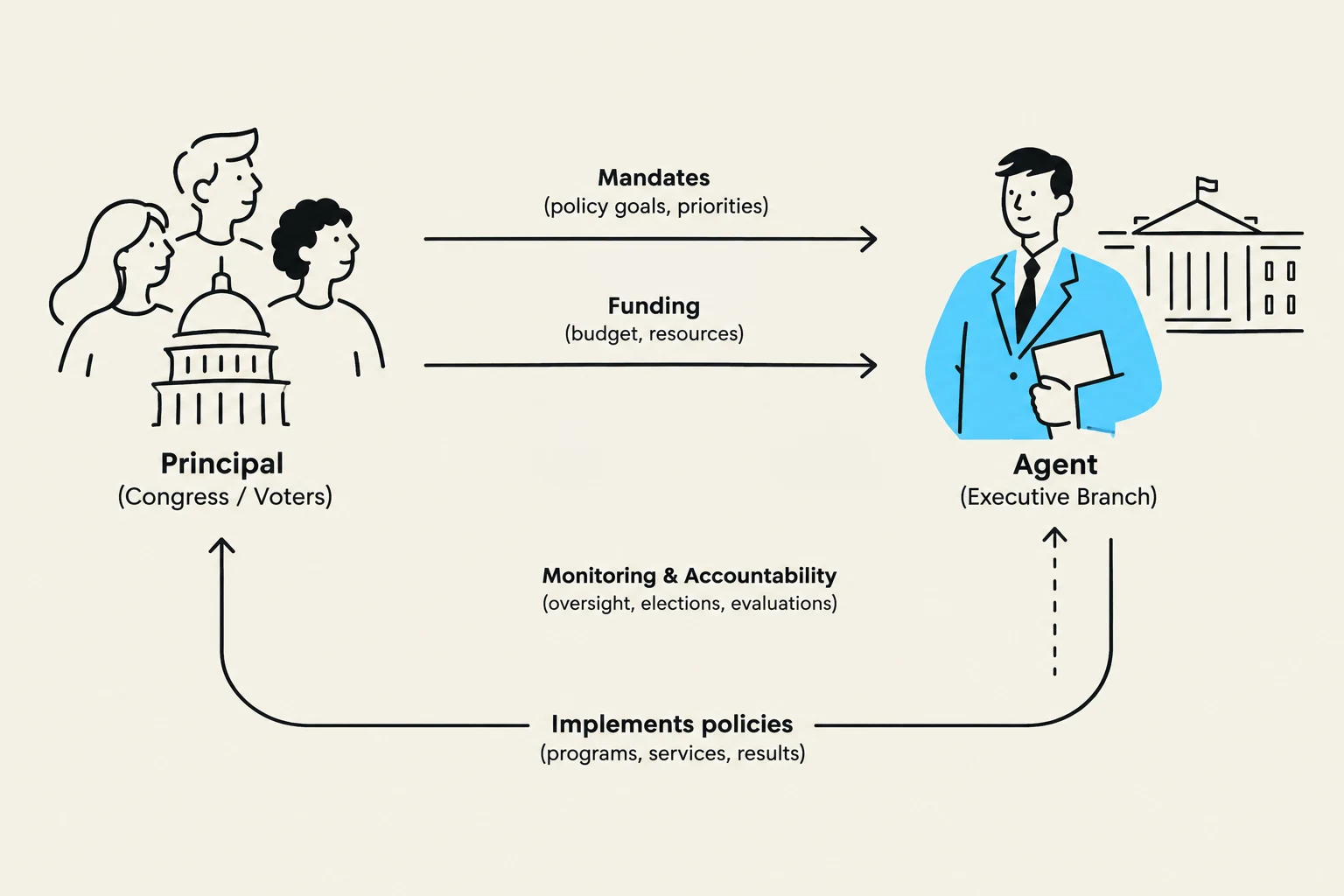
This diagram illustrates the principal-agent relationship in government, where the principal (Congress/Voters) delegates mandates and funding to the agent (Executive Branch), who implements policies and is subject to monitoring and accountability.
Measuring Agency Divergence
To understand how much an agent deviates from a principal, we can look at the relationship between the intended policy outcome and the actual outcome. If we define P as the policy direction desired by the legislature and A as the actual policy implemented by the executive agency, the "agency cost" or divergence can be thought of as the distance between these two points.
In a simplified mathematical model, if we represent policy on a single dimension, the divergence D can be expressed as:
D=∣P−A∣
Where:
P is the legislative intent.
A is the administrative action.
If D=0, the agent is perfectly aligned with the principal. As D increases, the effectiveness of the constitutional check on the executive decreases, suggesting that the bureaucracy is operating with increasing autonomy.
Balancing the Scales: Legislative Oversight
To mitigate the risks of the principal-agent problem and ensure the executive remains within its constitutional bounds, the legislative branch employs several oversight mechanisms. These are the "checks" that keep the "balance."
Power of the Purse: Congress controls the funding for all executive agencies. By withholding or attaching conditions to appropriations, Congress can force agents back into alignment with legislative intent.
Oversight Hearings: Committees can summon executive officials to testify, reducing information asymmetry by forcing agents to disclose their actions and reasoning.
Statutory Clarification: When an agency interprets a law in a way that Congress finds unacceptable, the legislature can pass new, more specific laws to narrow the agency's discretion.
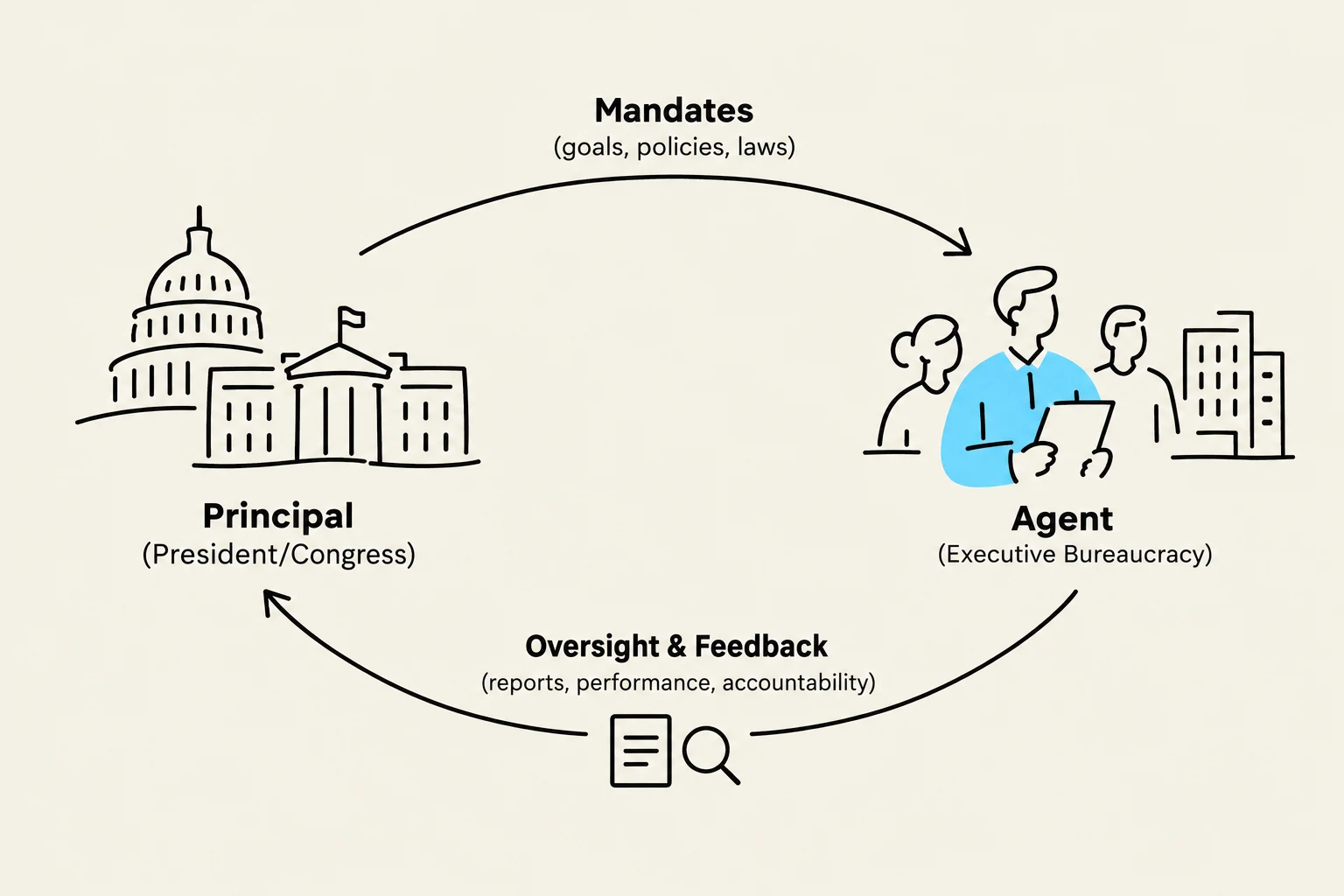
This diagram illustrates the principal-agent relationship in government, showing how mandates from the principal (President/Congress) are executed by the agent (Executive Bureaucracy), with oversight and feedback mechanisms in place.
The tension between the branches is not a flaw in the system; it is the system's primary feature. The constant struggle between the legislative desire to direct policy and the executive's need to implement it ensures that no single entity can dominate the American political landscape without significant resistance.
Summary for Review:
Separation of Powers: Dividing authority to prevent tyranny.
Checks and Balances: The tools used by branches to limit one another.
Principal-Agent Problem: The risk that delegated agents (bureaucrats) will act in their own interest rather than the interest of the principals (legislators/voters).
Keep reading for free.
Create an account to finish this reading and make it part of your study routine.