Separation of Powers and Statutory Enactment in Canada
An overview of the separation of powers doctrine and the process by which statutes are enacted in federal and provincial legislatures in Canada, including the roles of different government branches and the stages of a bill's journey to becoming law.
In any democratic legal system, the stability of the rule of law depends on how power is distributed and how new laws are created. Understanding the relationship between the different branches of government and the mechanical process of turning a proposal into a binding law is fundamental to studying constitutional and administrative law. This article explores the doctrine of the separation of powers and the specific procedures used by federal and provincial legislatures to enact statutes.
The Separation of Powers Doctrine
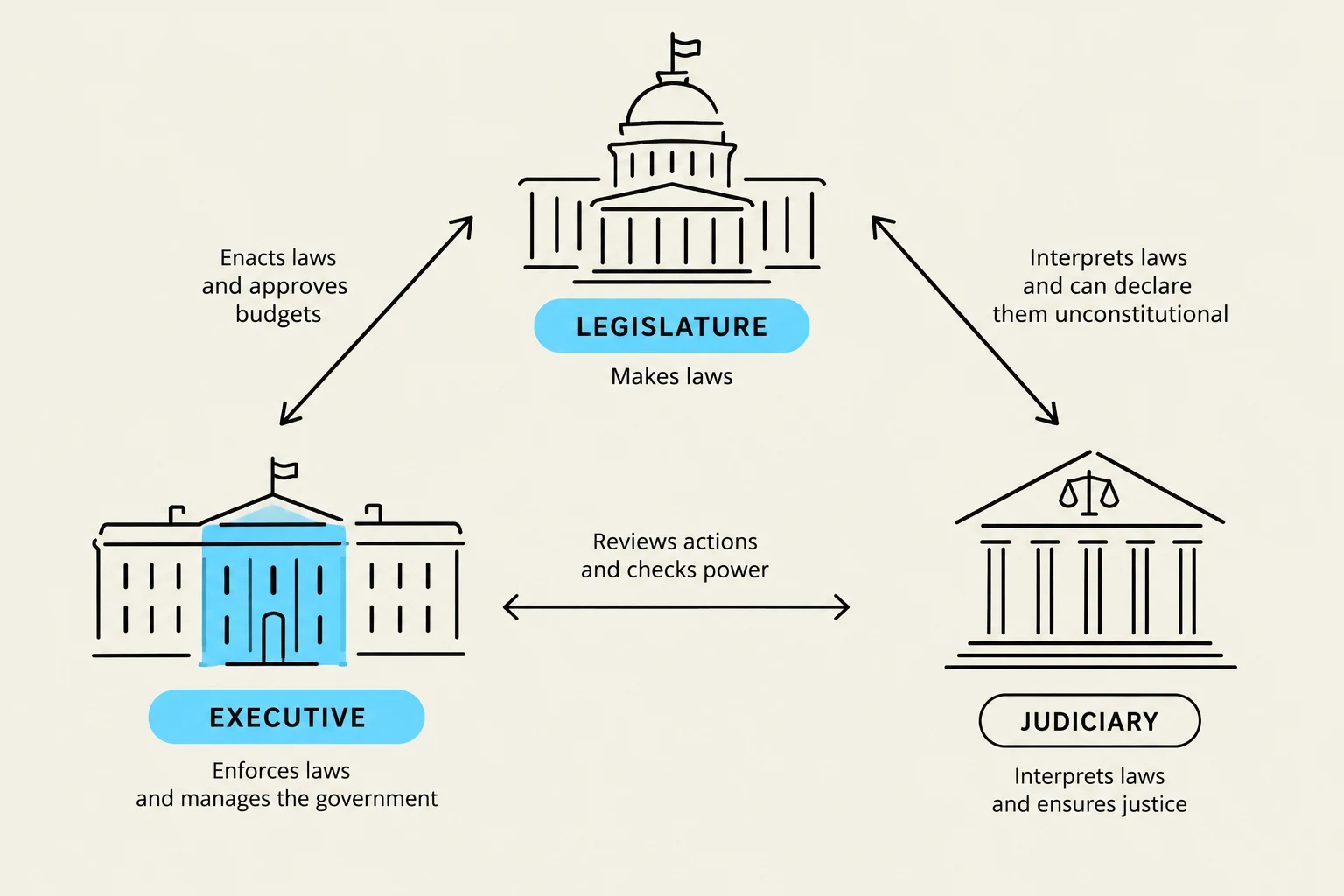
The separation of powers is a constitutional principle designed to prevent the concentration of absolute power in a single entity. By dividing government functions into distinct branches, the system creates a series of checks and balances. Traditionally, these branches are categorized as follows:
The Legislature: The body responsible for debating, drafting, and passing laws.
The Executive: The branch responsible for implementing and administering the laws passed by the legislature.
The Judiciary: The branch responsible for interpreting the laws and ensuring they are applied fairly and according to the constitution.
While these roles are distinct, it is important to note that in the Canadian context, these branches are not entirely isolated from one another. Because of our system of responsible government, the Legislature and the Executive are closely connected. For example, members of the Executive (the Cabinet) are almost always members of the Legislature, ensuring that the government remains accountable to the elected representatives of the people.
Diagram illustrating the separation of powers in a government, showing the roles of the Legislature, Executive, and Judiciary branches.
Exam Tip: When discussing the separation of powers, do not describe the branches as completely independent silos. Always mention "responsible government" to explain why the Executive and Legislature overlap in practice.
The Statutory Enactment Process
A "statute" is a law passed by a legislative body. The journey from a mere idea to a binding law is known as the statutory enactment process. This process begins with a bill—a formal written proposal for a new law or an amendment to an existing one.
Types of Bills
Not all bills originate from the same source or serve the same purpose. They are generally categorized into two types:
Public Bills: These are proposed by the government (the Executive) and are intended to affect the general public or address broad policy issues.
Private Bills: These are often introduced by individual members of the legislature and typically deal with matters of a more specific or personal nature.
Regardless of the type, all bills are driven by similar underlying factors, such as shifting political landscapes, economic necessities, or evolving societal values.
Comparing Federal and Provincial Legislatures
While the core logic of law-making is similar across Canada, the structural differences between the federal government and provincial governments lead to variations in how statutes are passed.
Bicameral vs. Unicameral Systems
The most significant structural difference lies in the number of "houses" or chambers within the legislature:
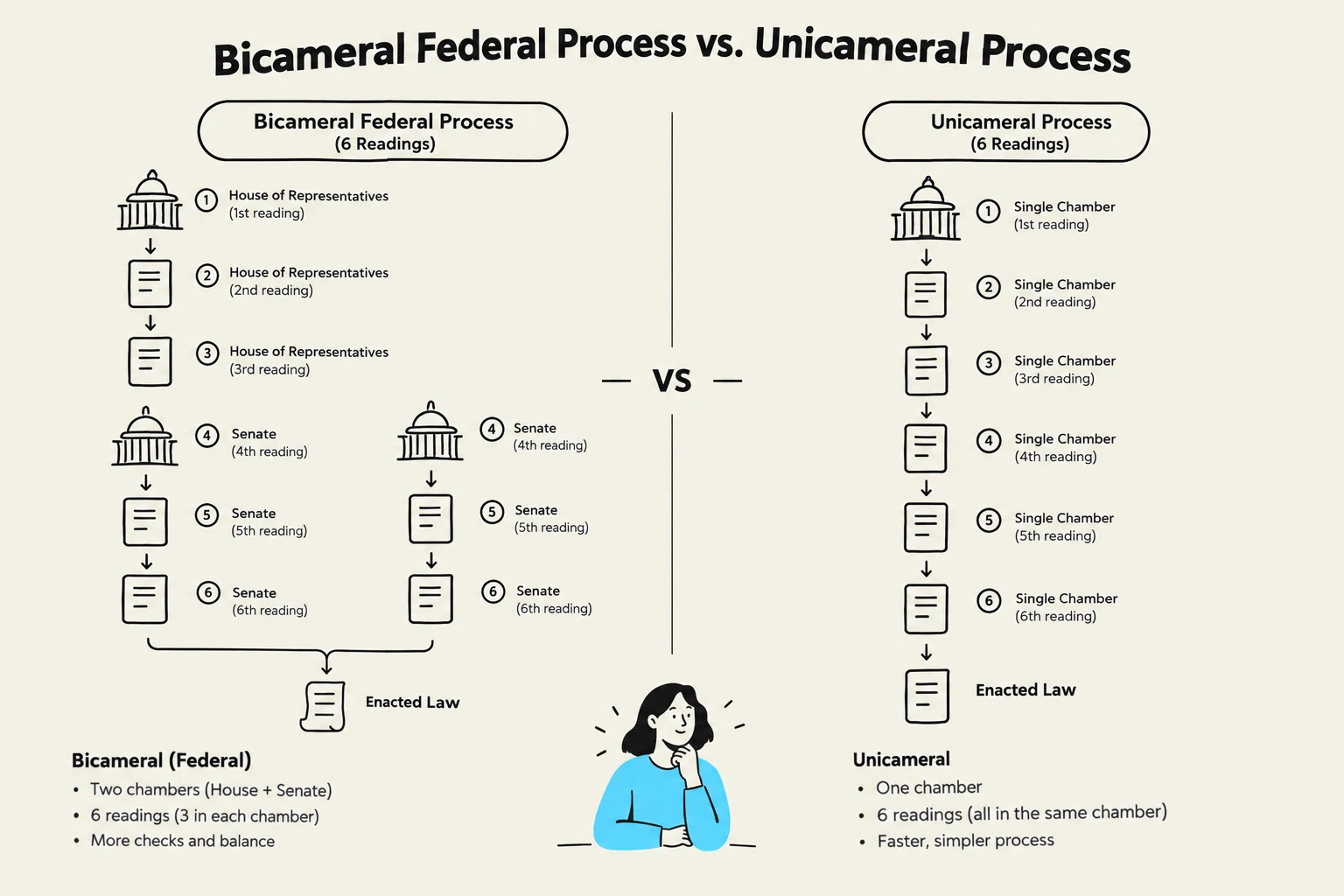
Federal Parliament (Bicameral): The federal level uses a bicameral system, meaning it consists of two chambers: the House of Commons and the Senate. Because a bill must pass through both houses, the process involves a more extensive series of readings (typically six readings in total).
Provincial Legislatures (Unicameral): Most provinces operate under a unicameral system, meaning they have only one legislative chamber. Consequently, the process is streamlined, requiring only three readings to move a bill toward law.
Comparison of the legislative process in a bicameral federal system versus a unicameral system, illustrating the steps and readings involved in enacting a law in each.
The Stages of Enactment
Despite these structural differences, both levels of government follow a similar procedural rhythm:
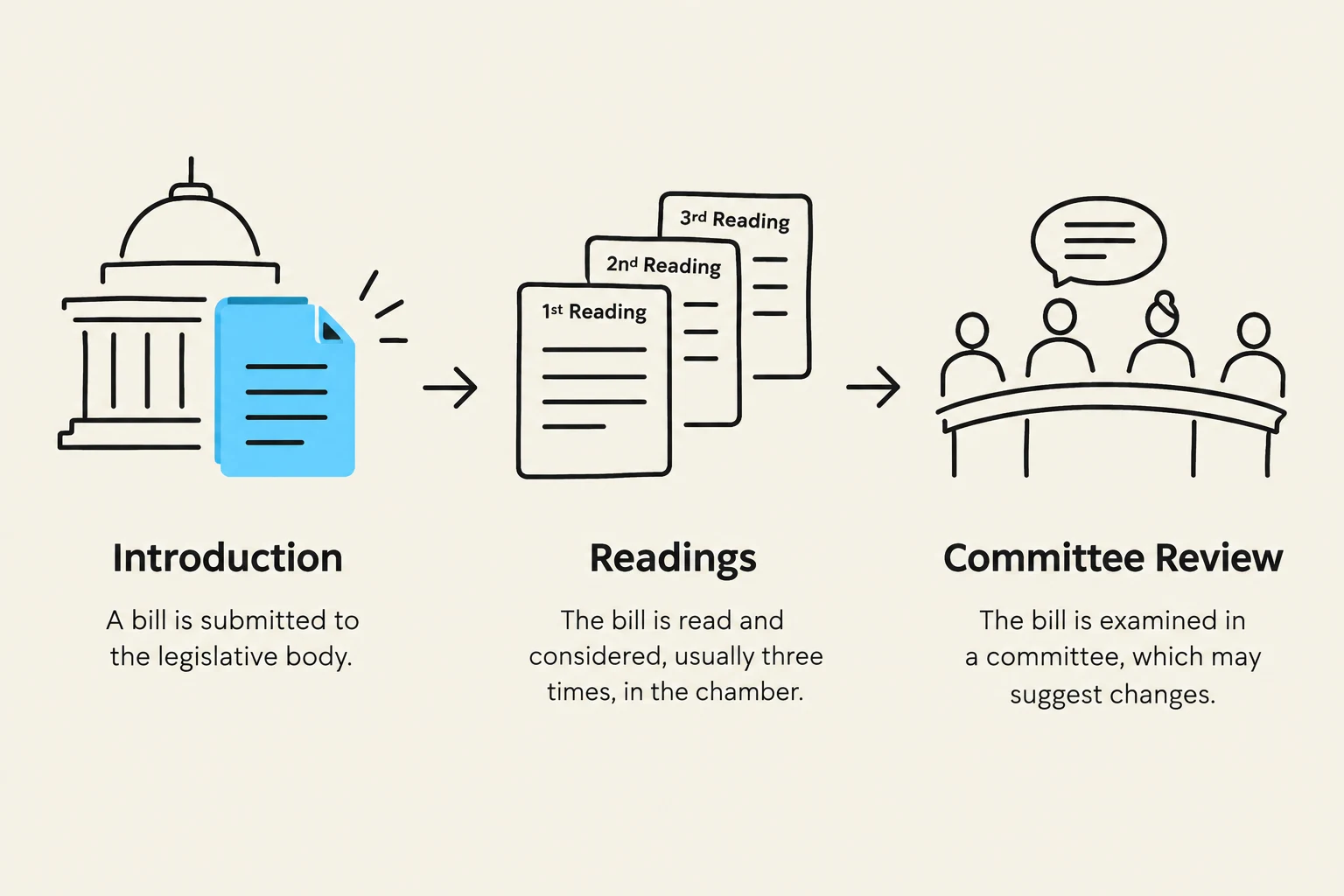
Readings: The bill is introduced and debated through several stages.
Committee Review: Between the second and third readings, the bill is sent to a committee. This is a critical stage where members examine the bill in detail, hear from experts, and suggest amendments.
Royal Assent: Once a bill has passed all necessary readings and committee stages, it must receive Royal Assent. This is the formal approval by the Crown (represented by the Governor General at the federal level or the Lieutenant Governor at the provincial level), which officially transforms the bill into an Act of Parliament or a provincial statute.
Note on Timing: Statutes can only be passed while the legislature is actively sitting. If a session ends before a bill is completed, the bill dies, though it may be re-introduced in the next session if the opposition consents.
When Does a Law Take Effect?
Passing a law and having it "come into force" are two different things. Even after Royal Assent is granted, a statute might not apply to the public immediately. There are three common ways a statute comes into force:
Upon Royal Assent: The law becomes effective the moment it receives formal approval.
A Specific Date: The text of the statute itself may state, "This Act comes into force on January 1, 2025."
Upon Proclamation: The legislature may leave it to the Executive to decide when the law is ready to be implemented. In this case, the law only becomes active once a "proclamation" is officially issued.
This diagram illustrates the legislative process of a bill, from introduction to committee review.
Summary Table: Federal vs. Provincial
Feature
Federal Parliament
Provincial Legislatures
Structure
Bicameral (2 Houses)
Unicameral (1 House)
Readings
6 Readings
3 Readings
Committee Review
Yes (between 2nd & 3rd)
Yes (between 2nd & 3rd)
Final Step
Royal Assent
Royal Assent
Keep reading for free.
Create an account to finish this reading and make it part of your study routine.