Sensory Contributions and Integration in Motor Control
Explores how the central nervous system interacts with the environment through sensory receptors, processes feedback, and integrates diverse sensory information to guide goal-directed movements and motor learning.
To perform any goal-directed movement, the central nervous system must constantly interact with the world. This interaction is not a one-way street; rather, it is a continuous loop where the environment provides stimuli, the nervous system processes these stimuli, and the motor system responds. Understanding how we collect, process, and integrate these diverse streams of information is fundamental to understanding human movement and motor learning.
Sensory Receptors for Movement
Movement is guided by a specialized array of sensory receptors that monitor both the internal state of the body and the external environment. These receptors can be categorized into several key systems:
Tactile and Auditory Systems
Tactile (cutaneous) receptors provide essential information about physical contact with the environment. There are four distinct types of tactile receptors that detect various aspects of touch, such as pressure and texture. Similarly, the auditory system uses sound waves to provide environmental cues that can influence movement timing and spatial awareness.
Vision
The visual system is perhaps our most dominant source of environmental information. It does not process all information in a single way; instead, it utilizes two specialized pathways:
Parvocellular system: Primarily involved in fine detail, color, and high-resolution spatial information.
Magnocellular system: Specialized for detecting motion, depth, and rapid changes in the visual field.
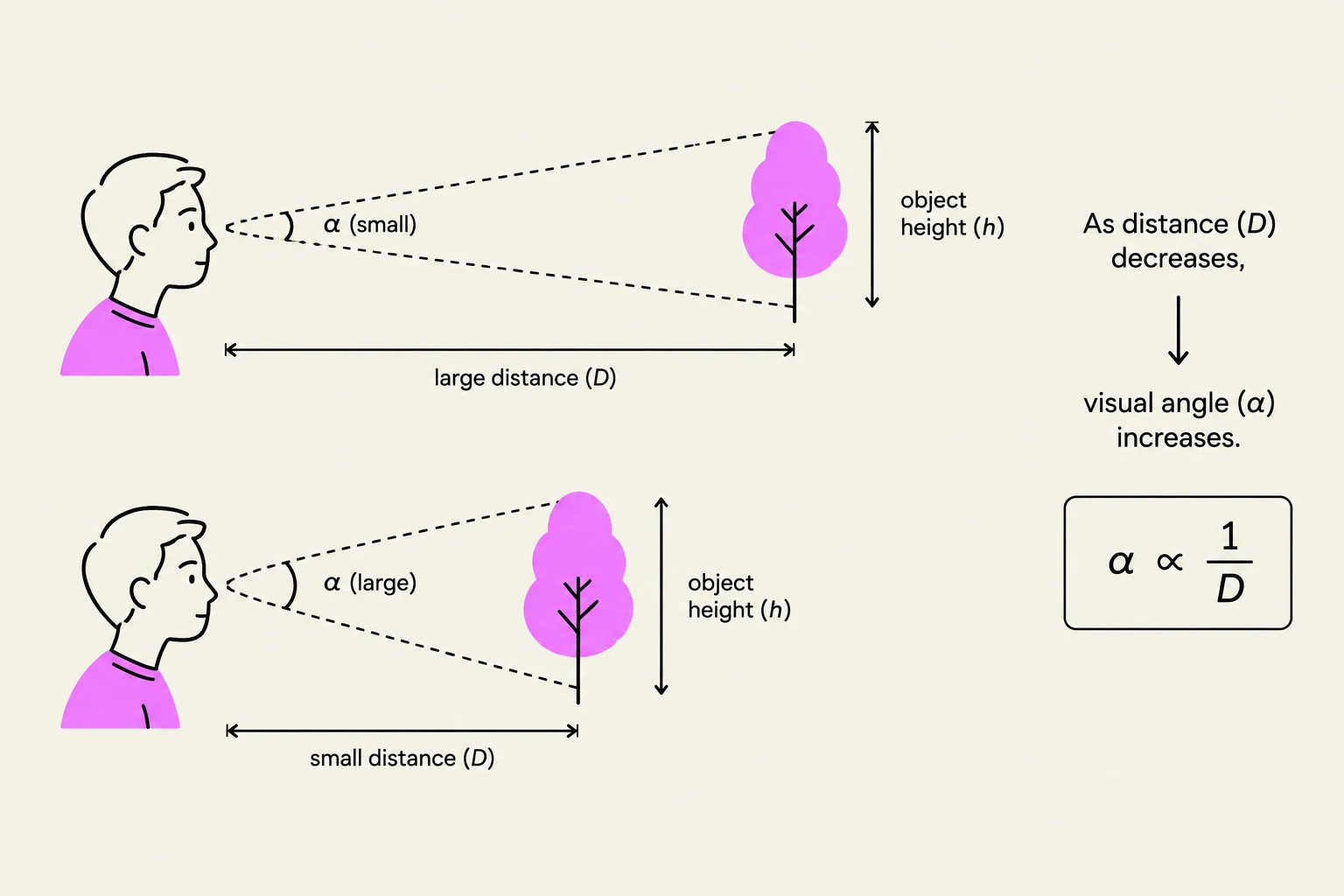
A critical aspect of vision is the relationship between distance and the visual angle (α). As an object moves closer to the observer, the visual angle it subtends increases. For example:
At a distance (D) of 1 m, the angle α might be 2.9∘.
At a distance of 0.25 m, the angle α increases to 21.8∘.
This diagram illustrates the relationship between the distance to an object and the visual angle it subtends. As the distance (D) decreases, the visual angle (α) increases, meaning the object appears larger. This is mathematically represented as α being proportional to 1/D.
Proprioception and Vestibular Systems
To move accurately, the brain must know where the limbs are in space without looking at them. This is achieved through proprioception. Key components include:
Muscle Spindles: Two types of spindles provide information regarding muscle length and the rate of change in length.
Golgi Tendon Organs: These receptors monitor muscle tension, helping to prevent injury and regulate force.
Joint Receptors: Provide information regarding the position and movement of joints.
Finally, the vestibular system (consisting of two main types of sensors) provides critical information regarding head position, orientation, and balance, which is essential for maintaining stability during movement.
Processing Feedback and Delays
Once a receptor detects a stimulus, that information must travel to the central nervous system to be processed. This is known as processing feedback. A vital concept for motor learners is that feedback is not instantaneous. There is a characteristic processing delay associated with sensory modalities.
For instance, visual feedback processing typically involves a delay of approximately 100 ms or more. Because of this latency, the nervous system cannot rely solely on "real-time" feedback to correct errors; it must instead use predictive models to account for the fact that what we see or feel has already happened in the past.
Exam Tip: If asked for the lowest acceptable estimate of visual feedback processing delay, remember that it is generally considered to be around 0.100 sec (100 ms).
Sensory Combination and Integration
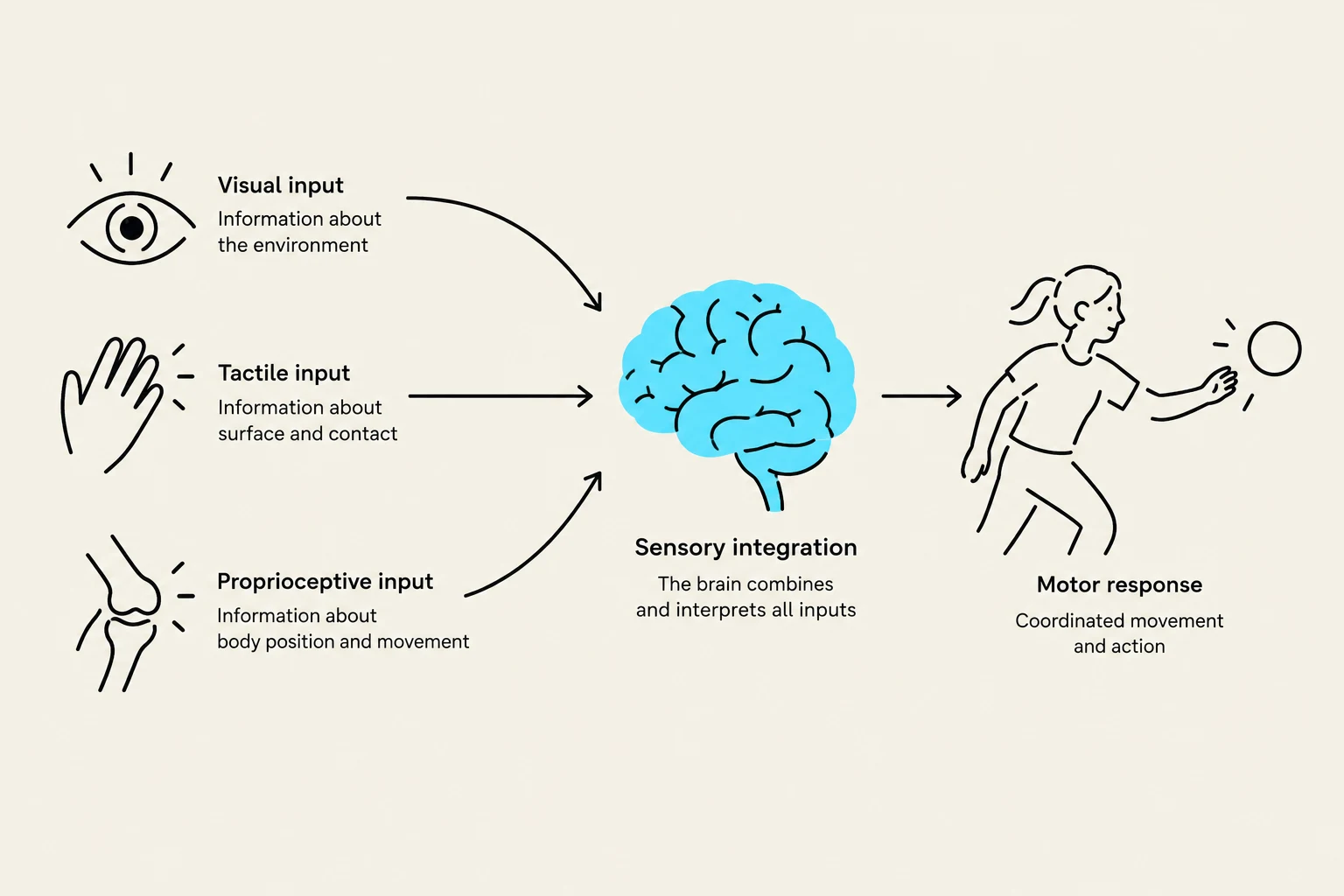
In most real-world tasks, we do not rely on a single sense. Instead, we engage in sensory combination and integration.
Sensory Combination: This involves the mathematical or statistical merging of information from different modalities (e.g., combining what you hear and what you see).
Sensory Integration: This is the higher-level process of forming a single, coherent perception from those combined inputs.
Integration is highly effective when sensory inputs are congruent. However, difficulties arise when there are sensory conflicts (e.g., when your eyes tell you that you are moving, but your vestibular system tells you that you are still). To resolve these discrepancies, the brain relies on context and causal inference—essentially "guessing" which sense is most reliable in a given situation.
This diagram illustrates the process of sensory integration, where the brain receives visual, tactile, and proprioceptive input to produce a coordinated motor response, such as catching a ball.
The Reference of Correctness
How does the brain know if a movement was successful? It uses a mechanism called the reference of correctness. This mechanism works by comparing the expected sensory consequences (what the brain thought would happen based on the motor plan) against the actual sensory consequences (the real feedback received from receptors).
This comparison is heavily informed by previous experience and serves two primary functions:
Anchoring: The brain uses established, reliable sensory information to stabilize perceptions and prevent them from drifting due to noise or minor conflicts.
Guidance: The brain uses the difference between expected and actual feedback to adjust ongoing motor commands, allowing for real-time corrections during a task.
In summary, the seamless coordination of movement requires a complex interplay of diverse sensory receptors, the management of inherent processing delays, the integration of multiple sensory streams, and a sophisticated internal reference to judge the accuracy of our actions.
Keep reading for free.
Create an account to finish this reading and make it part of your study routine.