Sensation vs. Perception: Detecting and Interpreting the World
Explore the fundamental psychological processes of sensation, the detection of external stimuli by sensory organs, and perception, the brain's interpretation of these stimuli. Understand transduction, sensory thresholds, and how our experiences shape our perception.
Have you ever walked into a room and immediately felt a sense of warmth, or heard a sudden bang and jumped in surprise? While these experiences feel like a single, seamless event, they are actually the result of two distinct biological and psychological processes: sensation and perception. Understanding the difference between these two is fundamental to psychological science, as it allows us to distinguish between the raw data our bodies collect and the meaningful stories our brains tell us about that data.
The Raw Data: What is Sensation?
Sensation is the physical process of detecting external stimuli through our sensory organs. Every moment, our environment is filled with energy—light waves, sound waves, chemical molecules, and pressure changes. When these physical energies interact with our sensory receptors (such as the cells in our eyes, ears, or skin), they trigger a biological response.
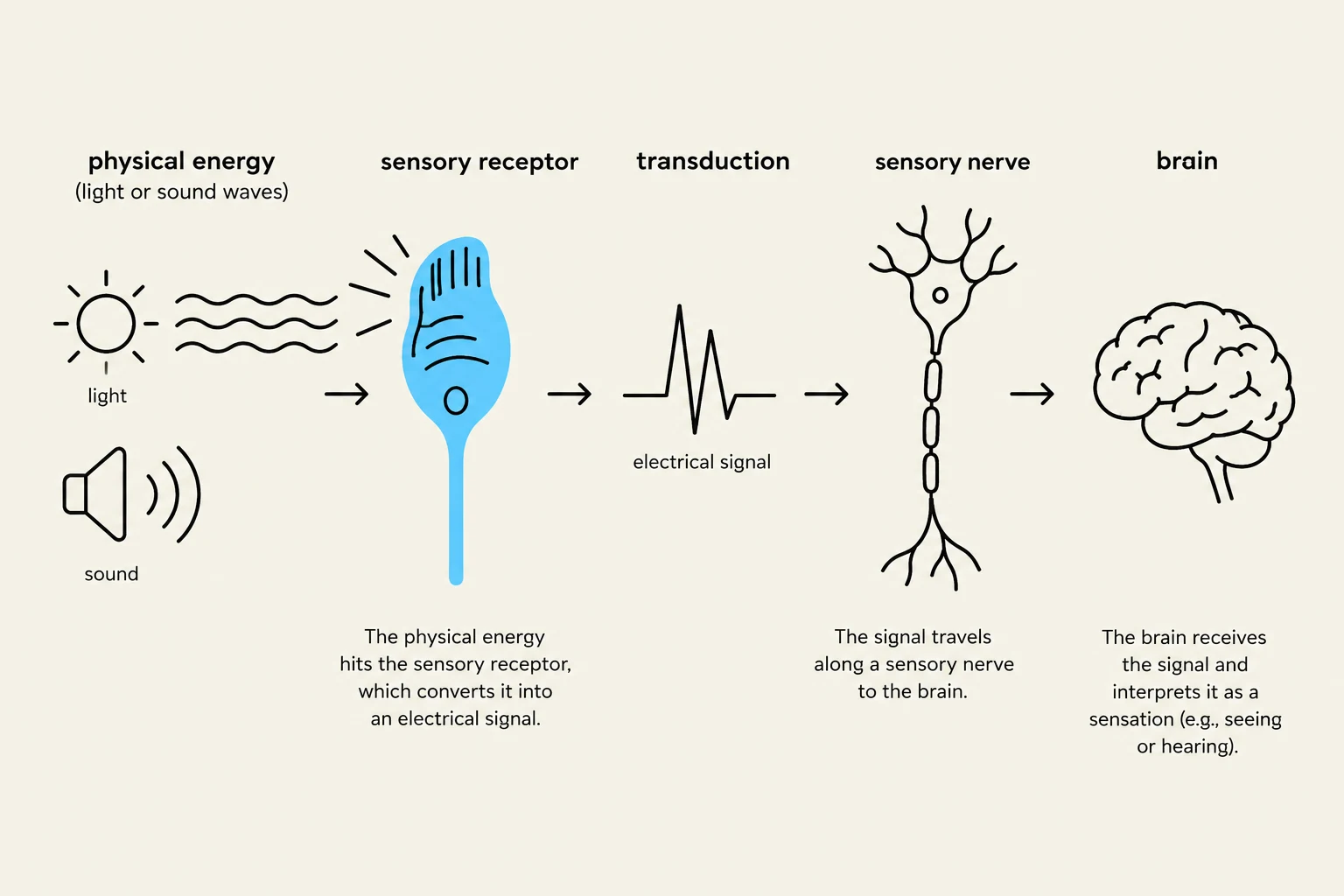
This process is often referred to as transduction, which is the conversion of physical energy into neural impulses that the brain can understand. For example, when light hits the retina in your eye, the photoreceptors convert that light energy into electrical signals that travel along the optic nerve.
Key Concept: Transduction
Without transduction, the brain would be "blind" to the world. Sensation is the bridge that turns the physical world into a biological language.
This diagram illustrates the process of sensory transduction, where physical energy like light or sound is converted into electrical signals by sensory receptors, transmitted along sensory nerves, and interpreted by the brain as sensations such as sight or hearing.
Sensation is purely about the "input." It doesn't care what the input means; it only cares that the input exists and is strong enough to be detected.
The Meaning Maker: What is Perception?
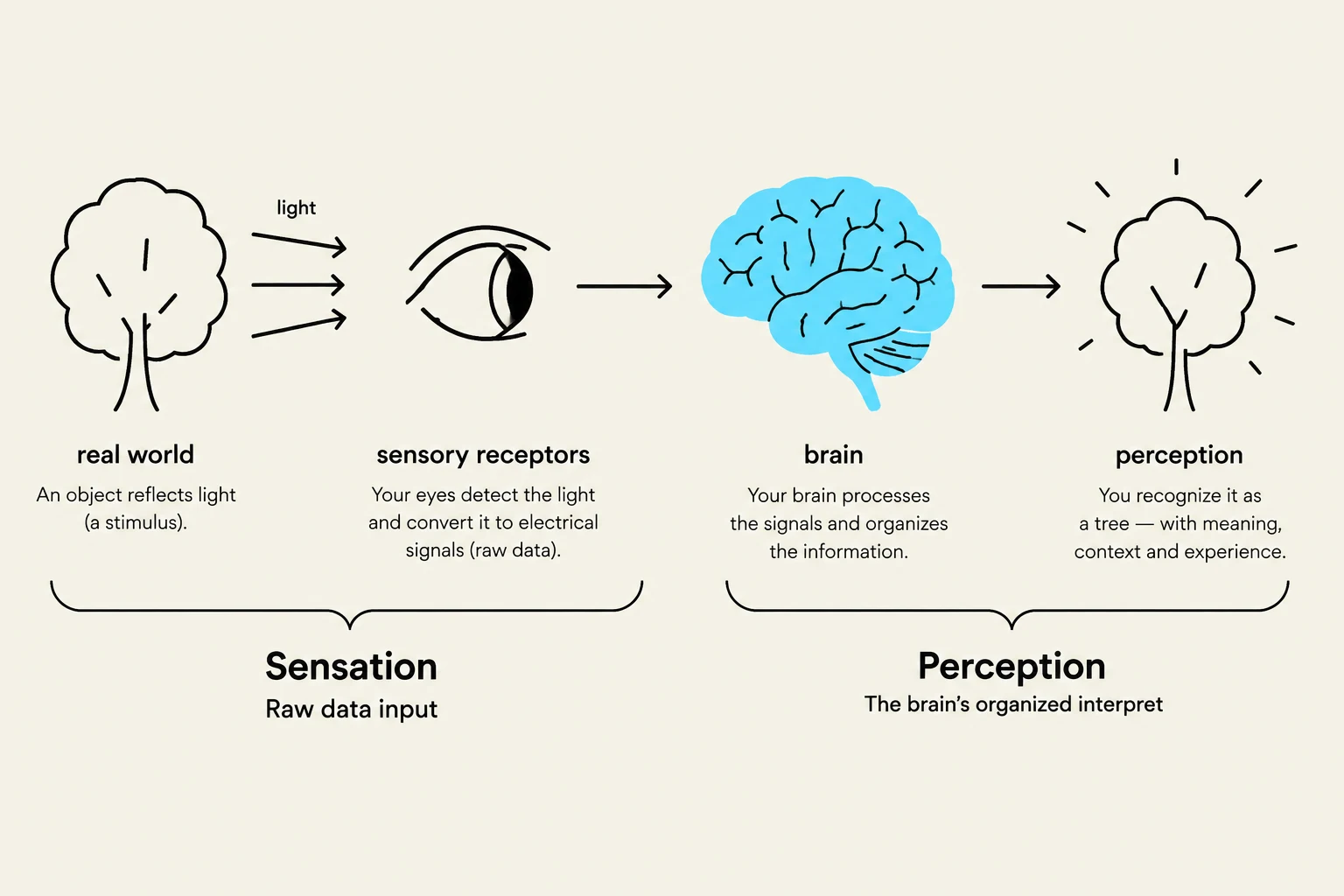
If sensation is the "input," then perception is the "interpretation". Perception is the psychological process of organizing, identifying, and interpreting those sensory inputs so that we can recognize meaningful objects and events.
While sensation tells you that there is a specific wavelength of light hitting your eye, perception tells you, "That is a ripe, red apple". Perception is heavily influenced by our experiences, expectations, culture, and even our current emotional state. This is why two people can experience the exact same sensation (such as hearing the same piece of music) but have vastly different perceptions (one person finds it relaxing, while another finds it jarring).
This diagram illustrates the process of sensation and perception, showing how the brain interprets stimuli from the real world through sensory receptors.
Comparing the Two: A Practical Example
To truly grasp the distinction, let's look at a single event through both lenses. Imagine you are walking through a forest and you smell something smoky.
The Sensation: The chemical molecules from the smoke enter your nose and bind to olfactory receptors. These receptors send electrical signals to your brain. At this stage, you have simply detected a chemical stimulus.
The Perception: Your brain receives those signals and compares them to your past experiences. It recognizes the specific scent of woodsmoke and concludes, "There is a campfire nearby" or, more alarmingly, "There is a forest fire!".
Feature
Sensation
Perception
Process
Physical/Biological
Psychological/Cognitive
Function
Detecting stimuli
Interpreting stimuli
Mechanism
Sensory receptors & Transduction
Brain organization & Recognition
Example
Detecting light waves
Recognizing a face
Thresholds and Sensitivity
Because sensation is a physical process, scientists often study how much stimulus is required for us to notice anything at all. This leads to two important concepts: the absolute threshold and the difference threshold.
Absolute Threshold: The minimum amount of stimulus energy that must be present for the stimulus to be detected $50%$ of the time. For example, how dim can a light be before you can no longer see it?
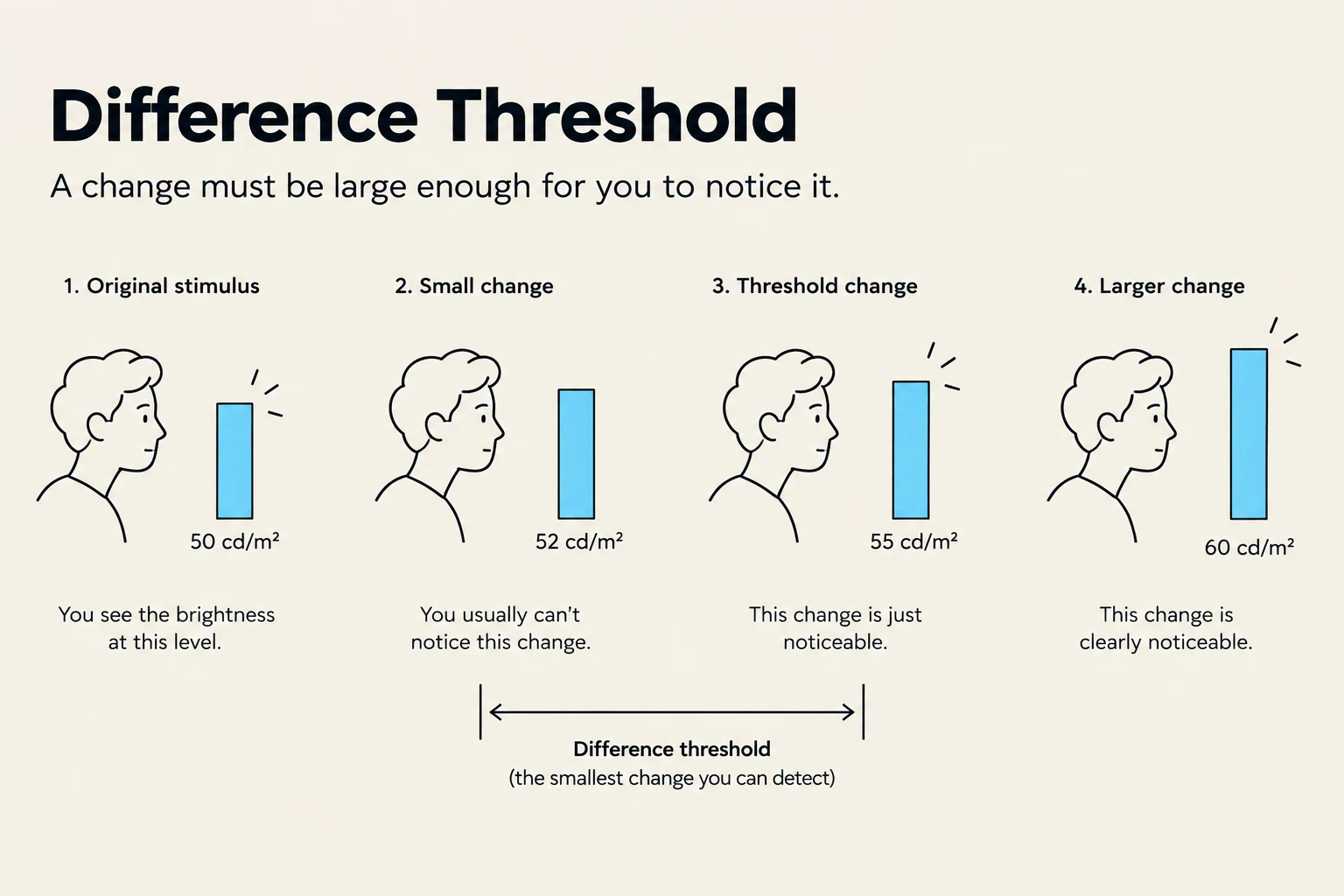
Difference Threshold (Just Noticeable Difference): The minimum difference between two stimuli required for a person to detect that they are different. For example, if you are holding a 50lb weight, how much extra weight must be added before you actually feel the change?
Exam Tip: When studying for exams, remember that Sensation is about the intensity and presence of a stimulus, whereas Perception is about the meaning and identity of that stimulus.
The difference threshold illustrates the minimum change in a stimulus that is detectable. The diagram shows how increasing brightness levels are perceived, with a specific threshold at which a change becomes noticeable.
Summary
In short, sensation and perception work in a continuous loop to create our reality. Sensation provides the raw, unorganized data from the environment via transduction, and perception uses that data to construct a coherent, meaningful map of the world. Without sensation, we would be disconnected from our environment; without perception, the world would be a chaotic, meaningless stream of signals.
Keep reading for free.
Create an account to finish this reading and make it part of your study routine.