Explores audition, the process of hearing, detailing the physics of sound waves (amplitude, frequency) and the anatomy of the ear (outer, middle, inner) involved in transducing sound into neural signals. It also covers pitch perception theories, types of hearing loss, and the role of the inner ear in balance.
Have you ever wondered how a vibration in the air transforms into the soaring melody of a song or the urgent ring of a telephone? This remarkable transformation is known as audition, or hearing. Audition is the process of detecting vibrations that travel as sound waves through various media, including gases, liquids, and solids. To understand how we hear, we must look at both the physical properties of these waves and the complex biological machinery of the ear that converts them into neural signals.
The Physics of Sound
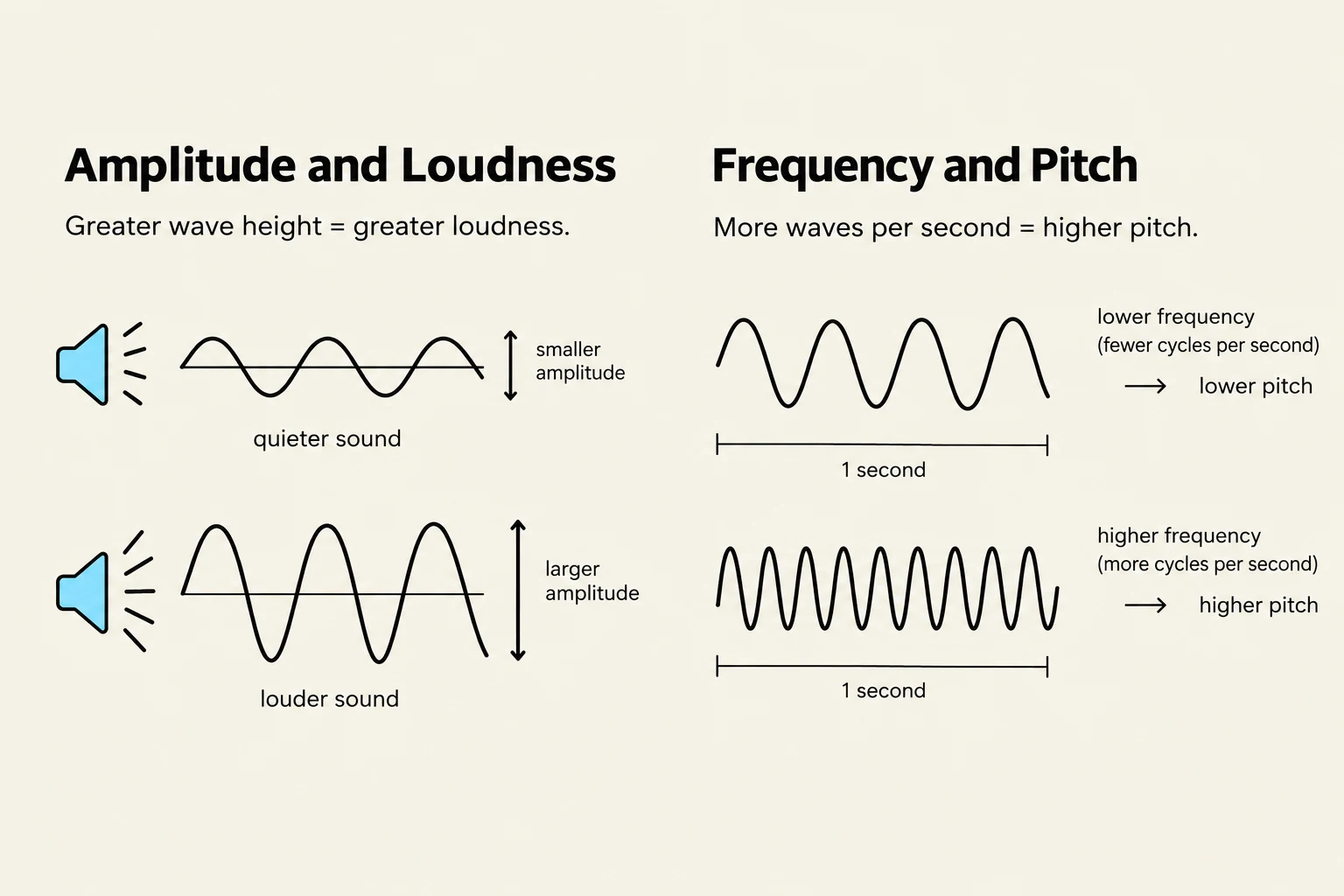
Sound begins as a series of vibrations moving as waves through a medium. These waves possess two primary physical properties that our brains interpret as distinct sensory experiences: amplitude and frequency.
Amplitude refers to the height of the sound wave—the distance from the bottom to the top of the wave. Our brain calculates the loudness of a sound based on this physical energy; a wave with a higher amplitude is perceived as a louder sound. Sound intensity is quantified using decibels (dB). The scale ranges from 0 dB, which is the threshold of hearing, to 140 dB, which is the threshold for pain and potential permanent hearing loss.
Frequency refers to the number of sound waves occurring within a single second. This physical stimulus is interpreted by the brain as pitch, or the subjective experience of a sound being high or low. Frequency is measured in Hertz (Hz), representing cycles per second.
This illustration explains the concepts of amplitude and loudness, and frequency and pitch, using wave diagrams. It shows that greater wave height corresponds to greater loudness, and more waves per second (higher frequency) corresponds to higher pitch.
Exam Tip: Remember the distinction between physical stimuli and subjective perception. Amplitude (physical) → Loudness (subjective); Frequency (physical) → Pitch (subjective).
The Anatomy of the Ear
The human ear is divided into three distinct sections: the outer ear, the middle ear, and the inner ear. Each section plays a specific role in the process of transduction—the conversion of physical energy into electrical signals that the brain can process.
The Outer Ear
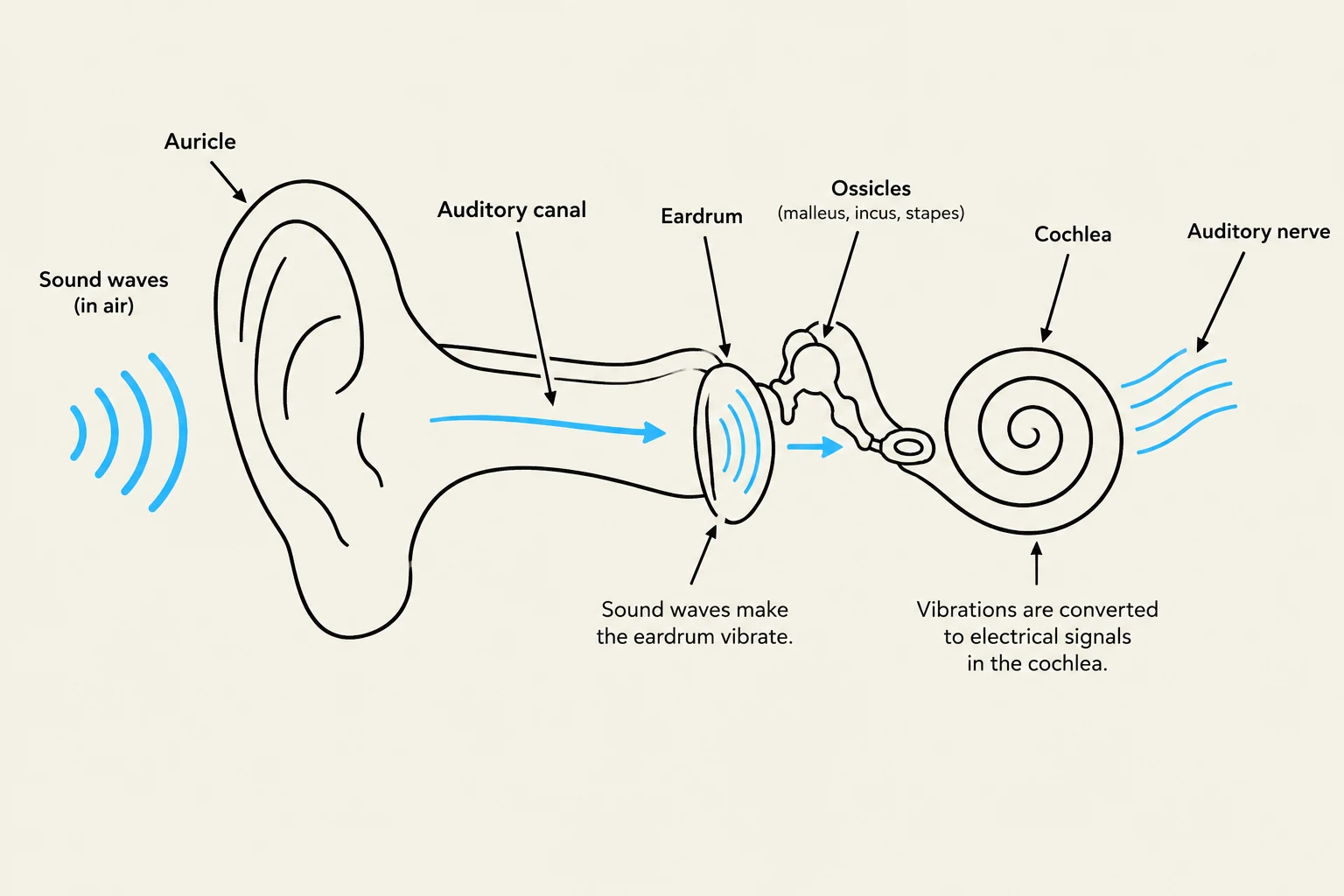
The process begins with the auricles (the visible parts of the ear), which collect airborne sound waves and help the listener locate the direction of the sound. These waves are then channeled into the auditory canal.
The Middle Ear
The sound waves eventually strike the tympanic membrane (eardrum), causing it to vibrate. These vibrations are passed to the ossicles, the three smallest bones in the human body. The ossicles consist of the malleus (hammer), the incus (anvil), and the stapes (stirrup). As vibrations move from the relatively large area of the eardrum through the much smaller ossicles, the force is concentrated, which effectively amplifies the sound before the stapes pushes against the oval window.
The Inner Ear
The movement of the oval window creates pressure changes in the fluid within the cochlea. These pressure changes cause the basilar membrane to move. Within the cochlea, a structure called the organ of Corti sits upon the basilar membrane; as the membrane moves, it bends the hair-like projections of sensory cells. This bending stimulates the cells to transmit electrical impulses along the auditory nerve to the brain.
Diagram illustrating the anatomy of the human ear and the process of hearing, showing how sound waves travel through the auditory canal, vibrate the eardrum and ossicles, and are converted into electrical signals in the cochlea before being sent to the auditory nerve.
From Sound to Perception
Once the impulses reach the brain, they are processed in two stages. First, they arrive at the primary auditory cortex, located at the top edge of the temporal lobe, which transforms the impulses into basic sensations of pitch and loudness. Second, these sensations are sent to the auditory association area, which interprets them into complex perceptions like words, melodies, or sentences.
Theories of Pitch Perception
Psychologists use two main theories to explain how we perceive different pitches:
Frequency Theory: Suggests that for low-pitched sounds, the rate at which nerve impulses reach the brain determines the pitch.
Place Theory: Suggests that for medium and high-pitched sounds, pitch is determined by the specific location on the basilar membrane where the vibration is most intense.
Hearing Loss and Balance
Hearing impairment is generally categorized into two types:
Conduction Deafness: Caused by physical blockages or damage to the outer or middle ear (such as the ear canal, eardrum, or ossicles), which prevents vibrations from reaching the cochlear fluid.
Neural Deafness: Caused by damage to the auditory receptors (hair cells) or the auditory nerve. This type of deafness can sometimes be treated with a cochlear implant, a device that bypasses damaged parts to transduce sound waves directly into electrical signals for the nerve.
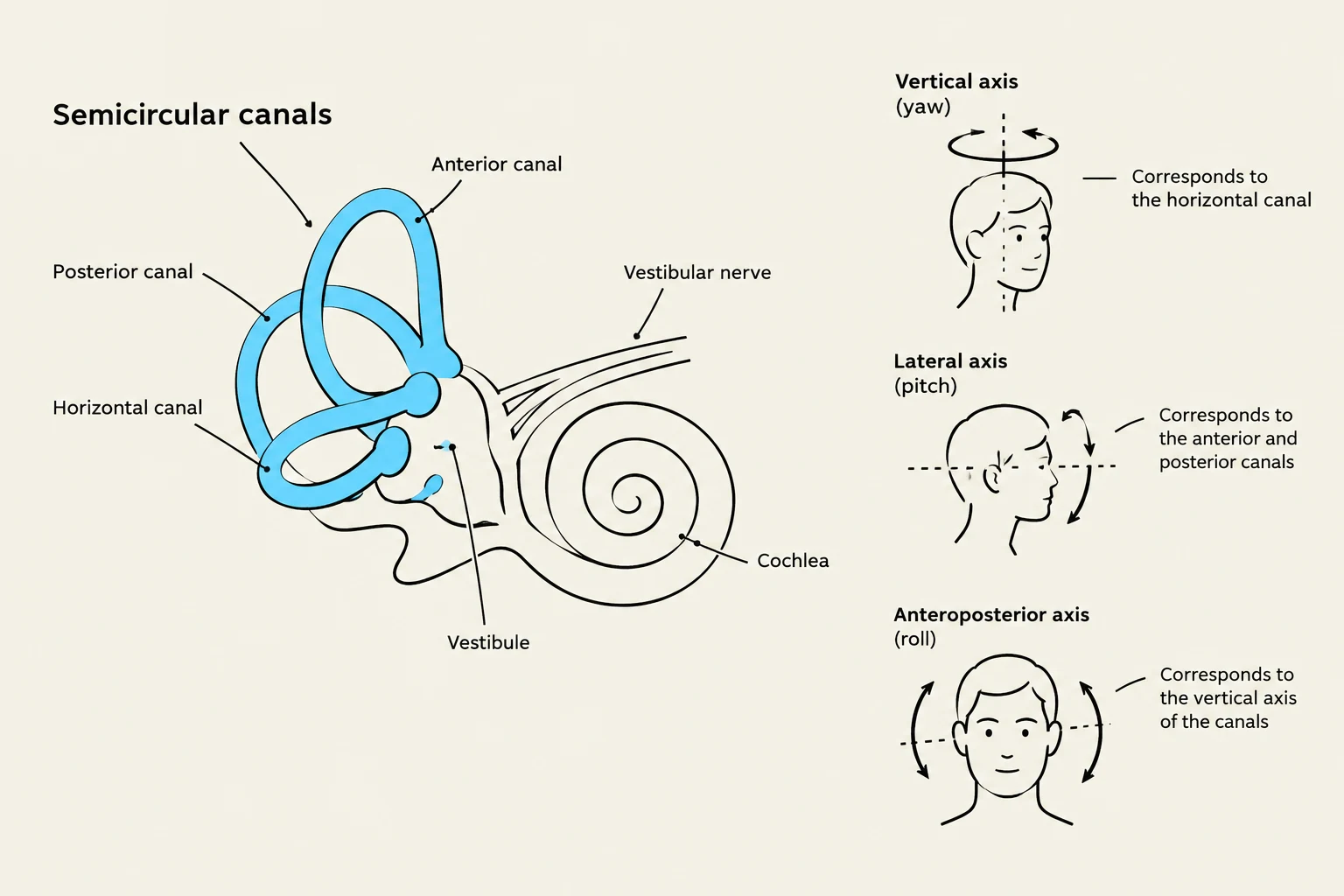
Interestingly, the inner ear is responsible for more than just hearing. It also contains the semicircular canals, which are filled with fluid and hair cells. These canals facilitate the vestibular sense, which provides our sense of spatial orientation and balance by detecting rotation in three dimensions (yaw, pitch, and roll).
Diagram illustrating the semicircular canals of the inner ear and their relationship to head movements along different axes.
Keep reading for free.
Create an account to finish this reading and make it part of your study routine.