


Plants have evolved sophisticated biological strategies to conquer diverse environments, from damp forest floors to arid deserts. Central to this success is the ability to reproduce sexually while minimizing dependence on external water. This is achieved through a complex lifecycle known as the alternation of generations, which has undergone significant evolutionary refinement in seed plants to ensure survival in dry conditions.
Alternation of Generations
Unlike animals, which typically have a single multicellular stage, plants alternate between two distinct multicellular generations. This process is the "plant solution" to sexual reproduction in terrestrial environments.
- The Diploid ($2N$) Sporophyte: This is the dominant, multicellular stage of the plant. It produces spores through the process of meiosis.
- The Haploid () Gametophyte: Instead of producing single-celled gametes directly from meiosis (as animals do), plants produce haploid spores () via meiosis. These spores then grow through mitosis into a multicellular gametophyte. This gametophyte eventually produces gametes () through mitosis, which then undergo fertilization to reform the $2N$ sporophyte.
Exam Tip: Remember the distinction in the "intermediate" stage. In animals, meiosis produces a single-celled gamete. In plants, meiosis produces a single-celled spore, which must grow into a multicellular gametophyte before gametes are even produced.

The Evolution of Plant Groups
Plants can be categorized based on their complexity, specifically regarding their vascular systems and reproductive methods:
- Nonvascular, seedless plants: Such as bryophytes, which lack specialized conducting tissues.
- Vascular, seedless plants: Such as ferns and their allies, which possess vascular tissue to transport water and nutrients but do not produce seeds.
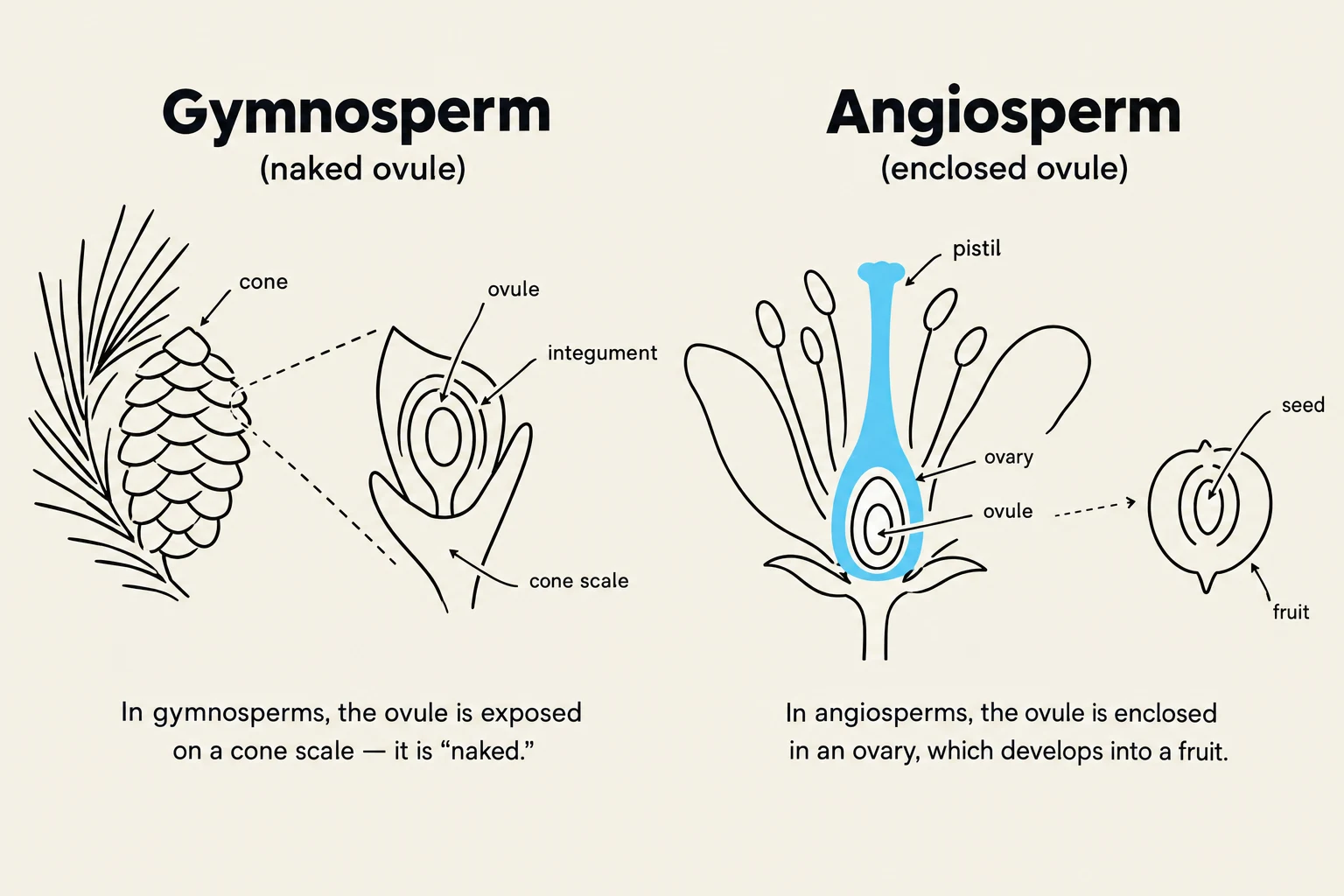
- Gymnosperms: Vascular plants that produce "naked" seeds.
- Angiosperms: Vascular plants that produce "covered" seeds, often housed within fruits.
Keep reading for free.
Create an account to finish this reading and make it part of your study routine.
Continue reading freeAlready have an account? Log in
Updated