Explore the principles of scientific reasoning, including empirical evidence and skepticism, and understand how cognitive biases like confirmation bias and overconfidence can impede objective thinking. Learn strategies to think more like a scientist in daily life.
In our daily lives, we are constantly bombarded with information, claims, and "facts." How do we distinguish between a well-supported scientific theory and a mere intuition or a clever piece of misinformation? The answer lies in the application of scientific reasoning—a structured way of thinking that relies on empirical evidence and healthy skepticism rather than personal belief or anecdotal experience.
Understanding how science works requires more than just memorizing formulas; it requires an awareness of how our own minds can lead us astray through cognitive biases.
The Foundation of Scientific Reasoning
This diagram illustrates the difference between a scientific theory, which is testable and yields measurable outcomes, and a non-falsifiable claim, which is vague and cannot be disproven by observation.
At the heart of science is the pursuit of objective truth through systematic observation. Unlike casual observation, scientific reasoning is built upon several core pillars:
Empirical Evidence
Science is an empirical endeavor. This means that claims must be supported by evidence that can be observed, measured, and verified by others. If a theory cannot be tested against the real world, it falls outside the realm of scientific inquiry. Empirical evidence provides the "ground truth" that allows researchers to move beyond speculation.
Skepticism and Falsifiability
A scientist does not accept a claim simply because it sounds plausible or because an authority figure stated it. Instead, they practice skepticism—a questioning attitude that demands rigorous proof before acceptance.
Crucially, for a theory to be scientific, it must be falsifiable. This means there must be a theoretical way to prove the claim wrong. If a theory is so vague that no possible observation could ever contradict it, it is not a scientific theory.
Exam Tip: When evaluating a claim, ask yourself: "What specific evidence would be required to prove this claim false?" If the answer is "nothing," the claim is likely pseudoscientific.
Cognitive Biases: The Mental Shortcuts That Mislead
While the scientific method is designed to be objective, the humans performing it are not. Our brains evolved to make quick decisions to ensure survival, often relying on "heuristics" or mental shortcuts. While efficient, these shortcuts frequently result in cognitive biases—systematic errors in thinking that distort our perception of reality.
Confirmation Bias
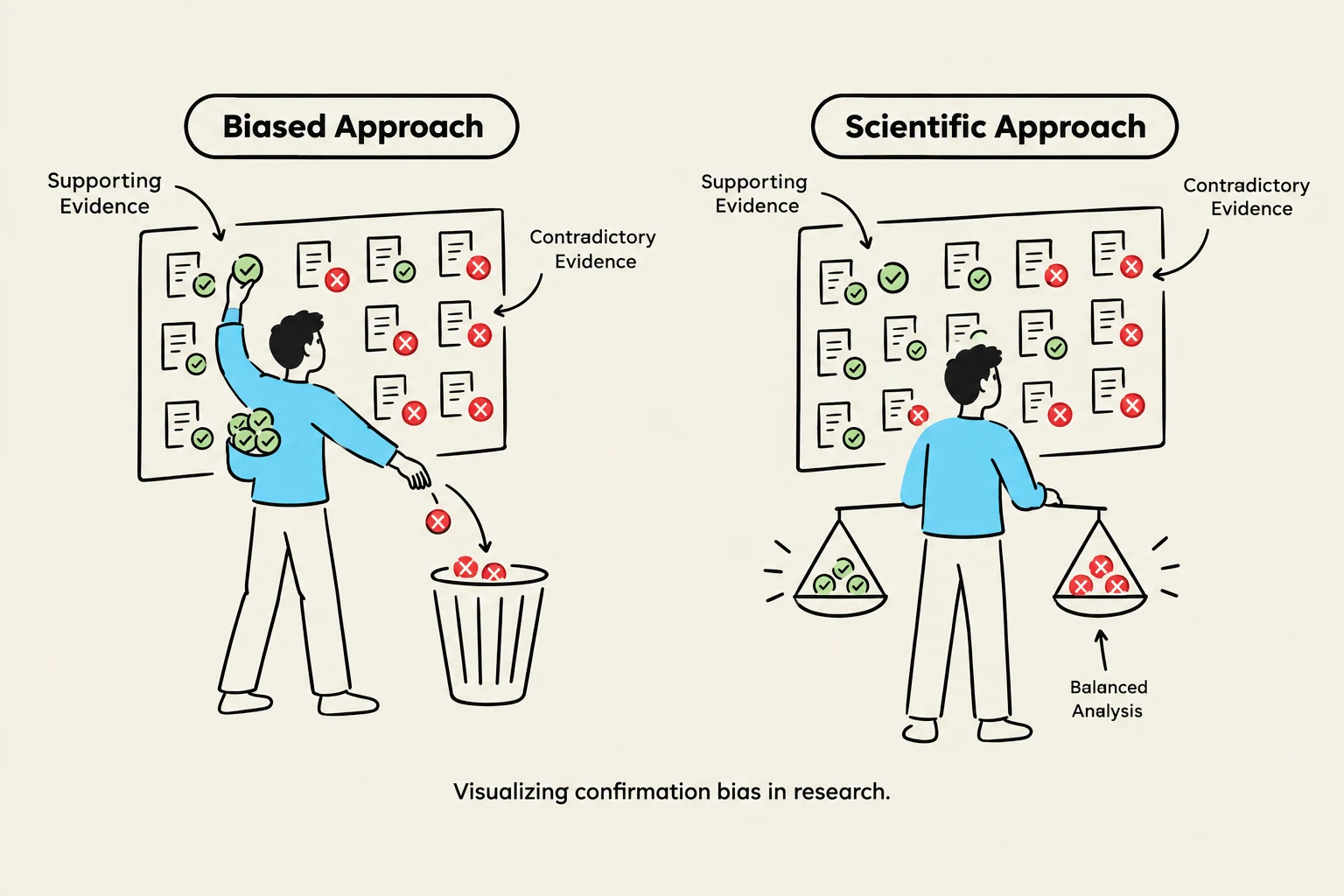
This illustration contrasts a biased approach to research, where supporting evidence is favored and contradictory evidence is discarded, with a scientific approach that aims for balanced analysis of all evidence.
Perhaps the most pervasive obstacle to scientific reasoning is confirmation bias. This is the tendency to search for, interpret, favor, and recall information in a way that confirms our pre-existing beliefs or hypotheses.
Worked Example:
Imagine a researcher believes that a specific herbal tea improves memory.
Biased Approach: They only look for studies that show improved test scores and ignore five other studies that showed no effect. They might even dismiss the negative studies as "poorly designed."
Scientific Approach: They actively seek out evidence that contradicts their belief, looking for reasons why the tea might not work.
Overconfidence
Humans have a natural tendency to overestimate the accuracy of their knowledge and their ability to predict future events. This is known as the overconfidence effect.
In a scientific context, overconfidence can lead researchers to jump to conclusions before sufficient data has been collected, or to ignore outliers in data that might suggest their initial hypothesis was incorrect. This bias is particularly dangerous because it creates a false sense of certainty, making us less likely to engage in the necessary skepticism required for rigorous science.
Bridging the Gap: How to Think Like a Scientist
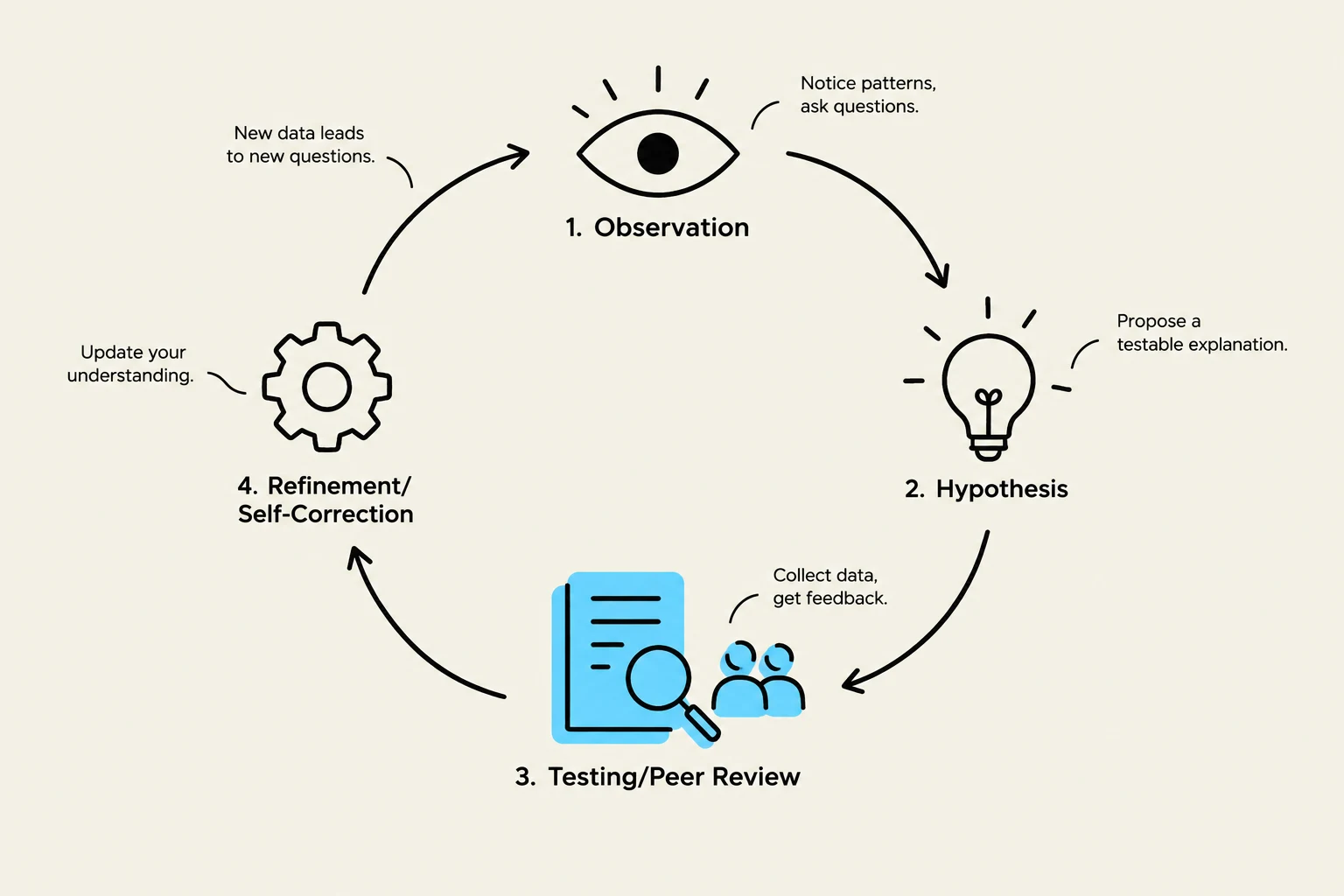
This diagram illustrates the scientific method, a cyclical process involving observation, hypothesis formation, testing, and refinement.
To combat these biases and apply scientific reasoning effectively, one must adopt specific intellectual habits.
Habit
Description
Purpose
Peer Review
Subjecting work to the scrutiny of experts in the same field.
To catch errors and biases before findings are accepted.
Replication
Repeating a study using the same methods to see if the results hold.
To ensure findings weren't just a "fluke" or a result of error.
Self-Correction
Being willing to change your mind when new evidence emerges.
To ensure that knowledge evolves as our understanding grows.
Summary of Best Practices
To navigate information effectively, remember these three steps:
Demand Evidence: Look for empirical data rather than anecdotes. An anecdote (e.g., "My uncle smoked for 50 years and lived to be 90!") is not scientific evidence.
Check for Bias: Ask yourself, "Am I only looking for information that proves I am right?"
Embrace Uncertainty: Science is rarely about "absolute truth"; it is about building the most accurate models possible based on the current evidence. Being comfortable with "I don't know yet" is a hallmark of a scientific mind.
Final Thought: Scientific reasoning is not just a method for researchers in labs; it is a vital life skill that allows us to navigate a complex world with clarity and precision.
Keep reading for free.
Create an account to finish this reading and make it part of your study routine.