Scalars and Vectors: The Building Blocks of Physics
This content explains the fundamental distinction between scalar and vector quantities in physics, detailing their properties, examples, and basic operations. It also covers graphical relationships and analyzing slopes in physics experiments.
In our daily lives, we encounter many different types of measurements. We talk about how much a bag weighs, how hot the air is, or how far we traveled to get to school. In physics, these measurements are known as physical quantities. However, not all physical quantities are created equal. To describe the natural world accurately, physicists categorize these quantities into two fundamental groups: scalars and vectors. Understanding the distinction between them is essential for everything from calculating the speed of a car to predicting the path of a projectile.
Scalars: Magnitude Only
A scalar is a physical quantity that is described solely by its magnitude, which simply means its size or numerical value. When you measure a scalar, you are answering the question "how much?".
While some scalars can be represented by negative numbers (for example, a temperature below zero), the negative sign in a scalar does not indicate a direction in space. Common examples of scalar quantities include:
Mass
Temperature
Energy
Speed
Distance
Charge
Vectors: Magnitude and Direction
A vector is more complex than a scalar because it possesses both magnitude and direction. If you tell someone you are driving at 50 km/h, you have given them a scalar (speed). If you tell them you are driving at 50 km/h North, you have provided a vector (velocity).
Graphically, a vector is represented by an arrow:
The tail of the arrow indicates the starting point.
The head (the tip) of the arrow indicates the direction.
The length of the arrow represents the magnitude.
Common examples of vector quantities include:
Displacement
Velocity
Acceleration
Force
Momentum
A diagram illustrating the components of a vector, including its tail, head, and magnitude.
Exam Tip: Always check if a question asks for "distance" (scalar) or "displacement" (vector). If a person walks in a complete circle and ends up where they started, their distance is the circumference of the circle, but their displacement is zero!
Vector Operations
Because vectors have direction, you cannot always add them like simple numbers. You must account for the way they are oriented in space.
Addition and Subtraction
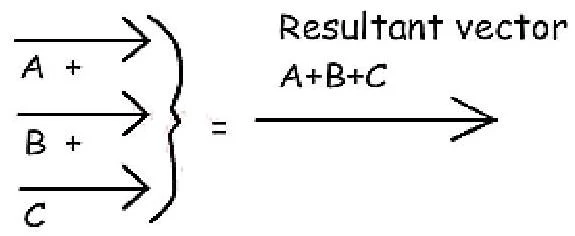
The most common way to add vectors is the "head-to-tail" method. To add multiple vectors, you place the tail of the second vector at the head of the first. The resultant vector is the single arrow drawn from the very first tail to the very last head.
If several vectors point in the same direction, you can simply sum their magnitudes. However, if a vector points in the opposite direction, it is treated as a negative value during addition.
This diagram illustrates the concept of vector addition, showing that the resultant vector is the sum of individual vectors A, B, and C.
This diagram illustrates the concept of vector addition, showing how vectors A, B, and C combine to form a resultant vector.
The Pythagorean Theorem
When two vectors are perpendicular (acting at a 90-degree angle to each other), we can find the magnitude of the resultant vector using the Pythagorean Theorem.
If vector a and vector b are the two component vectors, the magnitude of the resultant c is:
a2+b2=c2c=a2+b2
To find the specific direction (the angle φ), you can use trigonometry, such as:
tanφ=adjacentopposite
Worked Example:
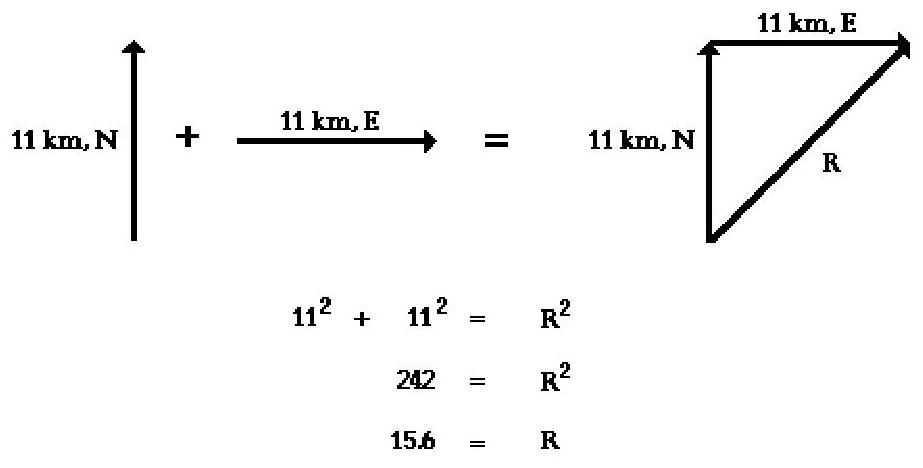
Peter walks 11 km North and then 11 km East. What is his resultant displacement?
Since North and East are at right angles, we use the Pythagorean Theorem:
c2c2c2c=112+112=121+121=242=242≈15.6 km
The direction would be Northeast.
Vector addition illustrating the Pythagorean theorem, where a vector of 11 km North is added to a vector of 11 km East, resulting in a resultant vector R.
Scalar Multiplication
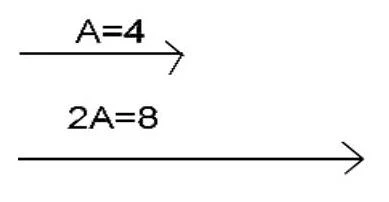
You can multiply a vector by a scalar, which changes the vector's magnitude.
If the scalar is positive, the direction remains the same.
If the scalar is negative, the vector's direction is reversed.
A simple algebraic illustration showing that if A equals 4, then 2A equals 8.
Graphical Relationships in Physics
In physics experiments, we often use graphs to visualize how different quantities interact.
Linear and Direct Relationships
A direct relationship occurs when two variables change in the same manner: as one increases, the other also increases. This is expressed as $y = kx$, where k is the constant of proportionality. On a graph, this appears as a straight line passing through the origin (0,0).
A graph showing a linear relationship between x and y, with a point plotted at (5, 10).
Inverse Relationships
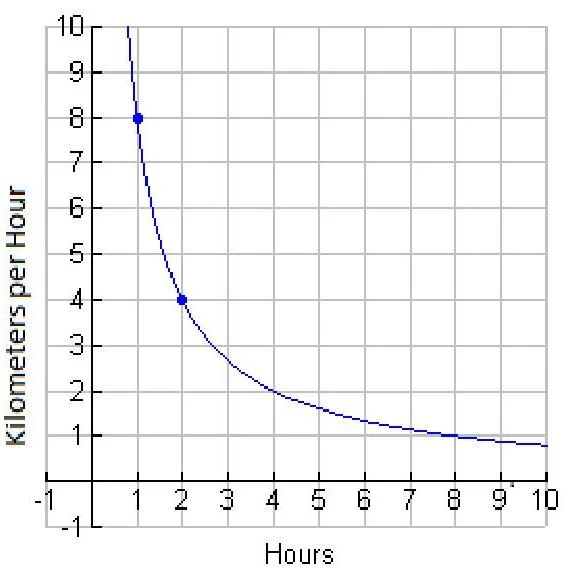
In an inverse relationship, the variables change in opposite manners: as one increases, the other decreases. This is expressed as y=xk. The graph of an inverse relationship is not a straight line, but a curve.
A graph showing the relationship between distance in kilometers per hour and time in hours, illustrating an inverse relationship where speed decreases as time increases.
Pro-Tip: If you have an inverse relationship (like a and M), plotting a against the reciprocal of the variable (1/M) will often result in a straight line. This makes it much easier to calculate the constant of proportionality using the slope of that line.
Analyzing Slopes
The slope of a graph can represent a specific physical value. For example, in a graph of speed (v) versus time (t), the slope represents the rate of change of speed, which is acceleration.
By mastering the distinction between scalars and vectors and learning how to manipulate them mathematically, you gain the tools necessary to solve the most fundamental problems in physics.
Keep reading for free.
Create an account to finish this reading and make it part of your study routine.