Understanding the Uniform Commercial Code: Sales and Leases
An overview of the Uniform Commercial Code (UCC), focusing on Article 2 for the sale of goods and Article 2A for lease contracts. It explains key concepts like tangible vs. intangible property, contract formation, open terms, and the "battle of the forms."
In the world of commerce, legal certainty is the bedrock of successful transactions. Historically, businesses relied on common law, which could vary significantly between different jurisdictions. To solve the problem of inconsistent state laws and facilitate smoother interstate commerce, the Uniform Commercial Code (UCC) was developed. The UCC provides a consistent, statutory framework that governs a broad spectrum of commercial transactions, from the initial formation of a contract to the final payment and security for those goods.
While states have the option to adopt or reject these model laws, the UCC has become the primary authority for the sale and lease of goods in most jurisdictions.
The Scope of the UCC: Goods and Property
The UCC does not govern every type of contract. Instead, it is specifically designed for transactions involving goods. To understand the UCC, one must distinguish between different types of property:
Tangible Property: This refers to items that have a physical existence—things you can touch or feel.
Goods: Under the UCC, goods are defined as any tangible, movable property. This includes items like machinery or electronics, and even items traditionally associated with real estate, such as oil, gas, timber, and crops, because they are movable.
Intangible Property: Unlike goods, intangible property has no physical existence; it is conceptual (such as a copyright or a patent) and therefore falls outside the scope of UCC Article 2.
This diagram illustrates the two main categories of property: tangible goods, which are physical items like crops and machinery, and intangible property, which includes non-physical rights such as intellectual property and licenses.
Article 2 vs. Article 2A: Sales and Leases
The UCC is divided into different "Articles" that address specific types of commercial arrangements.
Article 2: The Sale of Goods
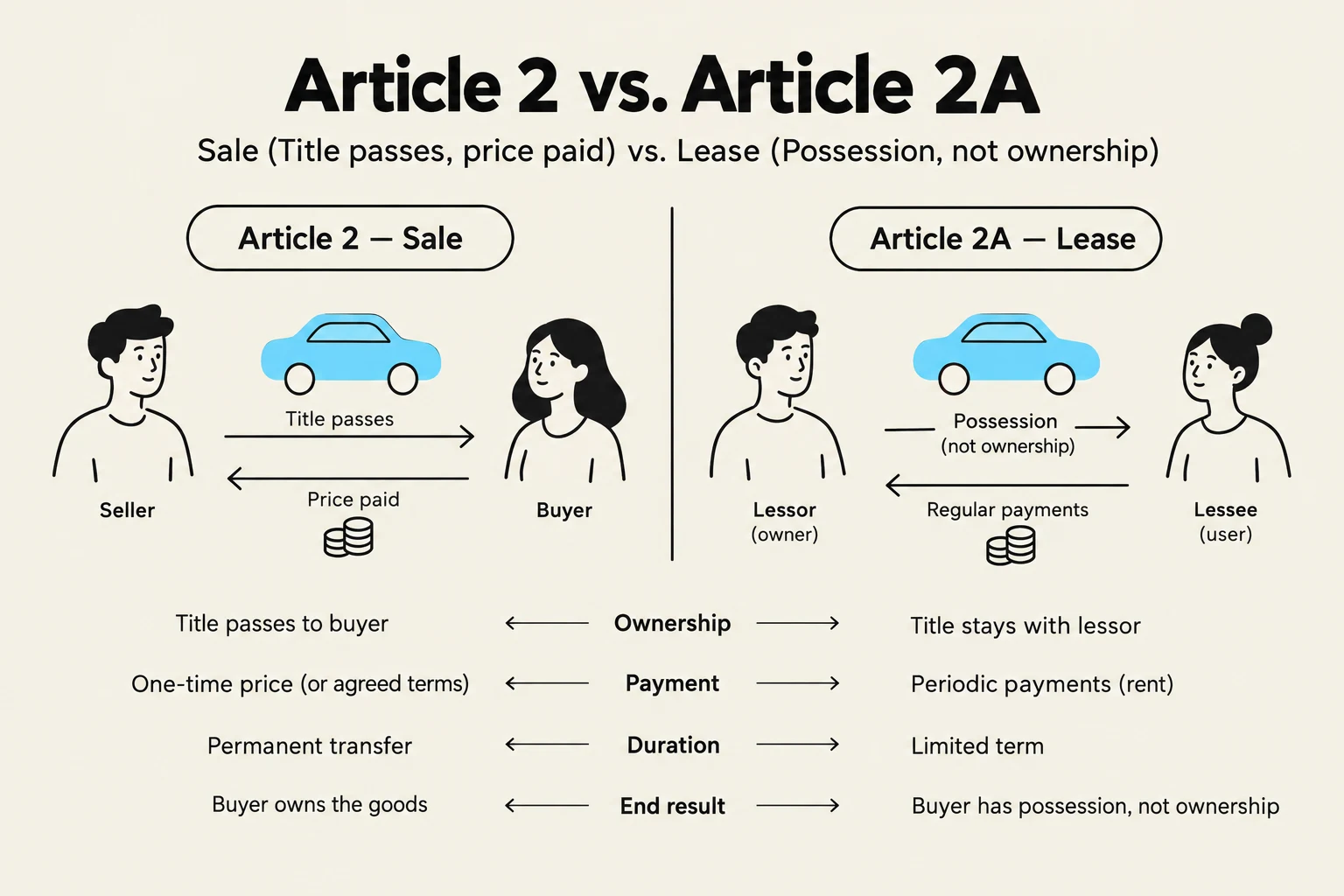
Article 2 governs sales contracts. A "sale" is defined as the passage of title from a seller to a buyer in exchange for a price. This price can be paid in cash or through the exchange of other goods or services.
Article 2A: Lease Contracts
Article 2A governs lease contracts. In a lease, the parties are known as the lessor (the party transferring the right of possession and use) and the lessee (the party acquiring those rights). Unlike a sale, the title does not pass to the lessee; instead, they pay for the right to use the goods for a specific period.
There are two primary types of leases under Article 2A:
Consumer Leases: These involve a lessor who regularly engages in the business of leasing and a lessee who is using the goods primarily for personal or family purposes. A key threshold is that the total lease payments must be less than $25,000.
Finance Leases: These typically involve three parties: a supplier, a lessee, and a lessor. The lessor buys the goods from the supplier and then leases them to the lessee to finance the deal.
This diagram illustrates the key differences between Article 2 (Sale) and Article 2A (Lease) in terms of ownership, payment, duration, and the end result for a transaction, using a car as an example.
Flexibility and "Open Terms"
One of the most significant advantages of the UCC over common law is its flexibility regarding "open terms". In many commercial settings, parties may intend to form a contract even if they haven't hammered out every single detail. If the parties intended to make a contract and there is a reasonably certain basis for a court to grant a remedy, the UCC provides "gap-fillers" to complete the agreement.
Price: If no price is set, the court will determine a "reasonable price at the time of delivery".
Delivery: If no delivery terms are specified, the buyer is expected to take delivery at the seller's place of business.
Quantity: Generally, a contract must specify a quantity. However, there are two major exceptions:
Requirement Contracts: A buyer agrees to purchase all or up to what they require.
Output Contracts: A buyer agrees to purchase all or up to what a seller produces.
Note: Both must be made in good faith.
Exam Tip: Good Faith
The concept of "Good Faith" is central to the UCC. It is defined as "honesty in fact" and the "observance of reasonable commercial standards of fair dealing". If a party has the power to set a price or quantity, they must do so reasonably and honestly.
Contract Formation and Enforcement
Merchants and the "Battle of the Forms"
The UCC applies different, often stricter, rules to merchants—those who are in the business of buying or selling goods.
One common issue in commercial law is the "Battle of the Forms," which occurs when two parties exchange pre-printed contract forms that contain conflicting terms. Under the UCC, if the parties are merchants, the additional terms in an acceptance become part of the contract unless the offer was limited to its own terms, the new terms materially alter the deal, or the offeror objects to them.
The Statute of Frauds
To prevent fraud, certain contracts must be in writing to be enforceable:
Sales: Goods valued at >$500.
Leases: Total lease payments >$1,000.
A writing can be paper or electronic (like an email) as long as it indicates an intent to contract and is signed by the party against whom enforcement is sought.
Parol Evidence and Interpretation
The Parol Evidence Rule generally prohibits parties from introducing evidence of outside agreements to contradict a clear, written contract. However, the UCC allows certain types of evidence to clarify the parties' intent:
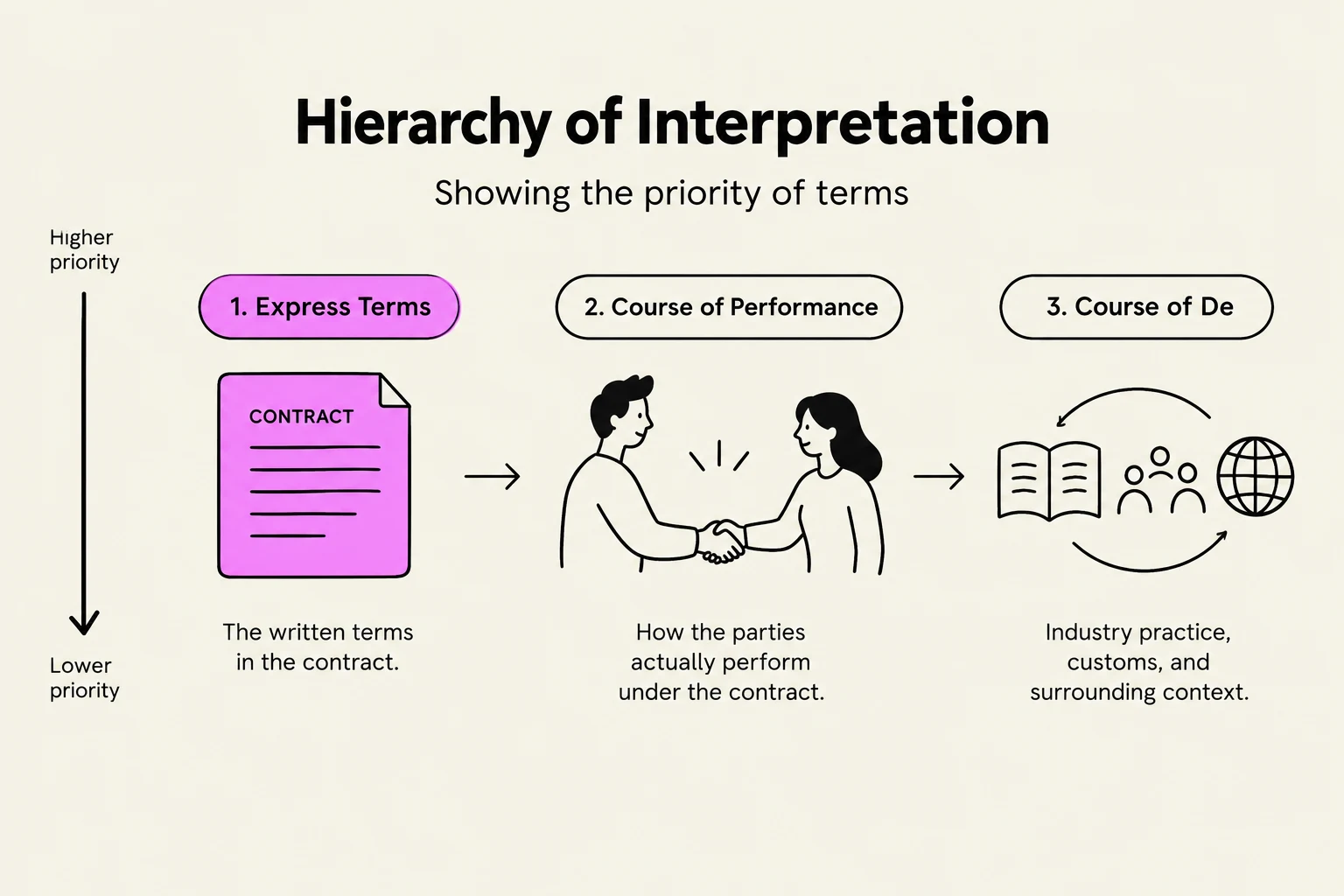
Course of Dealing: The sequence of previous actions or communications between the specific parties.
Usage of Trade: Regularly observed practices within a specific vocation or industry.
Course of Performance: The conduct of the parties occurring under the terms of the current contract.
This diagram illustrates the hierarchy of interpretation for contract terms, showing that express terms have the highest priority, followed by the course of performance, and then industry practice and surrounding context.
Unconscionability
Finally, the UCC protects parties from "unconscionable" terms—those so one-sided or unfair that they are unreasonable to enforce. If a court finds a term or an entire contract unconscionable, it has three options: refuse to enforce the whole contract, refuse to enforce only the unfair part, or limit the application of the term to avoid an unfair result.
Keep reading for free.
Create an account to finish this reading and make it part of your study routine.