Ruminant Nutrition: Forages, Concentrates, and Micronutrients
An overview of ruminant nutrition, covering the roles of forages and concentrates, terminology for feed delivery, measurement of forage quality (NDF, ADF), and the importance of vitamins and minerals.
Understanding the nutritional landscape of ruminants requires a clear grasp of how different feed components interact with the rumen. Ruminants, such as dairy cows and beef cattle, have a unique digestive system that relies on microbial fermentation to extract energy from complex plant structures. To optimize production, nutritionists must balance high-fiber forages with energy-dense concentrates while ensuring a precise supply of micronutrients through supplements and additives.
Understanding Feed Categories
In ruminant nutrition, feeds are categorized based on their nutrient density and their role in the total diet.
Forages are the foundation of the ruminant diet. These are crops (annual or biennial) grown to be utilized by grazing or harvested as a whole crop. Forages provide the necessary "scratch factor" to maintain rumen health.
Concentrates are substances that are relatively low in fiber but high in energy and protein. These are essential for high-producing dairy cows and feedlot cattle to meet their intensive metabolic demands.
To manage these ingredients, we use specific terminology to describe how they are delivered to the animal:
Complete Feed: A total diet containing grain, protein, fat, minerals, and vitamins (typically 5–12 kg/day).
Supplement: A targeted addition of protein, fat, minerals, and vitamins (typically 500g–5kg/day).
Premix: A concentrated mixture of minerals and vitamins (typically 50g–1kg/day).
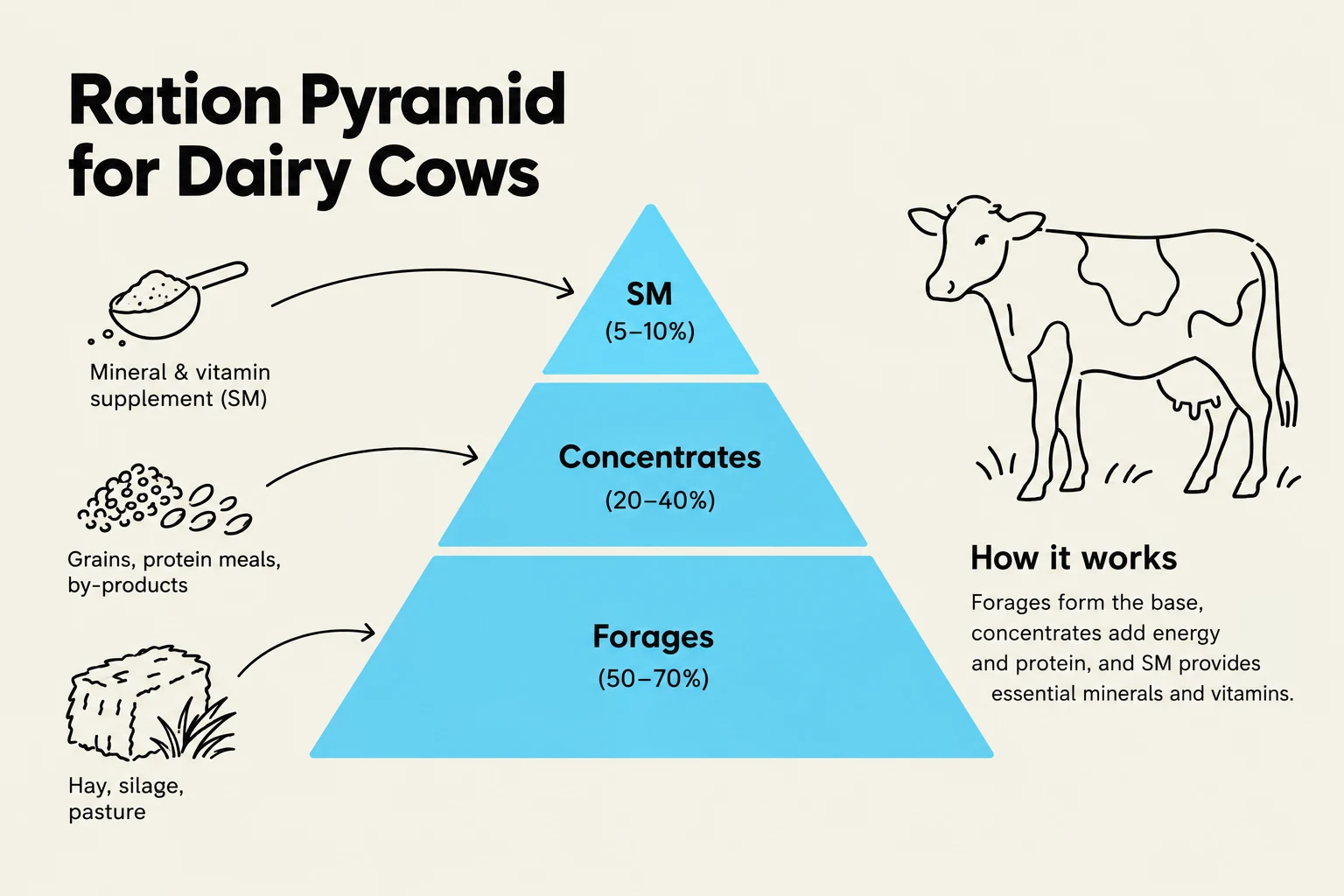
A diagram illustrating the ration pyramid for dairy cows, detailing the proportions of forages, concentrates, and mineral/vitamin supplements in their diet.
Measuring Forage Quality and Fiber
The quality of a forage is largely determined by its chemical composition, specifically its fiber content and digestibility. Two of the most critical metrics used by nutritionists are NDF and ADF.
NDF (Neutral Detergent Fibre): This represents the total fiber fraction, including cellulose, hemicellulose, and lignin. NDF is a primary indicator of intake; as NDF increases, the animal feels "full" faster, which can limit total dry matter intake.
ADF (Acid Detergent Fibre): This fraction consists of cellulose and lignin. ADF is used as an indicator of energy and digestibility; higher ADF levels generally mean lower digestibility.
The structural component that most limits digestibility is Lignin. Lignin is an undigestible, complex structure that encases other carbohydrates, making them inaccessible to rumen microbes.
To calculate the NFC (Non-Fibre Carbohydrate) fraction—which represents the highly digestible energy source—nutritionists use the following formula:
NFC=100−ash−EE−CP−NDF−NDICP
Where:
EE = Ether Extract (Fat)
CP = Crude Protein
NDICP = Neutral Detergent Insoluble Protein
Exam Tip: Remember the inverse relationship between maturity and quality. As a plant reaches reproductive maturity, NDF and Lignin levels increase, which causes a decrease in both digestibility and energy density.
Micronutrients: Vitamins and Minerals
While macronutrients provide energy and structure, micronutrients are essential for physiological function. These are typically provided via mineral and vitamin premixes.
Vitamin Deficiencies
Deficiencies in vitamins can lead to rapid clinical decline in both cows and calves:
Vitamin A: Deficiency causes night blindness, watery eyes, and muscle incoordination. In pregnant cows, it can lead to pre-term abortion.
Vitamin D: Essential for bone health. Deficiency results in rickets, characterized by enlarged joints, a wobbly gait, and an arched back.
Vitamin E: Deficiency is linked to white muscle disease, lowered immunity, and the production of oxidized milk.
Mineral Management
Minerals are categorized into macrominerals (like Ca, P, and Mg) and microminerals (like Cu, Zn, and Se).
A critical challenge in mineral nutrition is availability. For example, while most minerals can be provided in inorganic forms, chelated minerals (trace minerals bound to organic molecules like amino acids) can increase absorption by 300% to 500% and do not interact negatively with other minerals.
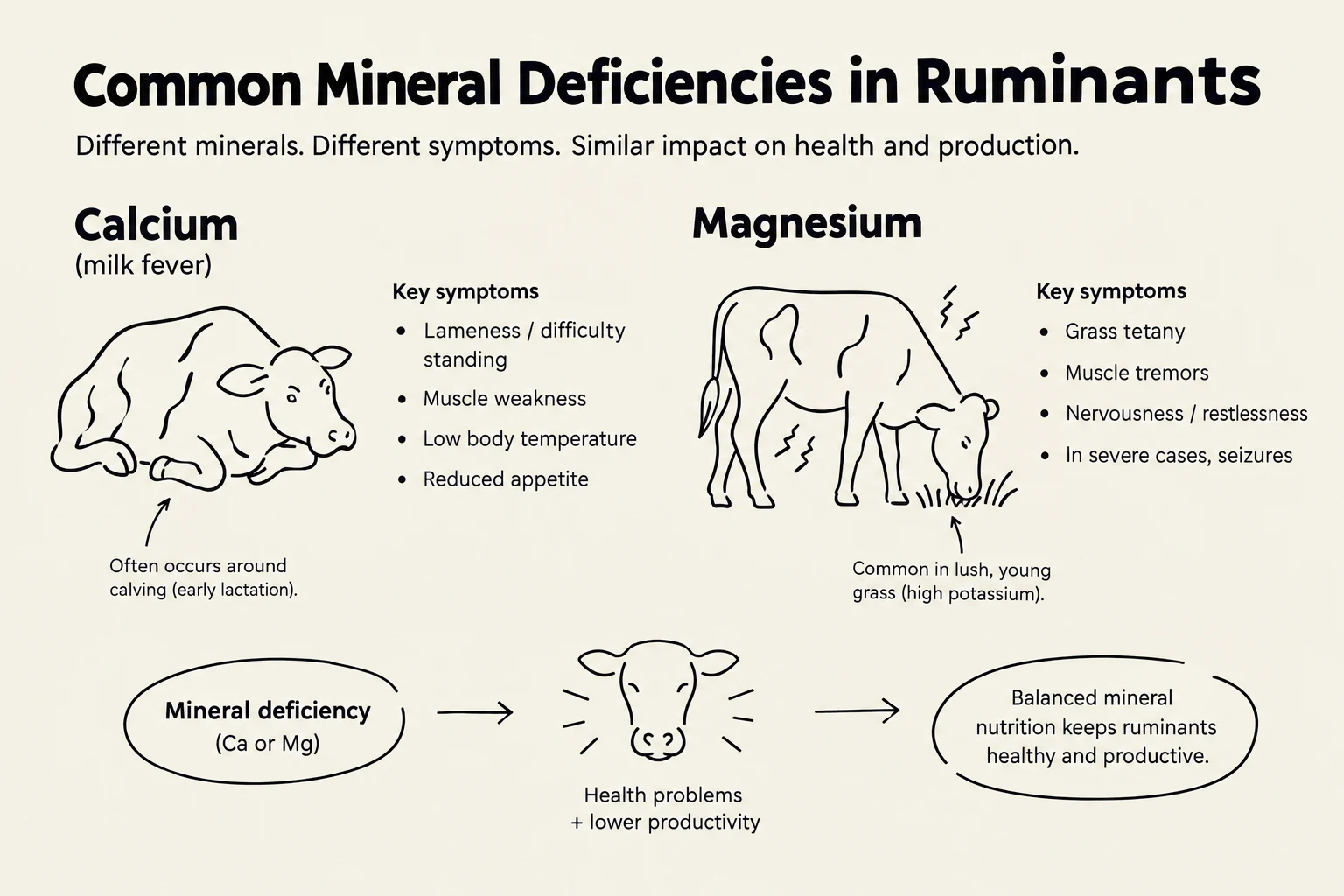
This diagram illustrates common mineral deficiencies in ruminants, specifically calcium and magnesium, detailing their symptoms and contributing factors. It also shows the general impact of mineral deficiency on animal health and productivity, and the benefit of balanced mineral nutrition.
Feed Additives and Rumen Management
Feed additives are non-nutrient ingredients used to improve performance or health. When selecting additives, producers must consider the benefit-to-cost ratio.
Additive Category
Example
Primary Function
Buffers
Sodium bicarbonate
Manages rumen pH to prevent acidosis
Ionophores
Rumensin
Improves efficiency by altering microbial populations
Anionic Salts
Various
Manages metabolic conditions
Methane Abatement
3-NOP (Bovaer)
Reduces methane emissions
A significant concern in high-grain diets is Subacute Ruminal Acidosis (SARA). When too much starch is fermented, lactate production increases, causing the rumen pH to drop below 5.5. This can lead to a cascade of issues, including damage to the gut epithelium, liver abscesses, and decreased milk production. To combat this, buffers like sodium bicarbonate are frequently used to maintain a stable pH.
Summary Note: Effective nutrition is not just about adding more; it is about balancing the rumen environment. High-quality forages provide the fiber needed for rumination and saliva production (which acts as a natural buffer), while concentrates provide the energy required for peak production.
Keep reading for free.
Create an account to finish this reading and make it part of your study routine.