This article explores the core principles of drug definitions, dosage forms, routes of administration, and the complex science of pharmacokinetics, essential for understanding pharmacy practice and patient safety.
In the field of pharmacy, understanding how a medication is prepared and how it enters the body is fundamental to ensuring patient safety and therapeutic success. For pharmacy technicians, mastering the relationship between a drug's physical form, its intended route, and how the body processes it is essential for accurate dispensing and effective patient support. This article explores the core principles of drug definitions, dosage forms, routes of administration, and the complex science of pharmacokinetics.
Defining Drugs and Dosage Forms
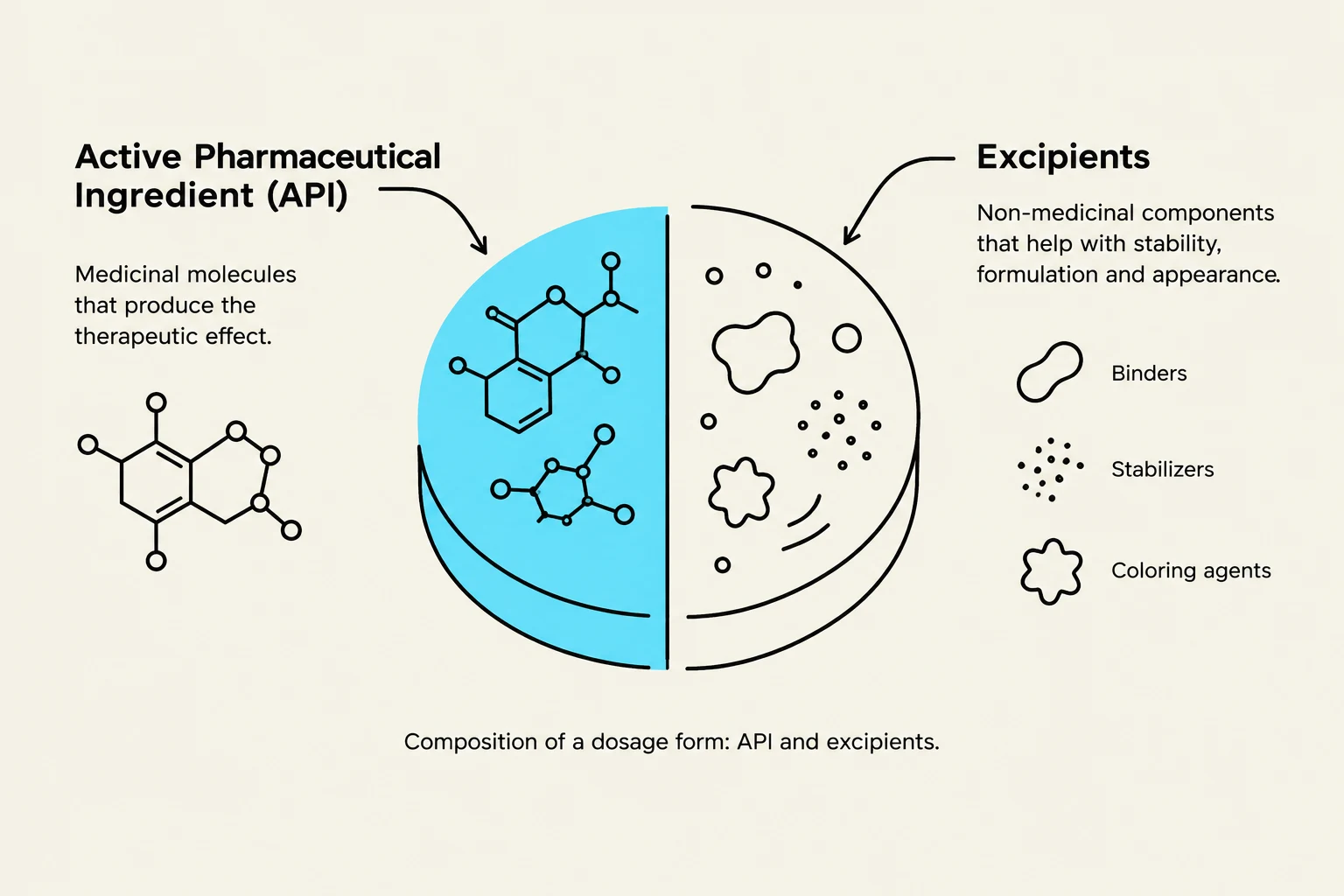
This diagram illustrates the composition of a dosage form, differentiating between the Active Pharmaceutical Ingredient (API) which provides the therapeutic effect, and excipients, which are non-medicinal components that aid in stability, formulation, and appearance. Examples of excipients include binders, stabilizers, and coloring agents.
To understand pharmacy practice, one must first define what a "drug" is. According to the federal Food and Drugs Act, a drug is any substance or mixture of substances manufactured, sold, or represented for use in the diagnosis, treatment, mitigation, or prevention of a disease, disorder, or abnormal physical state in humans or animals. This definition is broad, encompassing prescription medications, non-prescription drugs, vaccines, blood products, and even disinfectants.
A dosage form is the specific physical form in which a medication is prepared and introduced to the body. A dosage form is not just the drug itself; it is a combination of two distinct types of ingredients:
Active Pharmaceutical Ingredients (API): The medicinal ingredient responsible for the actual therapeutic effect.
Non-medicinal Ingredients (Excipients): These are substances that do not have medicinal value but are essential to the formulation. They serve various roles, such as:
Stabilizing agents: Including preservatives to prevent microbial growth or antioxidants to protect against oxidation.
Manufacturing agents: Such as binders to hold tablets together or diluents to provide bulk.
Appearance/Taste enhancers: Coloring and flavoring agents used to improve patient compliance.
Note on Purity: For certain routes, such as injections, non-medicinal ingredients must meet strict standards regarding sterility (absence of microorganisms), particulate matter (tiny solid/liquid particles that can cause contamination), and pyrogens (substances like bacterial endotoxins that induce fever and chills).
Routes of Administration and Effects
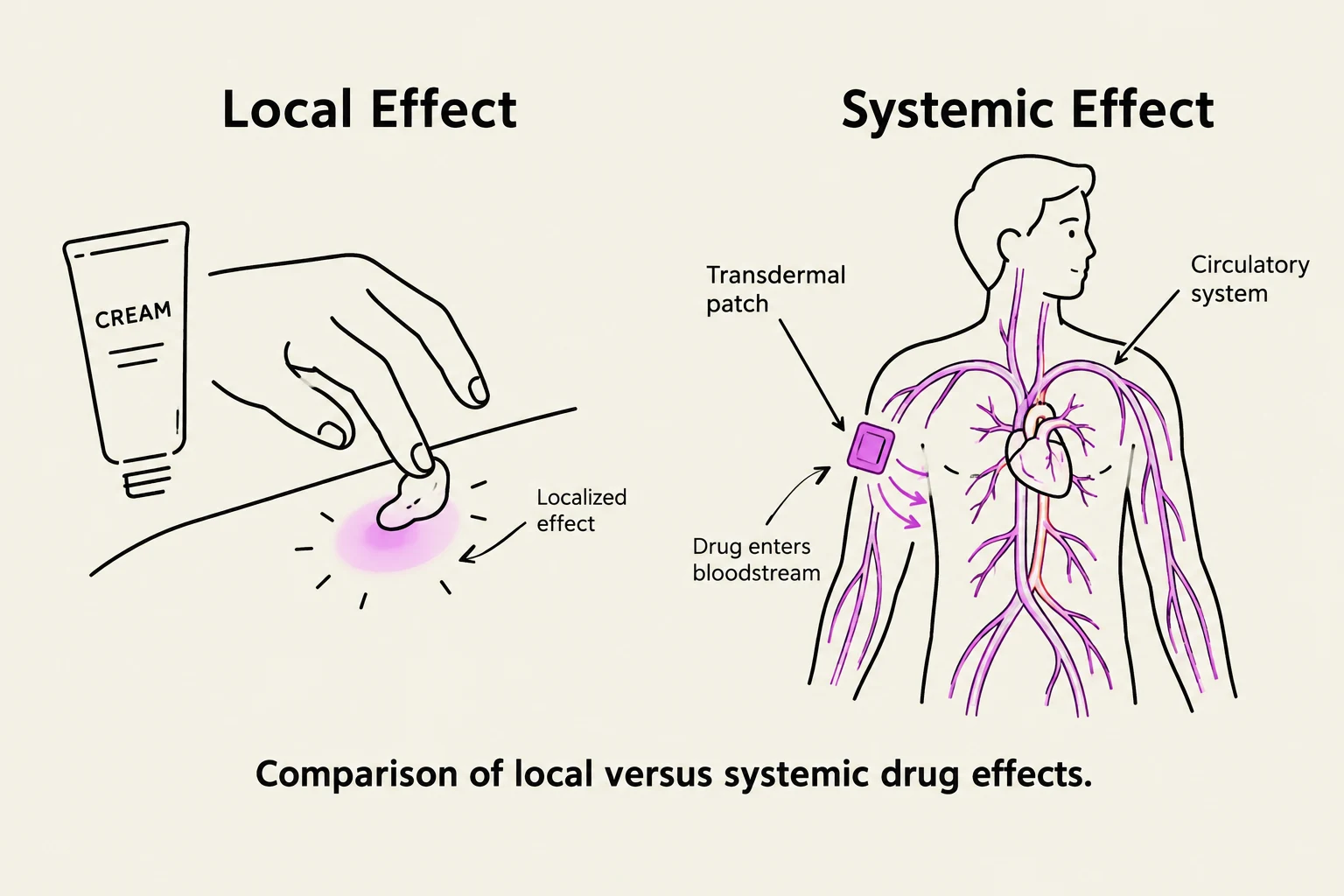
This illustration compares the local effect of a cream applied to the skin with the systemic effect of a transdermal patch, which releases medication into the bloodstream.
The route of administration is the specific pathway by which a drug is introduced into the body. Depending on the route and the formulation, a drug will produce either a local or a systemic effect.
Local vs. Systemic Effects
Local Effect: Occurs when the drug is applied directly to the site where it is needed. Examples include applying a cream to a skin rash or using eye drops for an infection.
Systemic Effect: Occurs when the drug enters the circulatory system and is transported throughout the body to reach its target site. For example, a nitroglycerin patch is applied to the skin, but the drug is absorbed into the bloodstream to relieve chest pain in the heart.
Common Routes of Administration
Route
Description
Common Dosage Forms
Oral (P.O.)
Taken by mouth; absorbed via the GI tract.
Tablets, capsules, syrups, elixirs.
Sublingual/Buccal
Under the tongue or between cheek and gum.
Tablets, troches, sprays.
Topical/Transdermal
Applied to skin; topical is for local, transdermal is for systemic.
Creams, ointments, patches.
Ophthalmic/Otic
Into the eye or ear.
Drops, ointments, inserts.
Respiratory
Inhaled into the lungs.
MDIs, Dry Powder Inhalers (DPI), nebulizers.
Rectal/Vaginal
Inserted into the rectum or vagina.
Suppositories, ovules, creams, enemas.
Parenteral
Injected into veins (IV), muscle (IM), or fat (SC).
Solutions, suspensions, emulsions.
Pharmacokinetics: How the Body Handles Drugs
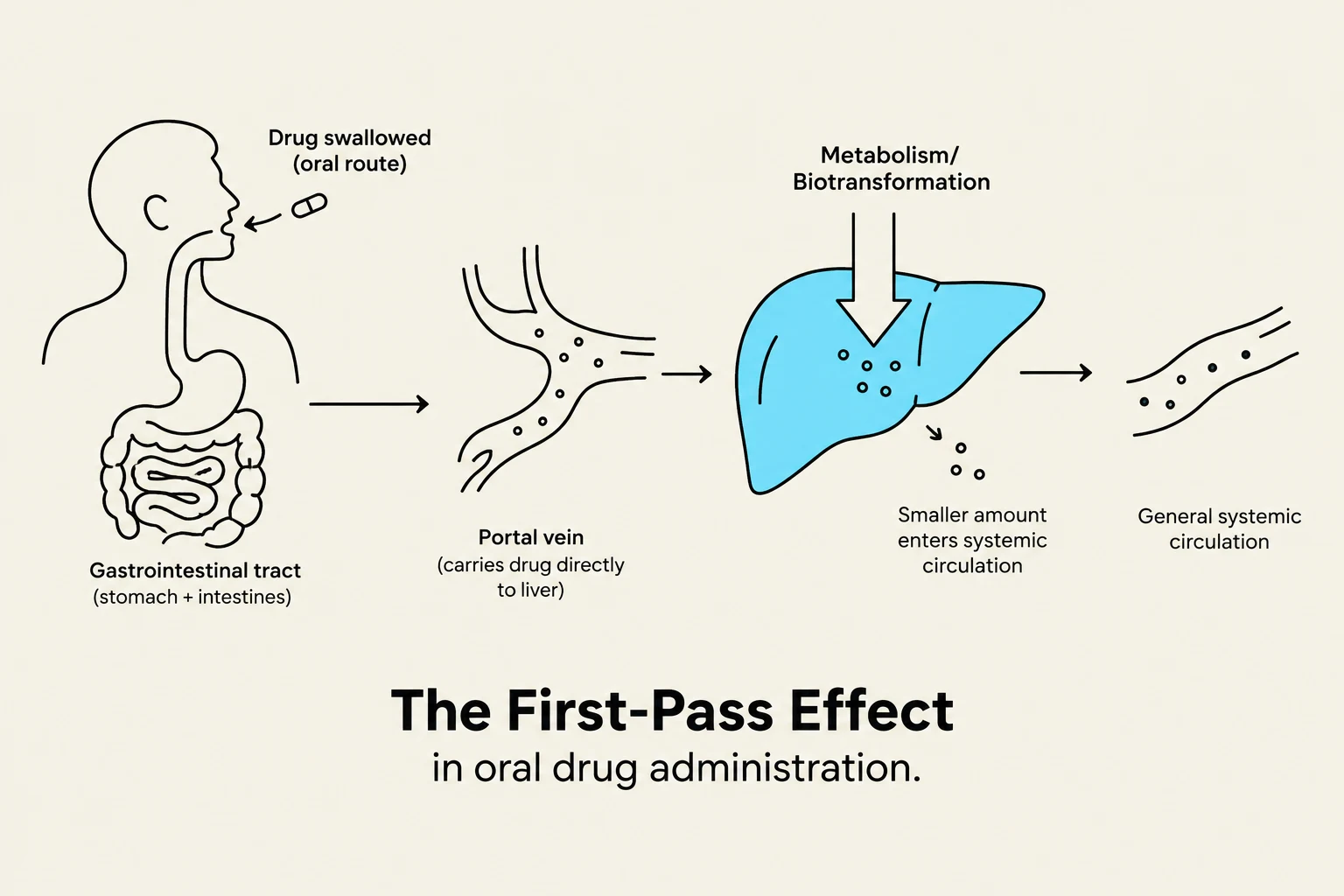
Diagram illustrating the first-pass effect in oral drug administration, showing how a drug is processed by the gastrointestinal tract and liver before entering general systemic circulation.Pharmacokinetics is the study of how a drug moves through the body. It is often summarized by the acronym ADME:
Absorption: The process by which a drug enters the bloodstream from the site of administration.
Distribution: How the drug spreads through the body via the blood to various tissues and organs.
Metabolism (Biotransformation): The chemical alteration of a drug, primarily in the liver, to make it easier to eliminate.
The First-Pass Effect: This is a critical concept for oral medications. When a drug is swallowed, it is absorbed from the gut and travels directly to the liver via the portal circulation. The liver may metabolize a significant portion of the drug before it ever reaches the rest of the body. This is why some drugs (like nitroglycerin) are given sublingually to bypass the liver and achieve faster systemic effects.
Elimination: The removal of the drug and its metabolites from the body, typically through the kidneys (urine) or liver (bile).
Understanding these processes allows healthcare providers to predict the onset of action (how long it takes for the drug to start working) and the duration of action (how long the drug remains effective).
Safety, Interactions, and Adverse Effects
Even when used as intended, drugs can cause unintended consequences.
Adverse Effects: Often called "side effects," these are undesirable or harmful effects. They can range from mild (nausea, drowsiness) to severe and life-threatening (anaphylaxis, organ damage).
Drug Interactions: This occurs when a drug's effect is altered by another substance, such as another medication, food, or alcohol. Interactions can be:
Additive: One drug enhances the effect of another.
Inhibition: One drug reduces the effectiveness of another.
Altered Metabolism/Absorption: A substance changes how the body breaks down or absorbs a drug, potentially leading to toxicity.
Exam Tip: When dealing with powdered medications that require reconstitution (adding a liquid to a powder to restore it to a liquid state), always follow the specific instructions for the solvent/diluent to ensure the correct concentration and stability.
Summary Table: Regular vs. Modified Release
Feature
Regular Release
Modified Release (ER, CR, SR)
Release Profile
Immediate release of the entire dose.
Gradual, sustained, or delayed release.
Blood Levels
Rapid rise and peak.
Relatively stable over time.
Dosing Frequency
Often requires multiple doses per day.
Often allows for less frequent dosing (e.g., once daily).
Keep reading for free.
Create an account to finish this reading and make it part of your study routine.