This review outlines the essential life functions of biological organisms, including movement, nutritional processes (ingestion, assimilation, digestion), transport, and respiration, and their corresponding body systems.
Biological organisms maintain life through a series of specialized functions and integrated body systems that manage energy, structure, and internal stability. To understand how a human body functions, one must look beyond individual organs and instead examine the fundamental processes—the "life functions"—that allow an organism to interact with its environment, acquire energy, and maintain its own structure.
This review outlines the essential life functions, ranging from the mechanical necessity of movement to the microscopic chemical reactions of respiration.
Mechanical Function: Movement
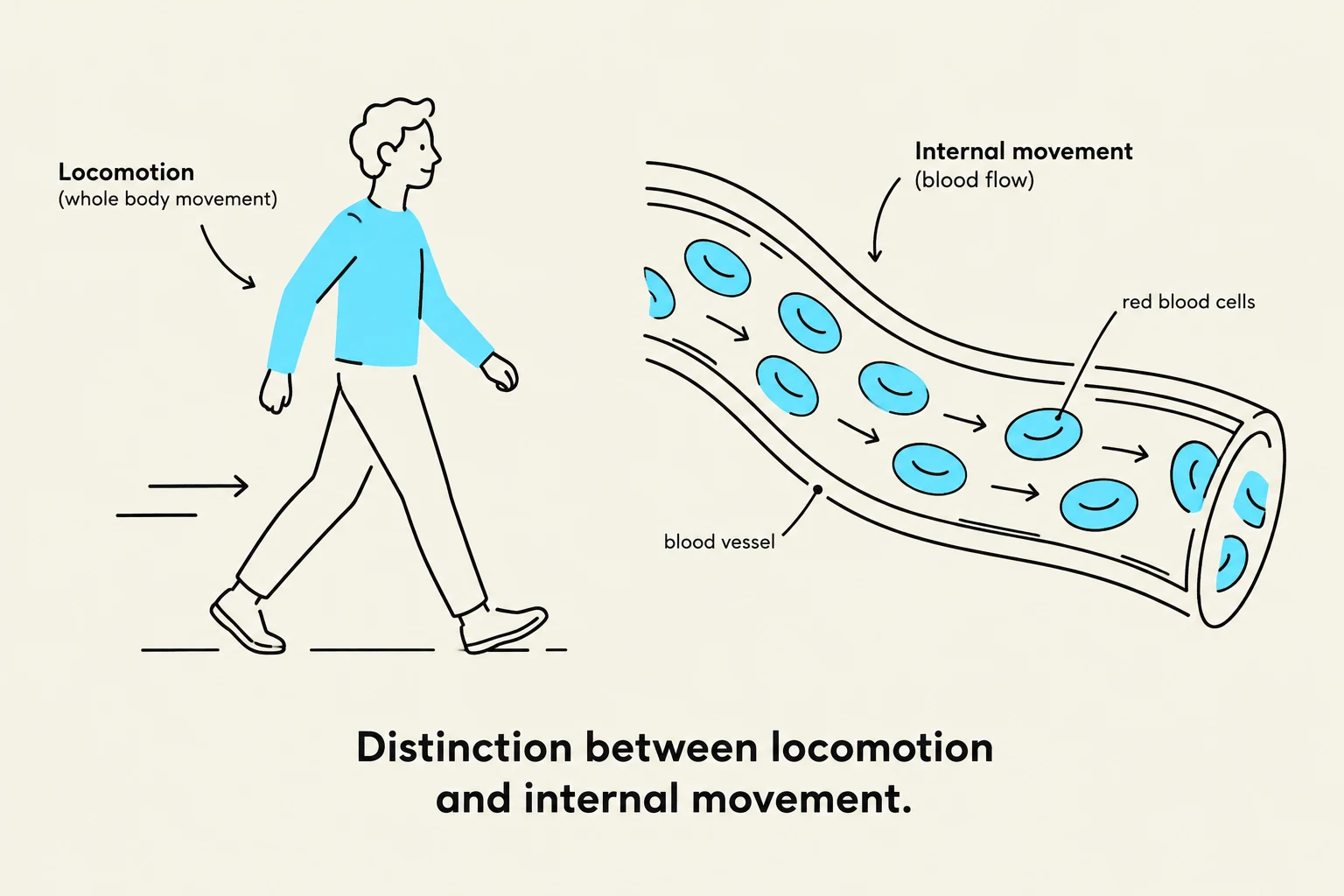
This illustration distinguishes between locomotion, which is whole-body movement, and internal movement, such as blood flow within a blood vessel.
The most visible aspect of life is the ability to change position. Movement is defined as the ability of an organism, or specific parts of an organism, to move. This can range from the locomotion of the entire body (such as walking or swimming) to the internal movement of substances within the body.
This function is primarily facilitated by the Muscle System. Muscles act as the biological engines that convert chemical energy into mechanical force, pulling on bones or other tissues to create motion.
Study Tip: When studying for exams, distinguish between "locomotion" (moving the whole body) and "internal movement" (like blood flow or muscle contractions). Both fall under the umbrella of the life function of movement.
Nutritional Processes: From Ingestion to Assimilation
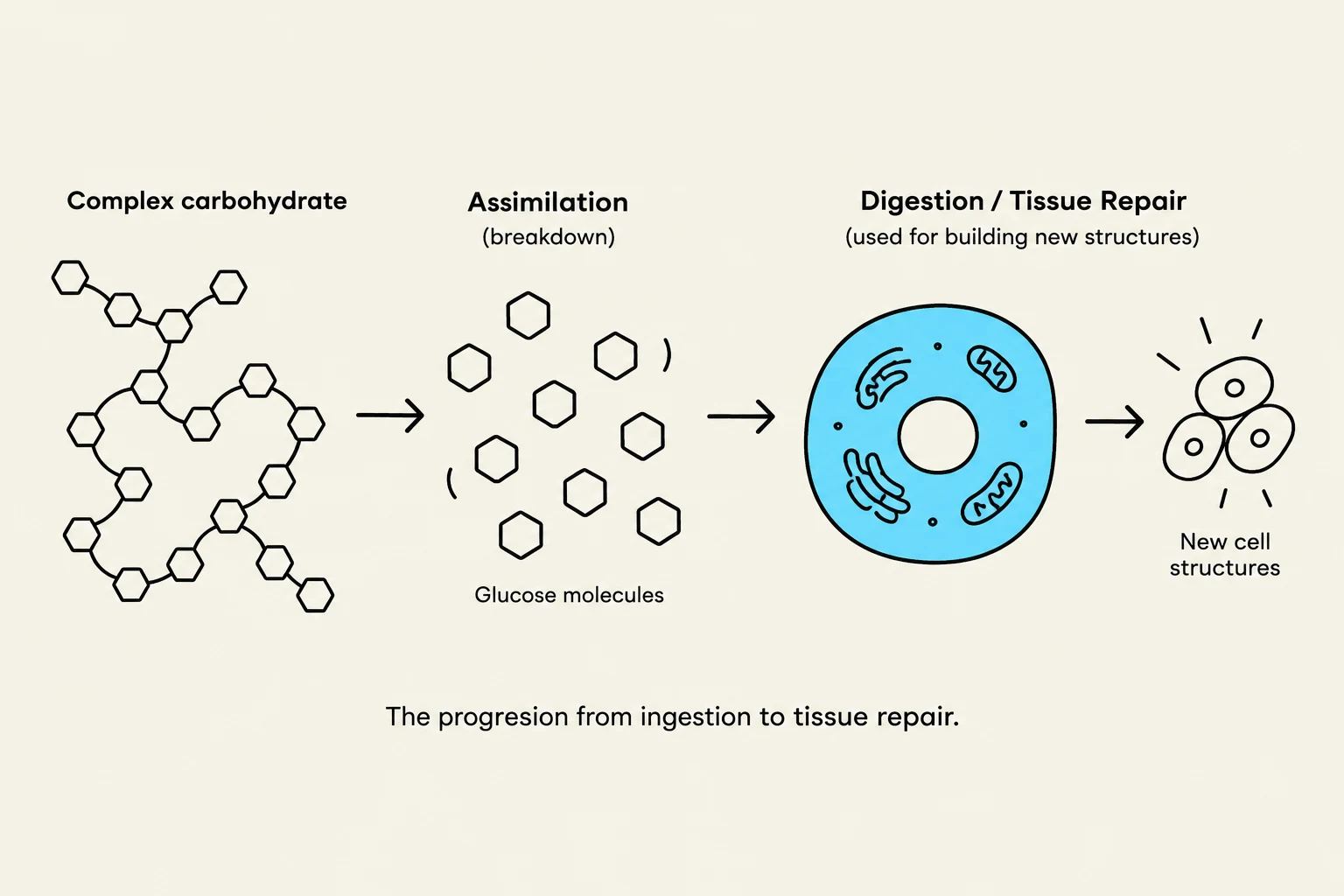
This diagram illustrates the process of how complex carbohydrates are broken down into glucose molecules, which are then used for digestion and tissue repair, leading to the formation of new cell structures.
To sustain life, organisms must acquire and process energy. This is not a single event but a multi-stage progression managed by the Digestive System. These stages ensure that the energy stored in food is converted into a form that cells can actually use.
1. Ingestion
The process begins with Ingestion, which is the initial act of taking food into the body. This is the gateway through which all external nutrients enter the biological system.
2. Assimilation
Once food is inside the body, it must undergo Assimilation. This involves the metabolic breakdown of complex food molecules into simpler, more manageable molecules. For example, a complex carbohydrate must be broken down into simple sugars like glucose before the body can utilize it effectively.
3. Digestion and Tissue Repair
While the term "digestion" is often used colloquially to describe the whole process, in a strict biological sense, it refers to the subsequent transformation of these digested food molecules into living tissue. This is a critical step for:
Growth: Adding new mass to the organism.
Self-repair: Replacing damaged cells or repairing biological structures.
Life Function
Definition
Ingestion
The process by which an organism takes in food.
Assimilation
The breakdown of complex food molecules into simpler food molecules.
Digestion
The transformation of digested food molecules into living tissue for growth and self-repair.
Transport: The Internal Logistics Network
Once nutrients are assimilated and waste products are generated, they must be moved to where they are needed. This is the role of Transport.
Transport is a two-way street involving the movement of:
Necessary substances: Moving nutrients, oxygen, and hormones to, into, and around cells.
Waste products: Moving cellular products and metabolic wastes out of and away from cells.
In the human body, this function is primarily executed by the Circulatory System. Without an efficient transport system, a cell would quickly starve or succumb to its own toxic metabolic byproducts.
Respiration: The Engine of Cellular Life
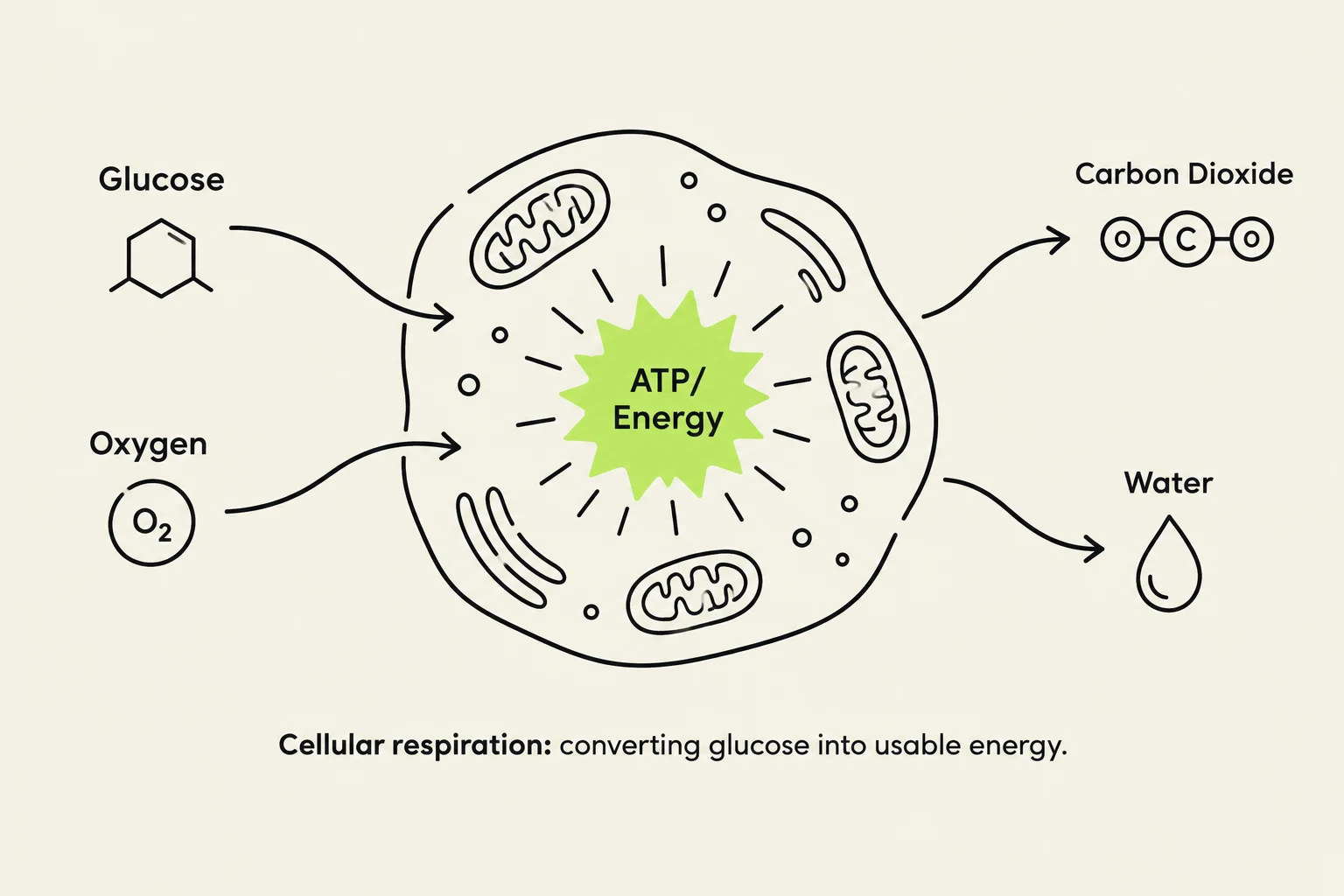
Cellular respiration: converting glucose into usable energy.
The final, and perhaps most fundamental, process is Respiration. It is important to distinguish biological respiration from the simple act of breathing (ventilation).
Respiration is a critical metabolic process involving the "burning" or oxidation of food molecules within a cell. This is a chemical reaction where the energy stored in the chemical bonds of food (like glucose) is released.
The general concept can be represented by the oxidation of glucose:
Glucose+Oxygen→Carbon Dioxide+Water+Energy (ATP)
This released energy is the "fuel" required to power every other life function mentioned above—from the contraction of a muscle to the active transport of molecules across a cell membrane.
Exam Alert: If a question asks about the "oxidation of food molecules to release energy," the answer is Respiration, not just "breathing" or "ventilation." Respiration happens at the cellular level.
Summary Table
For a quick review, refer to the following summary of the core concepts discussed:
Table 1-1: Review of the Life Functions and Body Systems
LIFE FUNCTIONS/ BODY SYSTEMS
DEFINITION
Movement
The ability of the whole organism—or a part of it—to move.
Muscle System
The mechanism facilitating movement.
Ingestion
The process by which an organism takes in food.
Assimilation
The breakdown of complex food molecules into simpler food molecules.
Digestion
The transformation of digested food molecules into living tissue for food growth and self-repair.
Digestive System
The system coordinating nutritional processes.
Transport
The movement of necessary substances to, into, and around cells, and of cellular products and wastes out of and away from cells.
Circulatory System
The system facilitating transport.
Respiration
The burning or oxidation of food molecules in a cell to release energy.
Keep reading for free.
Create an account to finish this reading and make it part of your study routine.