Research Methods in Psychology: Case Studies, Longitudinal, and Cross-Sectional Designs
An overview of key research methodologies in psychology, including in-depth case studies, long-term longitudinal studies, and snapshot cross-sectional designs. Learn about their applications, advantages, and limitations in understanding human behavior and development.
In the field of psychology, researchers are often faced with a fundamental question: how do we study the complexities of human experience? Some phenomena are so rare or unique that they require an intense, microscopic focus on a single individual, while others require us to understand how people change as they move through the stages of life. To answer these questions, psychologists employ different research architectures, most notably case studies and longitudinal designs. Understanding when to use these methods—and recognizing their inherent limitations—is essential for interpreting psychological data accurately.
The Power of the Deep Dive: Case Studies
This diagram illustrates the various components of a case study, which involves an in-depth examination of a single subject. It includes neurological scans, personal history, behavioral observations, assessment results, interviews, and genetic information.
A case study is an in-depth investigation of a single individual, a small group, or a specific event. Unlike large-scale surveys that aim to find broad patterns across thousands of people, case studies aim to uncover the "how" and "why" of a specific phenomenon.
When are Case Studies Used?
Case studies are particularly valuable in clinical psychology and neurology when studying rare conditions that could not be ethically or practically replicated in a laboratory. For example, if a patient suffers a unique type of brain injury that affects only their ability to process syntax but leaves their vocabulary intact, a case study allows researchers to observe the specific mechanics of that deficit in a way a general population study never could.
Pros and Cons of Case Studies
Feature
Advantages
Disadvantages
Depth
Provides rich, qualitative detail and nuanced understanding of complex issues.
Can be extremely time-consuming and resource-intensive.
Hypothesis Generation
Often serves as a starting point for creating new theories or hypotheses.
Findings are often idiosyncratic and cannot be easily generalized to the public.
Rare Phenomena
Allows for the study of rare diseases or unique life experiences.
Subject to researcher bias; the observer's interpretation may color the data.
Exam Tip: If a question asks about a research method used to study a "unique" or "rare" occurrence where a large sample size is impossible, the answer is almost certainly a case study. Remember that while case studies are great for generating hypotheses, they lack external validity (the ability to apply findings to the general population).
Tracking Development: Longitudinal vs. Cross-Sectional Designs
When psychologists want to study how humans change over time—such as how cognitive abilities evolve from childhood to adulthood—they must choose between two primary temporal strategies: longitudinal designs and cross-sectional designs.
Longitudinal Designs: The Long View
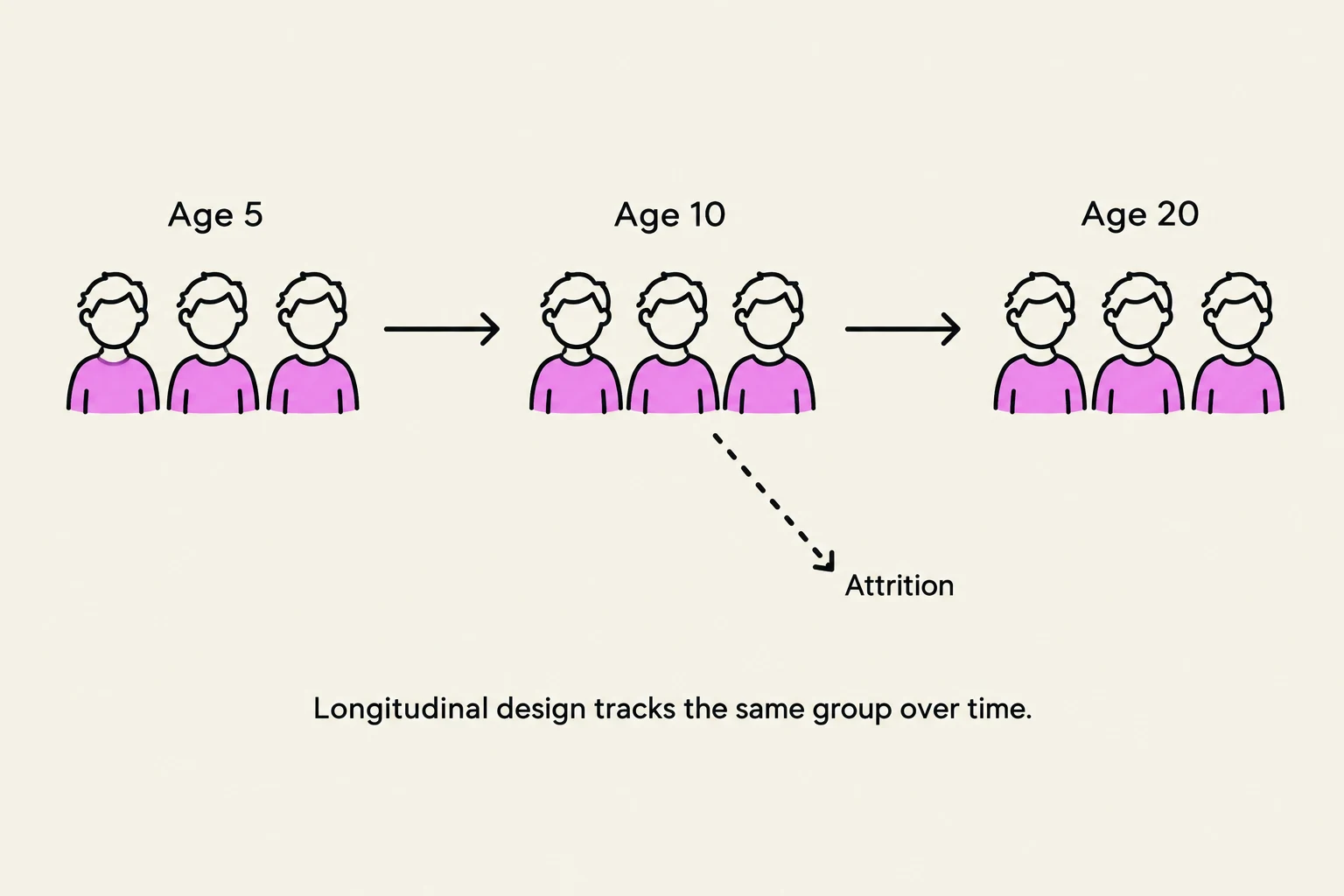
This diagram illustrates a longitudinal study design, showing how a group of individuals is tracked over time from age 5 to age 20, with a note on attrition.
A longitudinal design involves following the same group of participants over an extended period of time. Researchers might test a group of five-year-olds, then revisit that exact same group when they are ten, fifteen, and twenty years old.
The Primary Advantage:
The greatest strength of the longitudinal design is its ability to track individual change. Because you are measuring the same people, you can see how specific variables (like sleep patterns or educational interventions) correlate with developmental outcomes in that specific cohort. It provides a clear picture of the trajectory of development.
The Challenges:
Attrition: This is the most significant hurdle. Over many years, participants may drop out of the study due to moving, loss of interest, or death. If only the healthiest or most motivated people remain, the final data may be biased.
Practice Effects: Participants may become "better" at the tests simply because they have taken them multiple times, which can artificially inflate scores.
Cost and Time: These studies require immense patience and funding, as results may not be available for decades.
Cross-Sectional Designs: The Snapshot
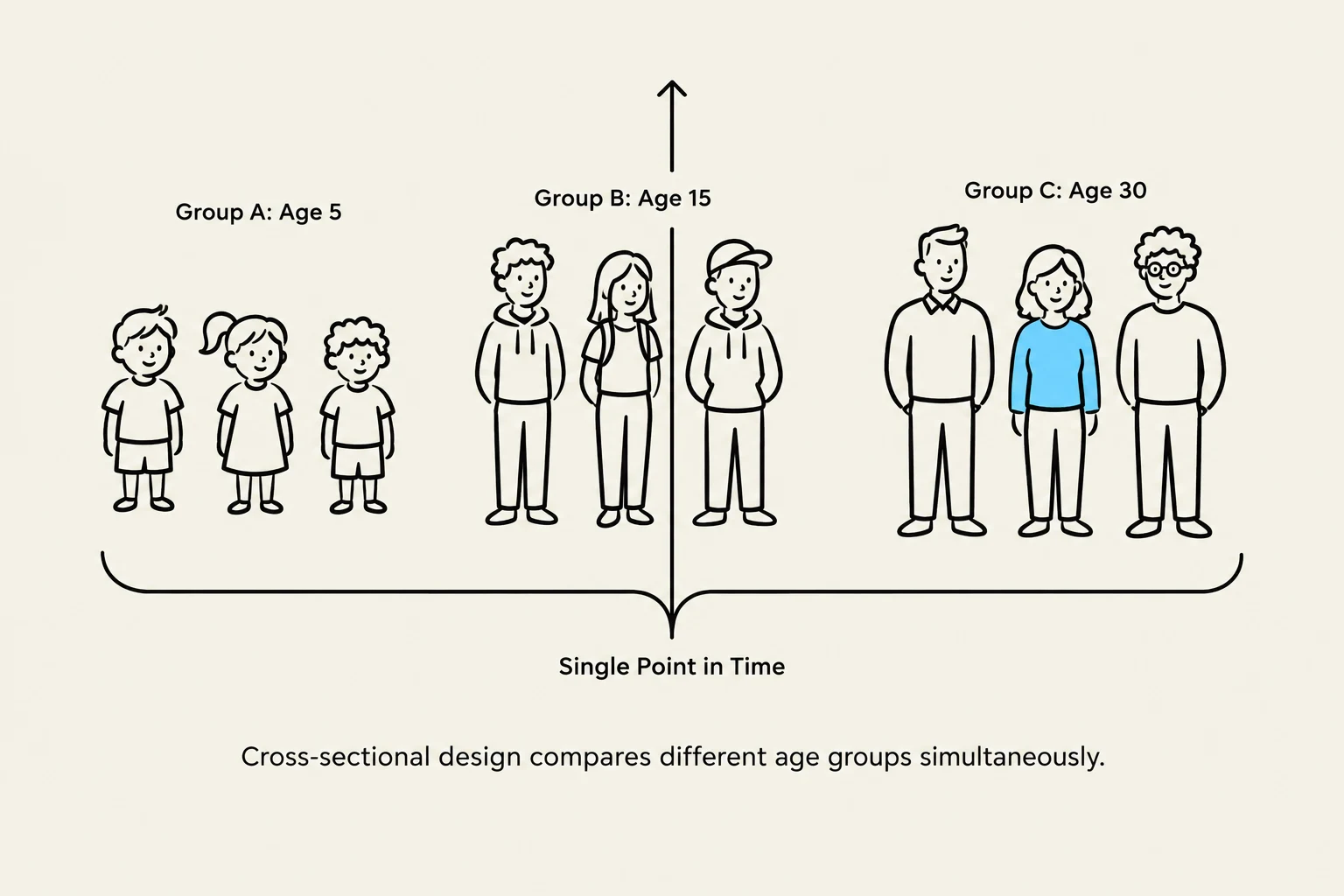
This illustration depicts a cross-sectional study design, which compares different age groups at a single point in time. It shows three groups: Group A (age 5), Group B (age 15), and Group C (age 30).
In contrast, a cross-sectional design compares different groups of people of different ages at a single point in time. Instead of waiting 10 years to see how a child grows, a researcher might study a group of 5-year-olds, a group of 10-year-olds, and a group of 15-year-olds all in the same month.
The Primary Advantage:
Cross-sectional studies are fast and inexpensive. They provide an immediate "snapshot" of age-related differences across a population.
The Challenge: The Cohort Effect:
The biggest pitfall of cross-sectional research is the cohort effect. A cohort is a group of people born around the same time who share similar historical or cultural experiences. If you compare 70-year-olds to 20-year-olds today, the differences you see might not be due to biological aging, but rather to the fact that the 70-year-olds grew up in a different technological era or had different nutritional standards.
Summary Comparison
To choose the right method, a researcher must balance the need for depth against the need for breadth and speed.
Case Study: Best for depth and rare phenomena; low generalizability.
Longitudinal: Best for tracking individual change over time; high cost and risk of attrition.
Cross-Sectional: Best for quick comparisons across ages; risk of cohort effects.
By understanding these distinctions, researchers can better design studies that minimize bias and maximize our understanding of the human condition.
Keep reading for free.
Create an account to finish this reading and make it part of your study routine.