Research Methods in Industrial-Organizational Psychology
This article explores the foundational steps of the research process in Industrial-Organizational (I-O) psychology, including literature reviews, research settings (laboratory vs. field), and core research methods such as true experiments, quasi-experiments, and archival research.
Industrial-Organizational (I-O) psychology is defined by the application of psychological principles to the workplace. Because I-O psychologists follow a "scientist-practitioner" model, they must be experts in both analyzing scientific data and applying those findings to solve real-world organizational challenges. To do this effectively, one must understand how evidence is gathered, evaluated, and applied. This article explores the foundational steps of the research process, the settings in which research occurs, and the specific methods used to establish scientific evidence.
The Starting Point: Literature Reviews and High-Quality Evidence
Before a researcher can collect new data, they must understand what is already known. This initial step is known as a literature review. A literature review involves searching for and reading previous research relevant to a specific site or problem, typically utilizing online databases (such as APA PsycInfo) or university libraries.
Not all information is created equal. In I-O psychology, the highest quality evidence is found in peer-reviewed research articles. These articles undergo a rigorous evaluation process by experts in the field to ensure the methodology and conclusions are sound. Within these journals, you will encounter two primary types of articles:
Empirical Articles: These are the "bread and butter" of research. They involve the actual collection and analysis of new data to test a specific hypothesis.
Review Articles: Rather than presenting new data, these articles synthesize existing literature to provide a comprehensive overview of the current state of knowledge on a specific topic.
Study Tip: When working on consulting projects, always prioritize peer-reviewed empirical articles over general websites or opinion pieces. If you find a "review article," use its reference list as a roadmap to find the original empirical studies it discusses.
Research Settings: Laboratory vs. Field Research
I-O research is generally conducted in one of two environments, each presenting a unique trade-off between control and realism.
Laboratory Research
Laboratory research takes place in highly controlled environments, such as a university research lab. The primary advantage of this setting is high internal validity—the level of confidence that a specific manipulation (the cause) actually produced the observed effect. Because researchers can control for "extraneous variables" (distractions or outside influences), they can be more certain about cause-and-effect relationships. However, lab research often suffers from low external validity, meaning the results might not translate to the messy, unpredictable real world.
This diagram illustrates the inverse relationship between internal and external validity in research. High internal validity, characterized by a controlled setting, random assignment, and few confounds, provides strong evidence that an effect is real. Conversely, high external validity, found in natural settings with diverse participants and more real-world factors, is less certain that the effect is due solely to the variables studied.
Field Research
Field research occurs in natural settings, such as an actual organization or an assembly line. This setting offers high external validity because the phenomena are being studied in their true context. The downside is lower internal validity; because researchers cannot control everything happening in a real company, it is harder to prove that one specific variable caused a change. Fortunately, in I-O psychology, laboratory results tend to be quite predictive of field results.
Core Research Methods
To move beyond simple observation, I-O psychologists use specific experimental and non-experimental designs to establish evidence.
The True Experiment
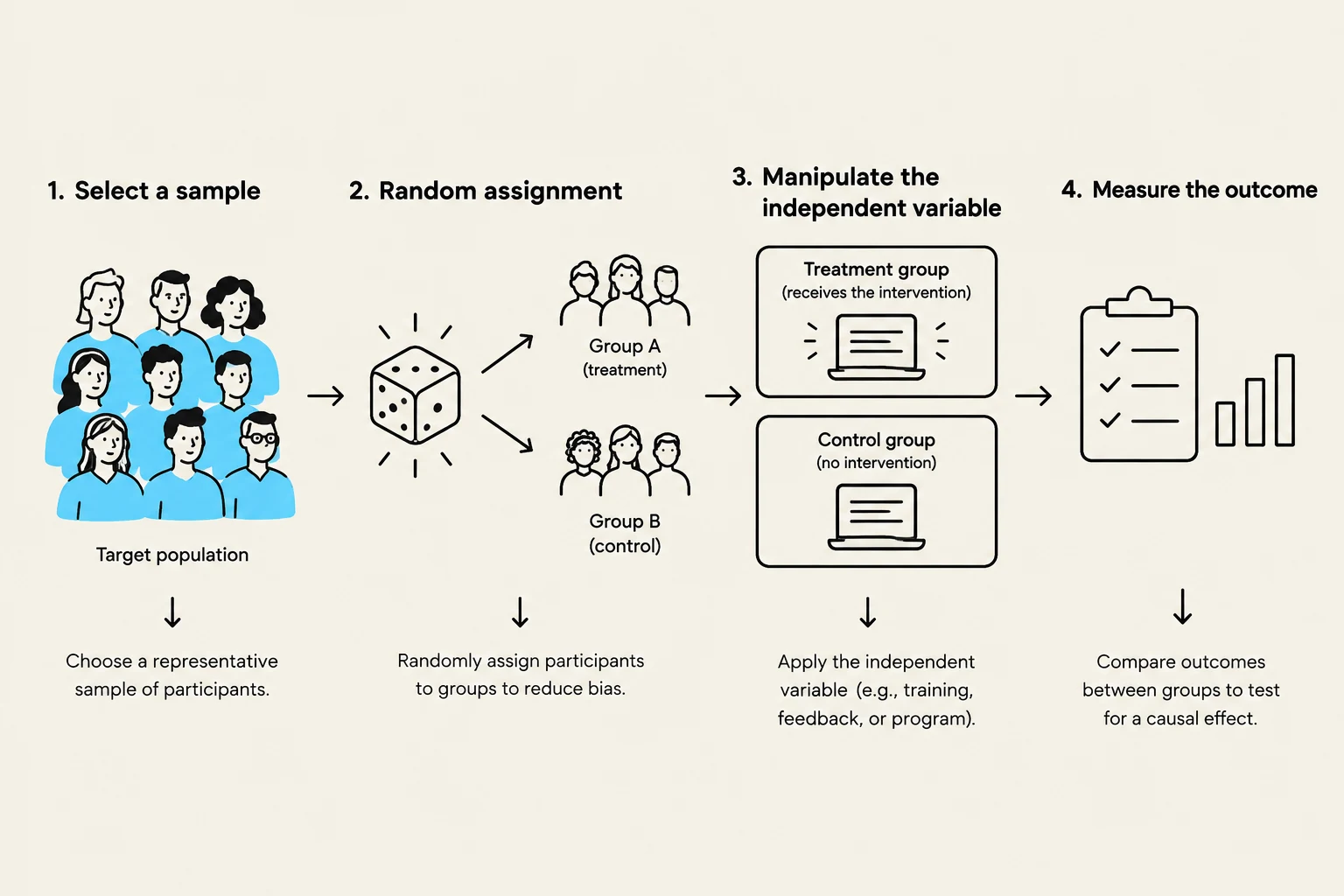
A true experiment is the gold standard for establishing cause-and-effect relationships. To qualify as a true experiment, a study must include two critical components:
Manipulation of Variables: The researcher actively changes an independent variable (the presumed cause) to see how it affects a dependent variable (the outcome being measured).
Random Assignment: Participants must be randomly assigned to different conditions (e.g., a training group vs. a control group). This ensures that any differences found between groups are due to the manipulation rather than pre-existing differences between the people in those groups.
This diagram illustrates the four key steps of a controlled experiment: selecting a sample from a target population, randomly assigning participants to a treatment or control group, manipulating the independent variable for the treatment group, and measuring the outcome to test for a causal effect.
Quasi-Experiments
In many organizational settings, a true experiment is impossible or unethical. For example, you cannot randomly assign people to "low education" or "high education" groups because those characteristics already exist. In these cases, researchers use quasi-experiments.
Quasi-experiments examine changes in an independent variable but lack the element of random assignment. Common types include:
Pre-existing Characteristics: Studying groups based on traits they already have (e.g., age or department).
Intervention Studies: Comparing two different groups where the researcher cannot control who goes into which group (e.g., comparing two different factory departments).
Before-and-After Designs: Measuring the same group of people before and after a specific event or change.
While quasi-experiments are incredibly useful, they cannot definitively establish cause-and-effect because "confounding factors" (uncontrolled variables) might be responsible for the results.
Archival Research
Finally, researchers often use archival research, which involves analyzing existing data that was previously collected by an organization for other purposes. An example would be an I-O psychologist analyzing company records to compare error rates between different work shifts. This method is efficient but relies entirely on the quality of the data originally recorded.
Summary Table: Methodological Comparison
Method
Random Assignment?
Cause-and-Effect?
Best Use Case
True Experiment
Yes
High Confidence
Testing new training methods in a lab
Quasi-Experiment
No
Moderate Confidence
Studying the impact of a new policy in a specific department
Archival Research
N/A
Low Confidence
Analyzing historical turnover rates
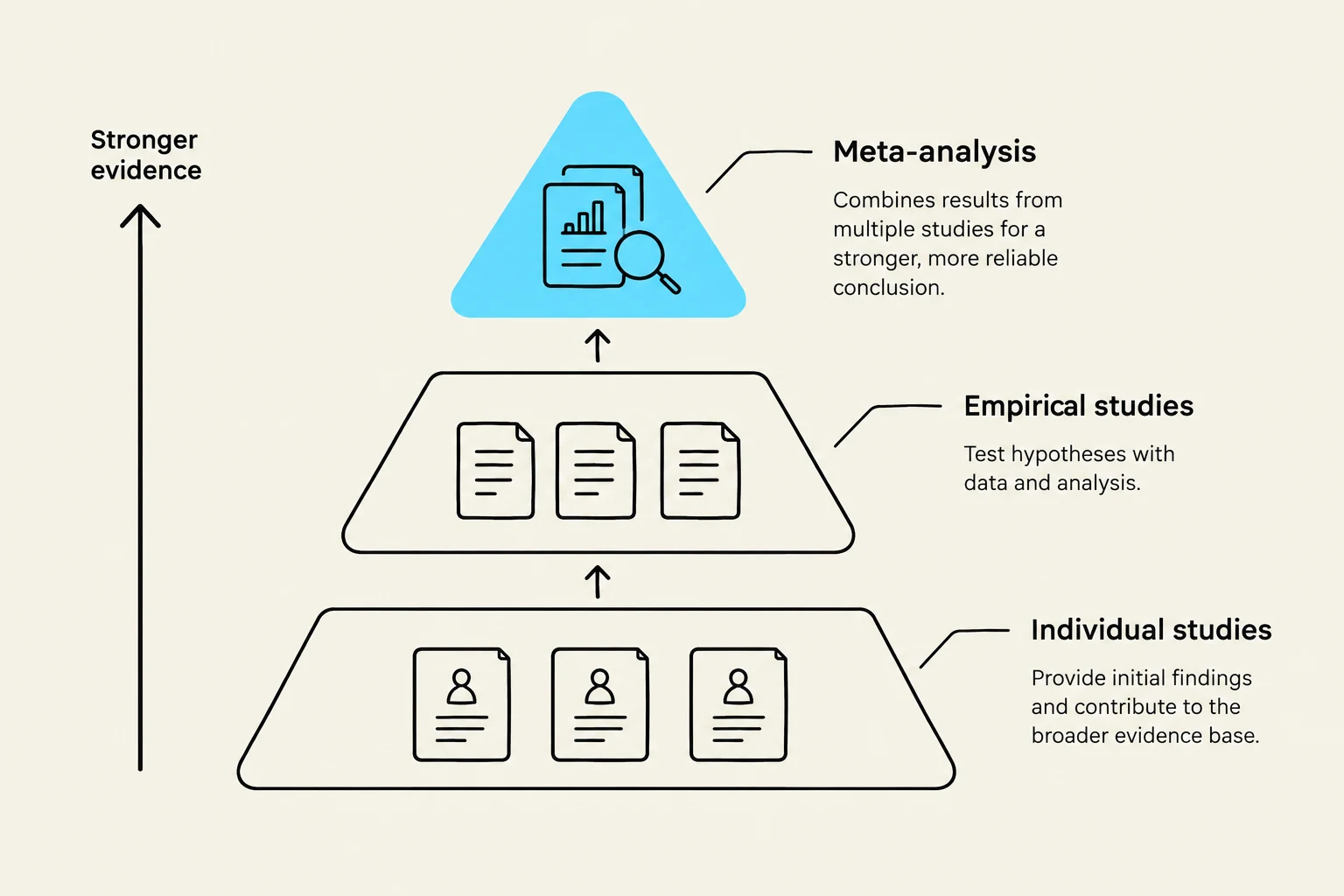
This diagram illustrates a hierarchy of evidence, showing how individual studies contribute to empirical studies, which in turn form the basis for meta-analyses that yield stronger conclusions.
Conclusion
Understanding these methods allows I-O psychologists to navigate the complexities of the workplace. Whether through the controlled precision of a laboratory experiment or the practical reality of field research, the goal remains the same: to use scientific rigor to improve the lives and productivity of people at work.
Keep reading for free.
Create an account to finish this reading and make it part of your study routine.