Reliability in the Lab: The Foundation of Scientific Integrity
This reading explains the critical role of reliability in scientific research, focusing on technical precision, personal dependability, adherence to protocols, and effective communication. It highlights how these factors contribute to reproducibility and the overall integrity of scientific findings.
In the scientific community, the value of a discovery is not determined solely by its novelty, but by its reproducibility. If an experiment cannot be repeated with the same results by different researchers, the original finding loses its scientific standing. At the heart of this reproducibility lies a single, critical trait: reliability. Being a reliable lab member means more than just showing up on time; it involves a disciplined commitment to following protocols, maintaining meticulous records, and communicating effectively with your team.
The Pillars of Reliability
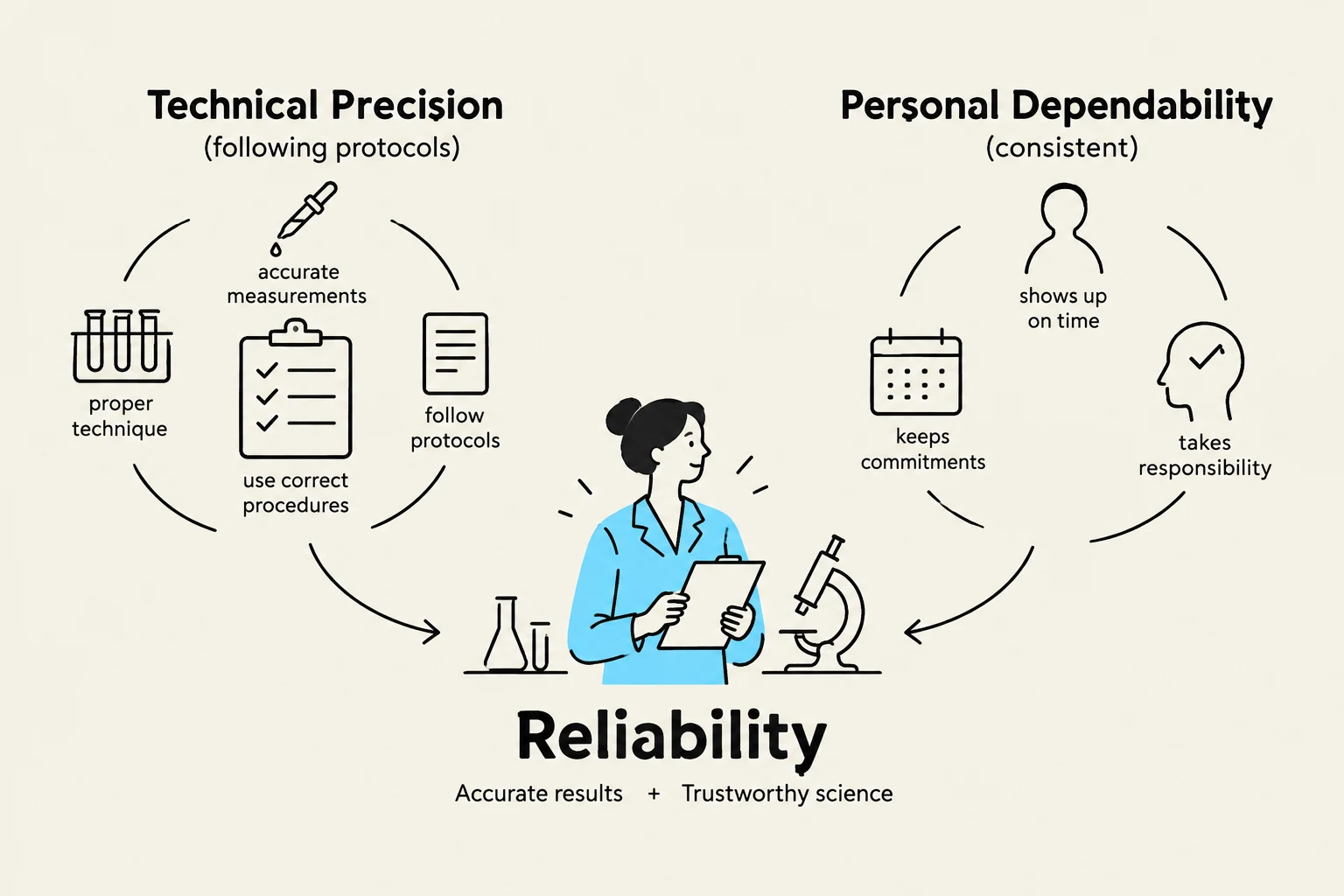
Reliability in a laboratory setting is built upon two main pillars: technical precision and personal dependability. Technical precision refers to the ability to execute a protocol exactly as written, ensuring that variables are controlled and measurements are accurate. Personal dependability refers to the consistency of the researcher—the assurance that when a task is assigned, it will be completed thoroughly and according to the established standards of the lab.
When these two pillars are strong, the "noise" in experimental data decreases. In scientific terms, we want to minimize the error associated with human performance so that we can clearly see the signal of the phenomenon we are studying.
This diagram illustrates the concept of reliability in science, breaking it down into two key components: Technical Precision and Personal Dependability. Technical Precision involves proper technique, accurate measurements, using correct procedures, and following protocols. Personal Dependability encompasses showing up on time, keeping commitments, and taking responsibility. Together, these elements contribute to accurate results and trustworthy science.
Following Protocols: Why "Close Enough" Isn't Enough
A laboratory protocol is a standardized set of instructions designed to ensure that an experiment is performed consistently. To a novice, a protocol might seem like a mere suggestion, but to a professional, it is a strict requirement. Deviating from a protocol—even slightly—can introduce confounding variables that invalidate the entire dataset.
Consider the following scenario involving temperature control in a chemical reaction. If a protocol specifies a reaction temperature of T=37.0∘C±0.5∘C, but a researcher decides that 38∘C is "close enough," they may inadvertently trigger a side reaction or accelerate the reaction rate beyond the intended parameters.
Mathematically, the impact of error can be viewed through the lens of variance. If we consider the measured value x as a function of the true value μ and an error term ϵ:
x=μ+ϵ
If the error ϵ is inconsistent due to a lack of protocol adherence, the variance σ2 increases, making it much harder to achieve statistical significance in your results.
Exam Tip: If a question asks why a researcher should strictly follow a written protocol even when they believe they know a "faster" way, the answer is almost always related to minimizing uncontrolled variables and ensuring reproducibility.
Communication and the Chain of Reliability
Reliability is not an isolated trait; it is a social one. A laboratory is a collaborative ecosystem where the work of one person often provides the foundation for the next person's experiment. Effective communication is the "glue" that holds this ecosystem together.
This includes:
Reporting Deviations: If you accidentally spill a reagent or if a piece of equipment makes a strange noise, you must report it immediately. Hiding a mistake is a violation of scientific integrity and can lead to weeks of wasted effort for your colleagues.
Data Transparency: Keeping clear, legible, and honest lab notebooks ensures that others can follow your logic and verify your steps.
Interpersonal Coordination: Being aware of shared resources (like pipettes, centrifuges, or reagents) and communicating your schedule prevents bottlenecks and errors in resource management.
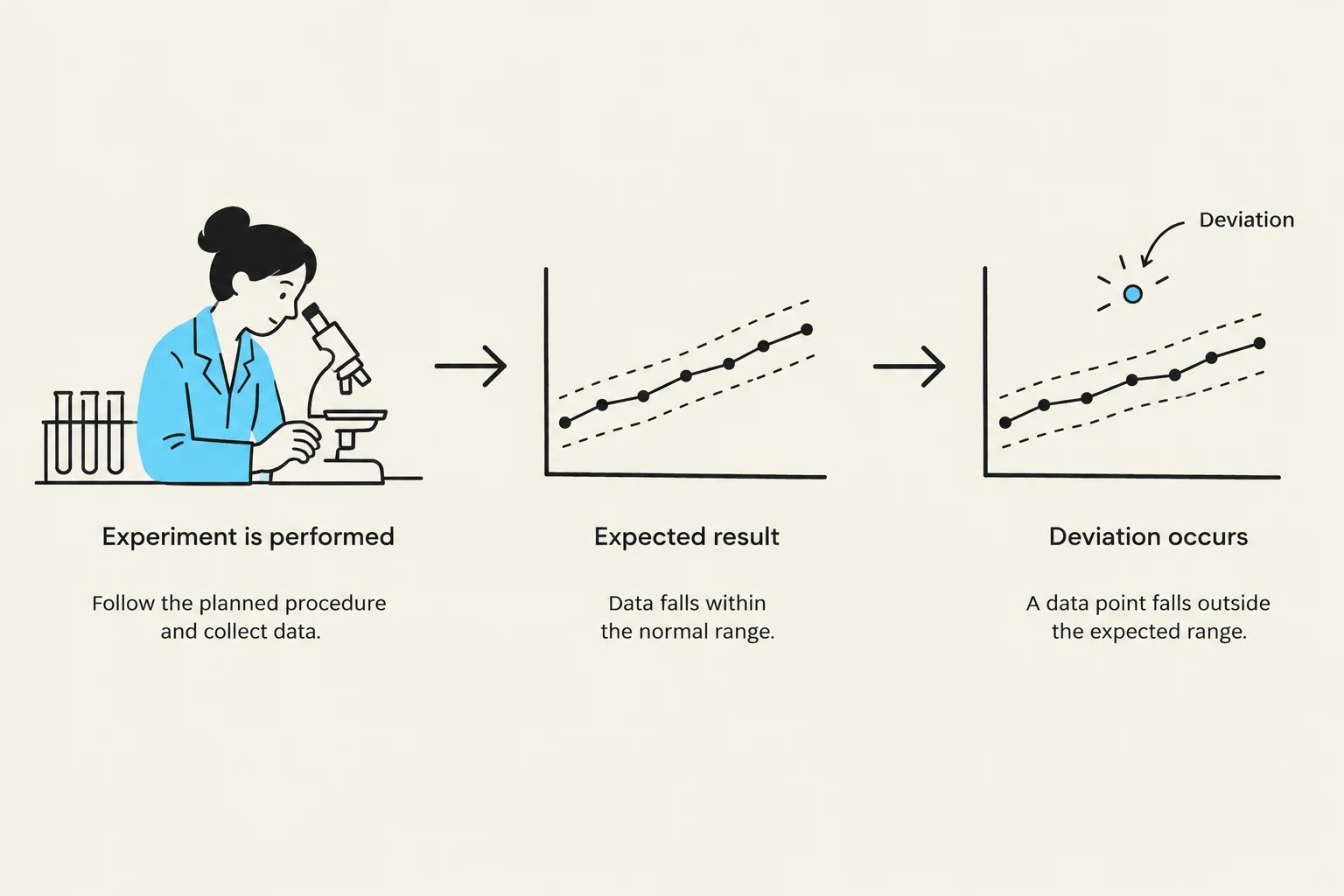
Illustration showing the process of an experiment, an expected result within a normal range, and a deviation where a data point falls outside the expected range.
Worked Example: The Cost of Unreliability
Imagine a lab working on a long-term cell culture study. The protocol requires the media to be changed every 48 hours at a specific pH.
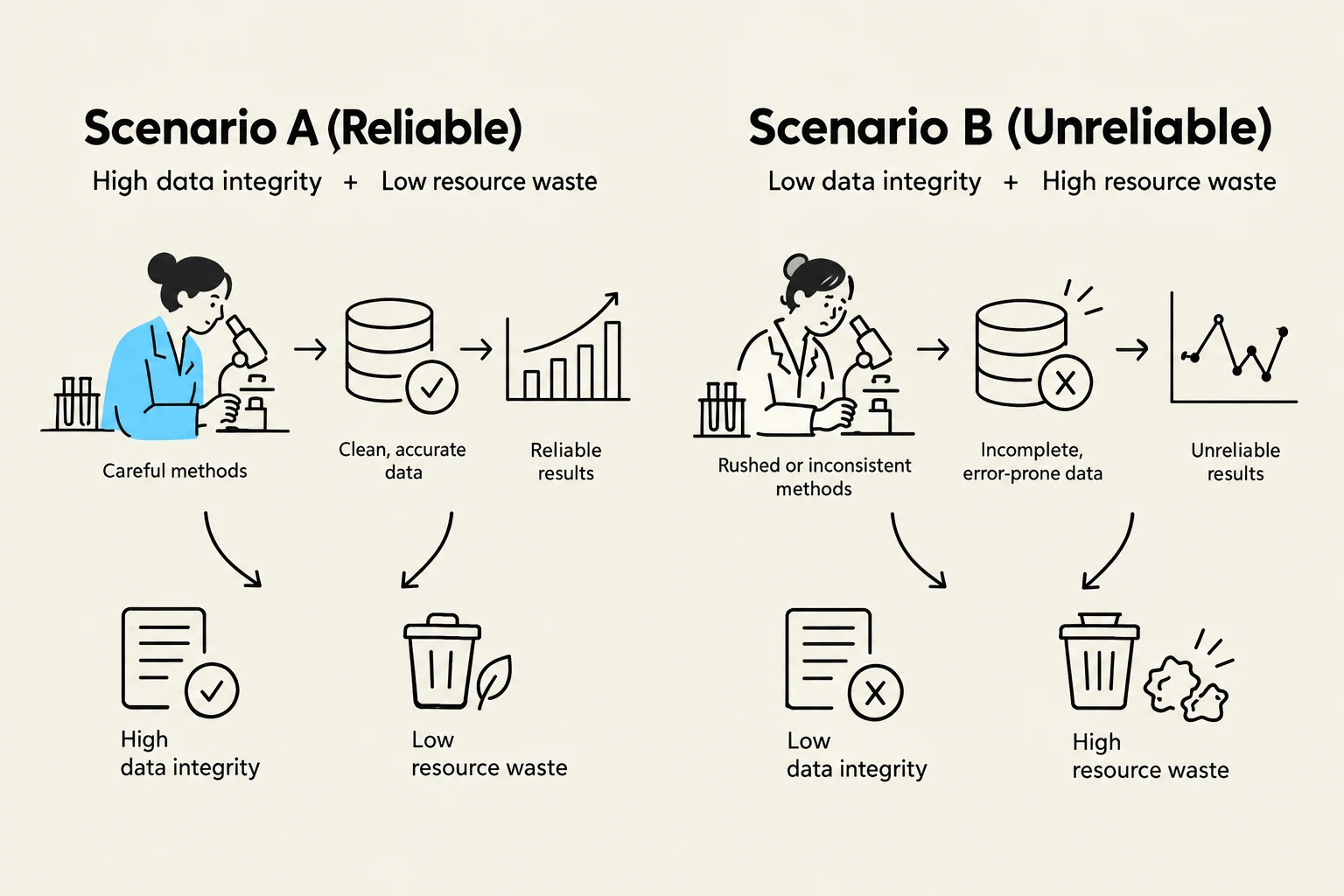
Scenario A (Reliable): Researcher A follows the protocol. They notice the incubator's CO2 levels are fluctuating slightly and report it to the Lab Manager. The sensor is recalibrated. The data remains clean and the experiment continues.
Scenario B (Unreliable): Researcher B decides to change the media at 60 hours because they were busy. They don't mention the delay. Two weeks later, the team notices the cells are dying. They spend three weeks troubleshooting "mysterious" cell death, only to realize it was caused by the nutrient depletion during the 12-hour delay.
In Scenario B, the lack of reliability resulted in:
Wasted Time: Three weeks of labor lost.
Wasted Resources: Expensive reagents and cell lines destroyed.
False Conclusions: The team might have incorrectly concluded that a specific drug was toxic to the cells, when in fact, it was just the timing of the media change.
This diagram illustrates two scenarios: Scenario A, where careful methods lead to clean data, reliable results, high data integrity, and low resource waste; and Scenario B, where rushed methods result in incomplete data, unreliable results, low data integrity, and high resource waste.
Summary Checklist for Lab Reliability
To ensure you are contributing to a reliable scientific environment, ask yourself these questions before and after every session:
Do I fully understand the protocol? If not, I must ask for clarification before starting.
Am I recording everything? This includes successes, failures, and even "minor" deviations.
Is my workspace organized? A cluttered workspace is a breeding ground for cross-contamination and errors.
Have I communicated my needs and findings? If I used the last of a reagent or if a machine is acting up, does the team know?
By mastering these habits, you transition from being someone who simply "does experiments" to being a scientist whose work can be trusted by the global community.
Keep reading for free.
Create an account to finish this reading and make it part of your study routine.