Regulation of Cyclin-CDK Activity and the Cell Cycle
Explains the fundamental mechanisms of cell cycle control in eukaryotes, focusing on the roles of Cyclin-Dependent Kinases (CDKs), cyclins, inhibitors, and ubiquitin ligases in regulating cell division.
The cell cycle is a highly orchestrated sequence of events that ensures a cell divides accurately, passing on a complete and undamaged set of genetic information to its daughter cells. This process is governed by a set of master regulators known as Cyclin-Dependent Kinases (CDKs). While CDKs are the engines of the cell cycle, they cannot function alone; they require specific regulatory subunits and a complex network of degradation machinery to ensure that the cycle moves forward in a unidirectional, controlled manner.
The Core Engine: CDKs and Cyclins
At the heart of cell cycle control is the interaction between CDKs and proteins called cyclins. CDKs are kinases—enzymes that phosphorylate target proteins to change their activity—but they are generally inactive on their own. To become active, a CDK must bind to a specific cyclin.
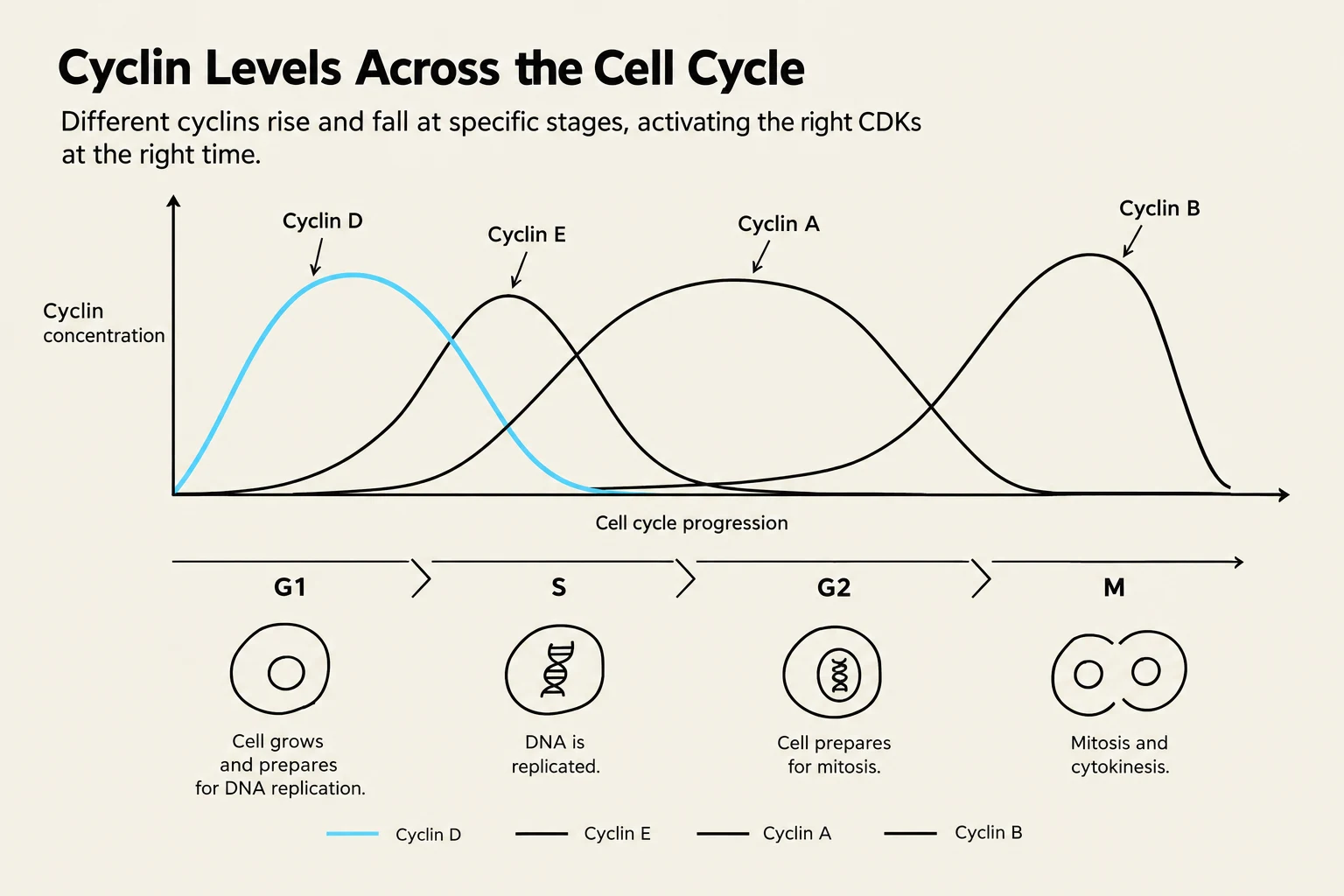
The relationship between these two is characterized by specificity and timing. Each type of cyclin is expressed at a particular stage of the cell cycle (such as G1, S, or M phase), where it binds to its partner CDK to trigger the transitions to the next stage. Once a stage is completed, the cyclin is rapidly degraded, effectively "turning off" that specific CDK activity so the cell can move forward.
Exam Tip: Remember that while cyclin levels fluctuate significantly throughout the cycle, the concentration of the CDK itself often remains relatively constant. The "switch" is the cyclin.
This graph illustrates the cyclical changes in cyclin concentrations throughout the cell cycle, correlating with different stages of cell growth, DNA replication, and division.
Fine-Tuning Activity: Inhibitors and Phosphorylation
Beyond the presence of cyclins, the cell employs additional layers of regulation to prevent premature division or to halt the cycle if errors are detected.
CDK Inhibitors: These are specialized proteins that bind directly to CDK-cyclin complexes to block their kinase activity. They act as molecular brakes, often in response to DNA damage or other cellular stressors.
Phosphorylation: The activity of an individual CDK/cyclin complex can be further modulated by adding or removing phosphate groups via other kinases and phosphatases. This allows for rapid, reversible control of the engine's power.
The Destruction Machinery: E3 Ubiquitin Ligases
For the cell cycle to progress, the cell must not only activate certain proteins but also destroy others. This is achieved through the ubiquitin-proteasome system, which marks specific proteins for destruction. This process involves a cascade of three enzymes:
E1 (Ubiquitin-activating enzyme): Uses ATP to "grab" and activate a single ubiquitin molecule.
E2 (Ubiquitin-conjugating enzyme): Acts as an intermediate that carries the activated ubiquitin to the E3 ligase.
E3 (Ubiquitin ligase): The most critical component for specificity. The E3 ligase binds both the E2-ubiquitin complex and the specific target protein, facilitating the transfer of ubiquitin onto the target.
Once a protein is tagged with a chain of ubiquitin molecules, it is recognized and degraded by the proteasome.
Orchestrating Transitions: SCF and APC/C
Two major E3 ubiquitin ligases act as the primary "executioners" that drive the cell through its most critical checkpoints:
The G1/S Transition and SCF
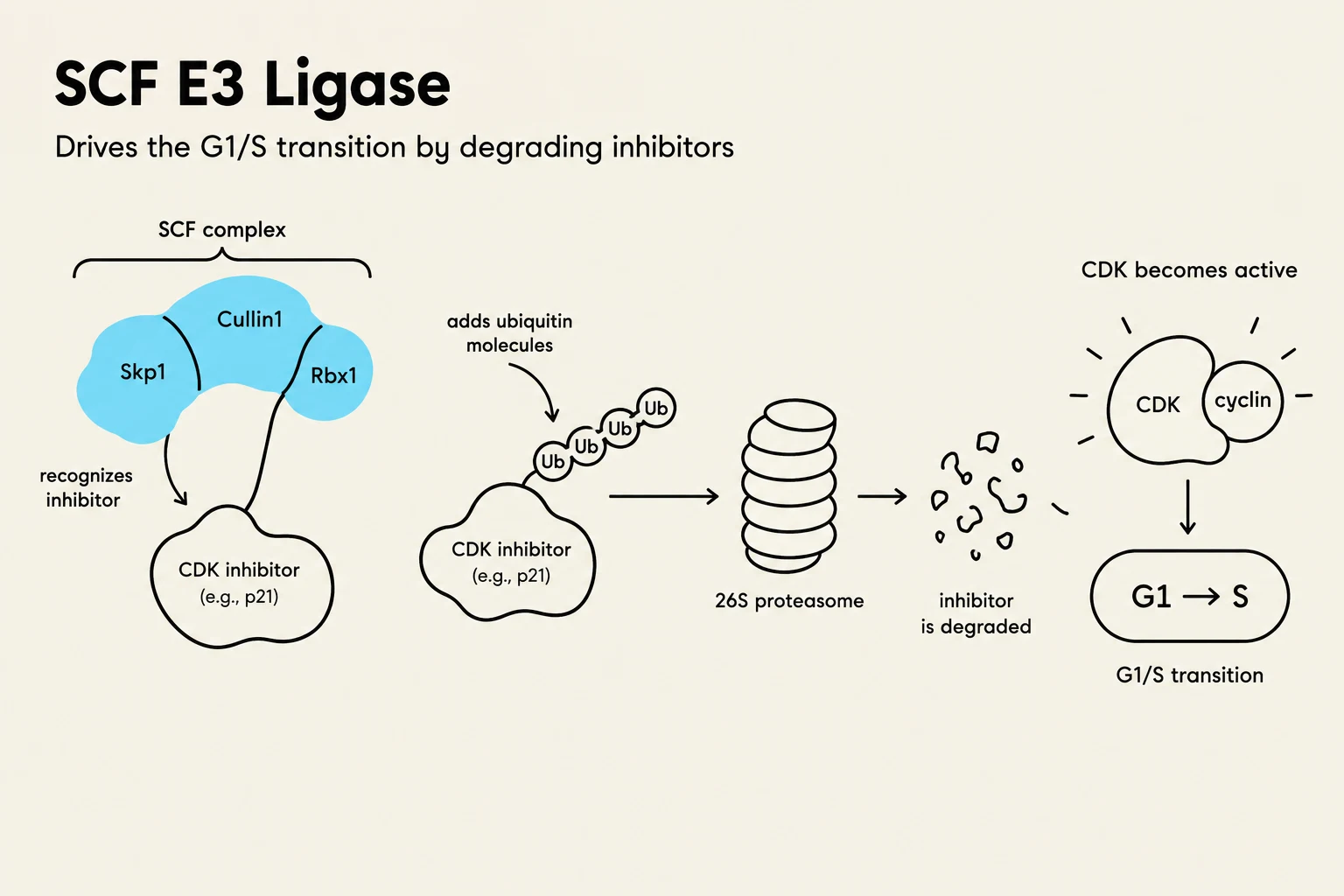
The SCF complex (Skp1-Cullin-Fbox complex) is an E3 ubiquitin ligase that plays a vital role in the transition from G1 phase to S phase. During this transition, the cell must degrade specific CDK inhibitors to allow S-phase CDKs to become active, enabling DNA replication to begin.
The Metaphase/Anaphase Transition and Mitotic Exit
As the cell enters mitosis, a different E3 ligase takes control: the Anaphase-Promoting Complex/Cyclosome (APC/C). The APC/C is responsible for two major events:
Metaphase/Anaphase Transition: The APC/C triggers the degradation of proteins that hold sister chromatids together, allowing them to separate and move toward opposite poles.
Mitotic Exit: To finish mitosis and return to a G1 state, the cell must destroy the mitotic cyclins. The APC/C targets these cyclins for degradation, which drops CDK activity and allows the cell to exit mitosis and complete cytokinesis.
This diagram illustrates the role of the SCF E3 ligase complex in driving the G1/S transition of the cell cycle by degrading inhibitors. The SCF complex, composed of Skp1, Cullin1, and Rbx1, recognizes and binds to CDK inhibitors. Ubiquitin molecules are then added to the inhibitor, marking it for degradation by the 26S proteasome. Once the inhibitor is degraded, CDK becomes active, allowing the cell to transition from the G1 phase to the S phase.
Summary of Cell Cycle Control
The precision of the cell cycle relies on the interplay between activation and destruction. The following table summarizes the regulatory logic:
Phase Transition
Primary Driver
Mechanism of Action
G1 → S
SCF (E3 Ligase)
Degradation of CDK inhibitors to activate S-phase CDKs
Metaphase → Anaphase
APC/C (E3 Ligase)
Degradation of proteins that maintain sister chromatid cohesion
Mitotic Exit
APC/C (E3 Ligase)
Degradation of mitotic cyclins to lower CDK activity
By utilizing these specific cyclins, inhibitors, and ubiquitin ligases, the cell ensures that each step occurs only when the previous step is successfully completed.
Keep reading for free.
Create an account to finish this reading and make it part of your study routine.