An exploration of reductionism as an approach to understanding religion, examining biological, psychological, and social perspectives, and the critiques of this method.
Religion is one of the most complex and pervasive phenomena in human history, manifesting through intricate rituals, profound moral systems, and deeply personal spiritual experiences. For centuries, theologians and philosophers have debated the nature of the divine. However, in the modern era, a different kind of debate has emerged: can these complex religious phenomena be "reduced" to simpler, more fundamental processes?
Reductionism in the study of religion is the attempt to explain religious belief and behavior by breaking them down into their constituent parts—specifically, by looking at the biological, psychological, or social mechanisms that drive them. While this approach offers powerful tools for scientific inquiry, it remains a subject of intense debate regarding whether a "reductionist" explanation truly captures the essence of the religious experience.
The Core of the Debate: What is Reductionism?
In a scientific context, reductionism is the idea that a complex system is nothing more than the sum of its parts. If we apply this to religion, a reductionist might argue that a prayer is not a communication with a deity, but rather a specific neurological firing pattern in the brain. Similarly, a religious ritual might not be a sacred rite, but a social mechanism designed to increase group cohesion.
The debate often centers on whether "explanatory reduction" leads to "ontological reduction."
Explanatory Reduction: Explaining how religion works using other disciplines (e.g., using neuroscience to explain the feeling of transcendence).
Ontological Reduction: Claiming that religion is nothing more than those underlying processes (e.g., claiming God does not exist because we can explain the brain activity associated with belief).
Exam Tip: When discussing reductionism, distinguish between the method (using biology to explain religion) and the conclusion (claiming religion has no independent reality). Most scientists use the former, while critics fear the latter.
Biological and Evolutionary Perspectives
One of the most prominent branches of reductionism is the Cognitive Science of Religion (CSR). This field seeks to understand the cognitive mechanisms that make religious ideas "sticky" or easy for the human mind to process.
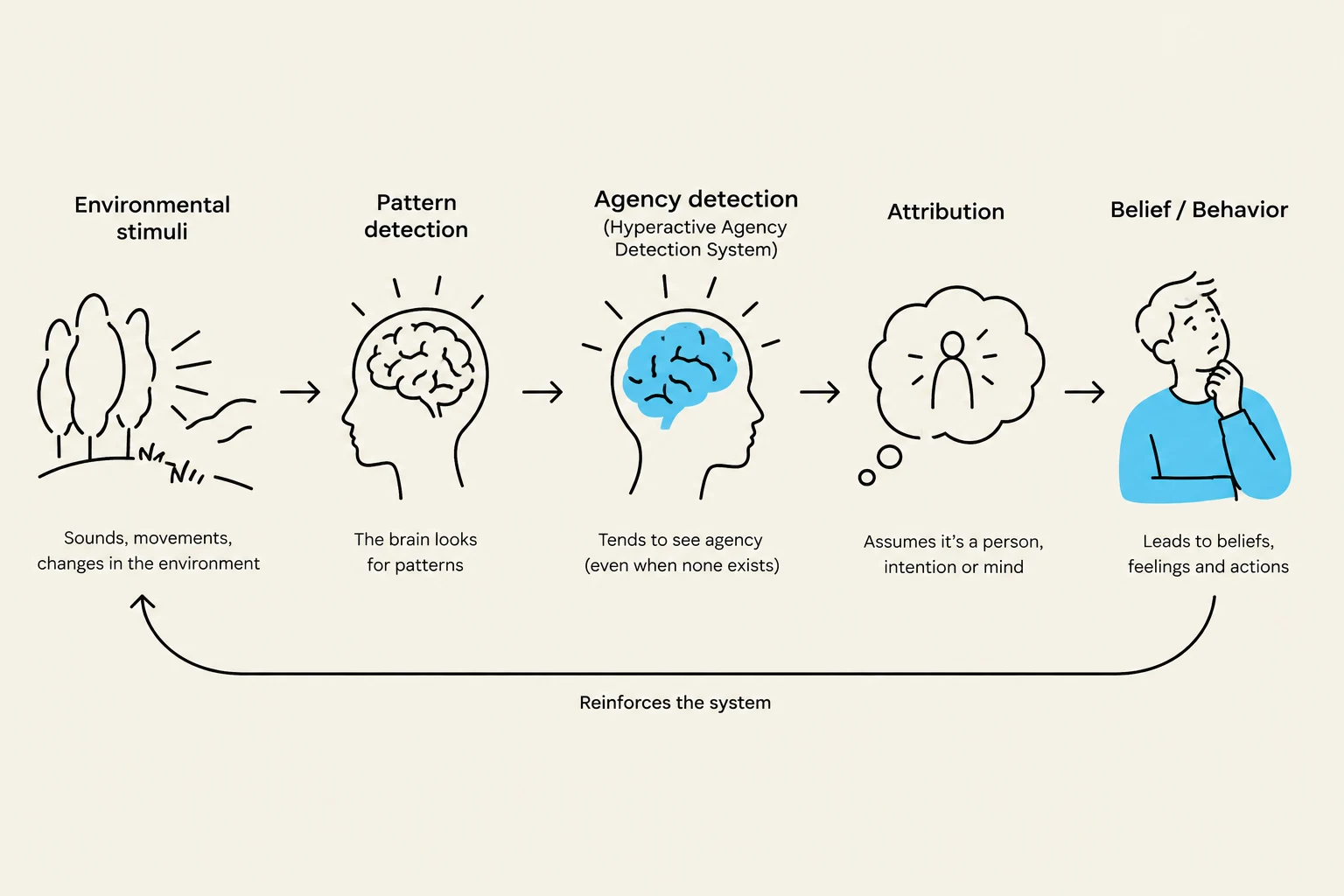
From an evolutionary standpoint, researchers look for the "why" behind religious tendencies. They investigate whether certain cognitive biases—byproducts of our evolution—make us prone to believing in supernatural agents. For example, the "Hyperactive Agency Detection Device" (HADD) is a theoretical mechanism where humans are evolutionarily primed to detect agency (intent) in the environment as a survival tactic (e.g., assuming a rustle in the grass is a predator rather than just wind). This tendency can lead to the attribution of intent to natural phenomena, forming the basis for animism or belief in spirits.
This diagram illustrates the process of agency detection, where environmental stimuli are processed by the brain to detect patterns, leading to the attribution of agency and subsequent beliefs or behaviors.
Psychological and Social Reductionism
Beyond biology, religion can be reduced to psychological and social frameworks.
Psychological Reductionism
Psychological approaches often focus on the internal functions of belief. This might include looking at how religion provides a sense of control in an uncertain world or how it manages existential anxiety regarding death. By studying the cognitive architecture of the mind, researchers can identify how certain concepts, such as "dualism" (the idea that the mind and body are separate), are intuitively grasped by humans and thus facilitate religious thought.
Social Reductionism
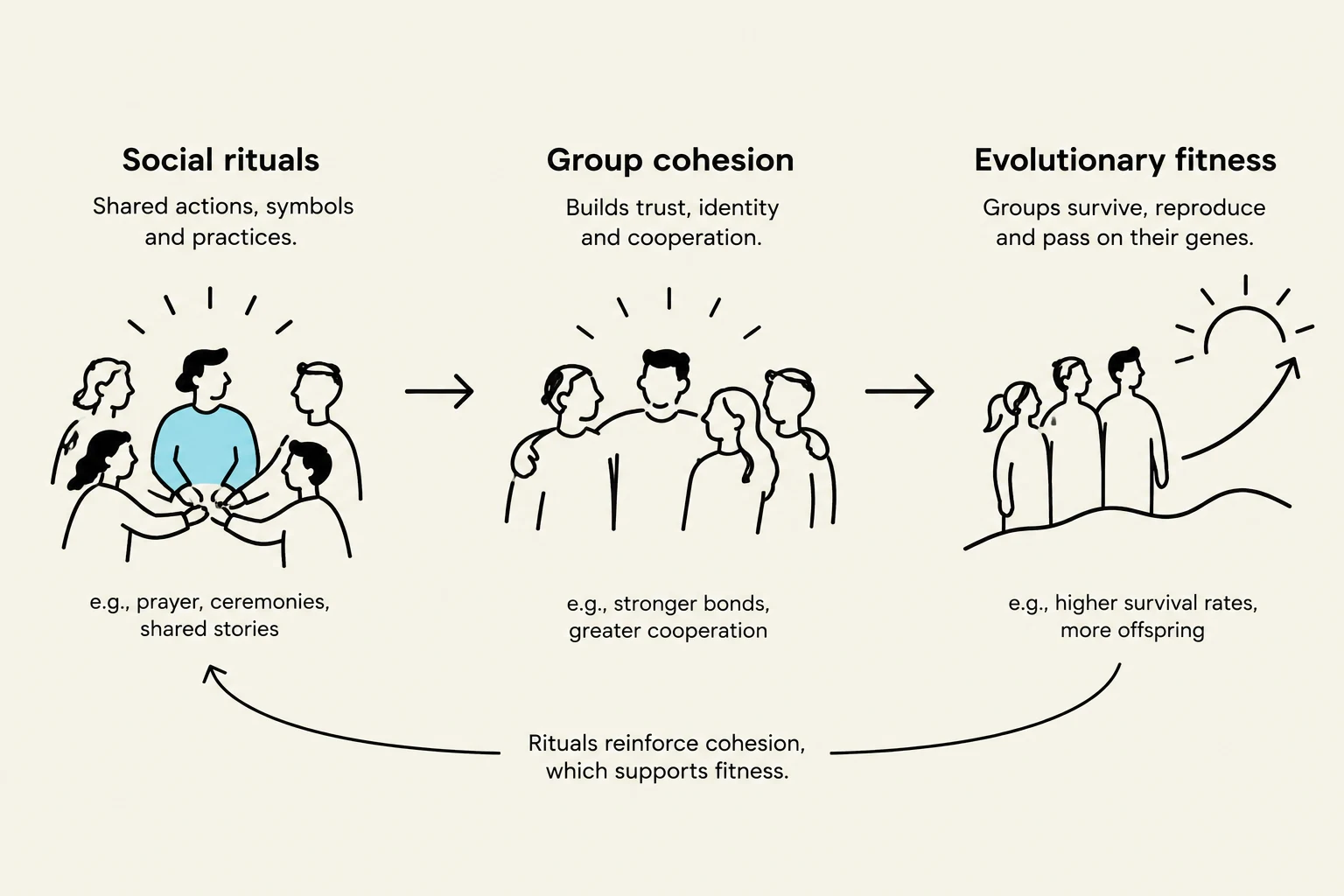
Social reductionism views religion as a tool for group survival and stability. In this view, religious doctrines and rituals serve as "social glue." By enforcing shared norms and creating high-cost rituals (rituals that require significant sacrifice), religion can ensure that members of a group are committed to one another, thereby increasing the group's ability to cooperate and compete with others.
This diagram illustrates the relationship between social rituals, group cohesion, and evolutionary fitness, showing how rituals can reinforce cohesion, which in turn supports a group's survival and reproduction.
The Critique: Is Something Lost in Translation?
The primary criticism of reductionism is that it may suffer from "explanatory gaps." Critics argue that even if we perfectly map every neuron that fires during a religious experience, we have not explained the meaning of that experience to the individual.
Consider the following comparison:
The Reductionist View: A person feels "peace" during prayer because of a decrease in cortisol and an increase in dopamine in the prefrontal cortex.
The Phenomenological View: A person feels "peace" because they feel a sense of connection to the infinite or a divine presence.
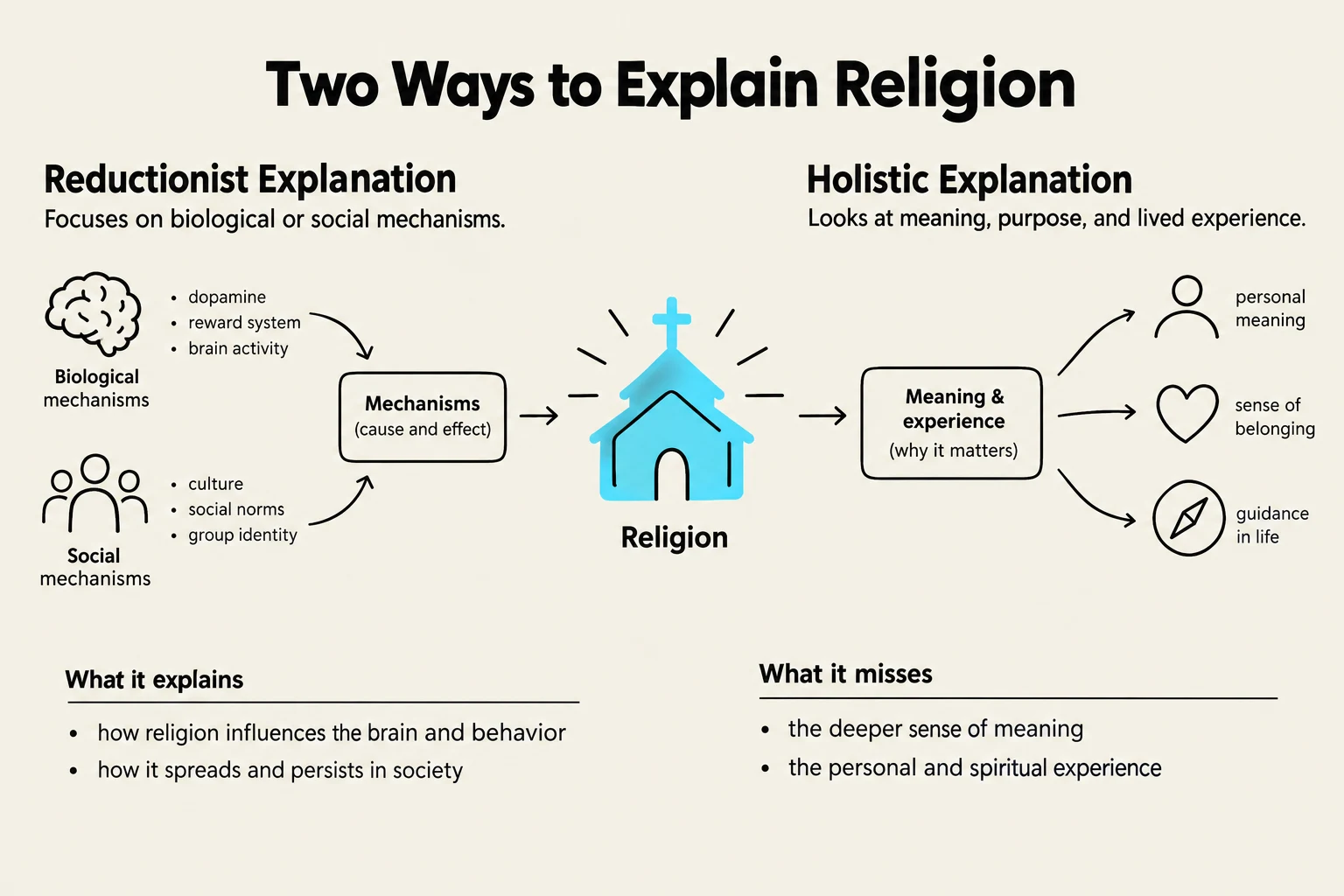
While both statements may be factually true, the reductionist version describes the mechanism, while the phenomenological version describes the experience. Opponents of reductionism argue that by focusing solely on the mechanism, we ignore the very thing that makes religion significant: its meaning and its impact on human culture and morality.
This diagram illustrates two contrasting approaches to understanding religion: the reductionist explanation, focusing on biological and social mechanisms, and the holistic explanation, emphasizing meaning, purpose, and lived experience.
Summary Table: Levels of Reduction
To help organize these concepts, the following table summarizes the different levels at which religion can be analyzed:
Level of Analysis
Primary Focus
Example Explanation
Biological
Brain chemistry & Genetics
Neurotransmitters facilitating "mystical" states.
Cognitive
Mental architecture
HADD leading to the detection of spirits.
Psychological
Individual mental states
Religion as a coping mechanism for anxiety.
Social
Group dynamics
Rituals as a means to increase group cooperation.
In conclusion, reductionism is not a "one size fits all" approach. While it provides essential insights into the cognitive and evolutionary roots of religious thought, the debate continues as to whether these scientific explanations can ever fully encompass the profound complexity of the human religious experience.
Keep reading for free.
Create an account to finish this reading and make it part of your study routine.