An explanation of redox reactions and the four stages of cellular respiration: glycolysis, pyruvate oxidation, the citric acid cycle, and oxidative phosphorylation. It also covers fermentation as an alternative pathway in the absence of oxygen.
At its most fundamental level, life is an energy game. To grow, move, and maintain complex structures, cells must harvest energy from the environment and convert it into a usable form. This process, known as cellular respiration, is not a single explosion of energy but a controlled, step-by-step extraction of electrons from food molecules. By understanding the chemistry of these transfers, we can unlock the mystery of how a single molecule of glucose powers the vast machinery of a living cell.
The Chemistry of Energy: Redox Reactions
Cellular respiration is fundamentally a series of redox reactions. A redox reaction involves the transfer of electrons between molecules, consisting of two simultaneous processes: oxidation and reduction.
To remember which is which, students often use the mnemonic LEO says GER:
LEO: Loss of Electrons is Oxidation.
GER: Gain of Electrons is Reduction.
In the context of respiration, we see a massive transfer of electrons from a fuel source to a final acceptor. Glucose (C6H12O6) is oxidized, meaning it loses electrons (and often hydrogen atoms) to become carbon dioxide (CO2). Conversely, oxygen (O2) is reduced; it acts as the terminal electron acceptor, gaining electrons and protons to become water (H2O).
Exam Tip: When looking at chemical equations, if a molecule loses hydrogen atoms (which carry electrons), it is being oxidized. If it gains them, it is being reduced.
This diagram illustrates the transfer of electrons from glucose to oxygen during cellular respiration, where glucose is oxidized and oxygen is reduced.
The Electron Shuttles: NAD+ and FAD
If electrons are the "currency" of energy, the cell needs "wallets" to carry them from the breakdown of food to the machinery that produces ATP. These are the electron carriers: NAD+ and FAD.
NAD+: This molecule picks up two electrons and one proton ($H^+$) during the various stages of respiration to become the reduced form, NADH.
FAD: Similarly, FAD accepts electrons to become FADH2.
These carriers are essential because the cellular pool of NAD+ is limited. They must be constantly "recycled" by dropping their electron cargo off at the Electron Transport Chain (ETC) so they can return to the earlier stages of respiration to pick up more.
The Four Stages of Cellular Respiration
The process of harvesting energy occurs in four distinct, interconnected stages, moving from the fluid cytoplasm into the specialized compartments of the mitochondria.
1. Glycolysis
Occurring in the cytosol (the fluid part of the cytoplasm), glycolysis is the first step in breaking down glucose. One six-carbon glucose molecule is split into two three-carbon molecules called pyruvates. This stage provides a small, immediate energy payoff:
2 Net ATP (produced via substrate-level phosphorylation).
2 NADH (sent to the ETC).
2. Pyruvate Oxidation
If oxygen is present, the pyruvates enter the mitochondrial matrix. Here, they undergo a transition step where they are converted into two acetyl-CoA molecules. This process releases 2 CO2 molecules as waste and produces 2 more NADH.
3. The Citric Acid Cycle (Krebs Cycle)
Also located in the mitochondrial matrix, the citric acid cycle is the "full oxidation" stage. The acetyl-CoA is completely broken down, and all the remaining high-energy electrons are transferred to carriers. For every one glucose molecule (which means two turns of the cycle), the yield is:
4 CO2 (released as waste).
2 ATP.
6 NADH.
2 FADH2.
4. Oxidative Phosphorylation
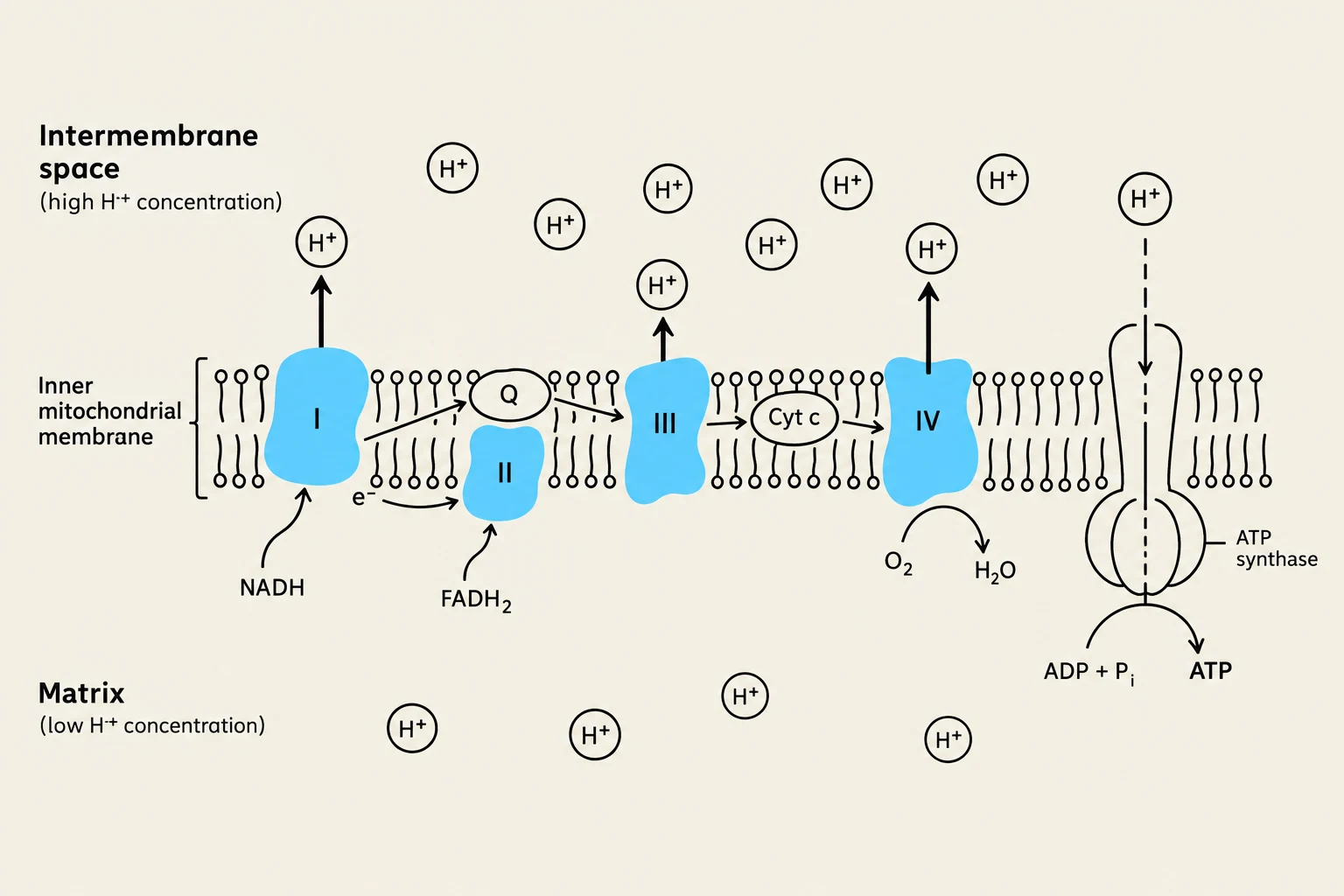
This is the grand finale, occurring in the inner mitochondrial membrane. It consists of two tightly coupled processes: the Electron Transport Chain (ETC) and chemiosmosis.
Diagram illustrating the electron transport chain and oxidative phosphorylation within the inner mitochondrial membrane, showing the movement of protons (H+) and the synthesis of ATP.
The Electron Transport Chain and the Proton Motive Force
The NADH and FADH2 produced in earlier stages travel to the ETC, a series of protein complexes embedded in the membrane. As electrons are passed from one complex to the next, they release energy. The complexes use this energy to actively pump protons ($H^+$) from the matrix into the intermembrane space.
This creates an electrochemical gradient: a high concentration of positive charge and protons in the intermembrane space compared to the matrix. The potential energy stored in this gradient is known as the proton motive force.
Chemiosmosis and ATP Synthase
Because the inner membrane is impermeable to ions, the protons can only flow back into the matrix through a special transmembrane protein called ATP synthase. This process of using a proton gradient to drive cellular work is called chemiosmosis.
ATP synthase acts like a biological motor. As protons flow through it, they cause the protein to spin, providing the mechanical energy required to phosphorylate ADP:
ADP+Pi→ATP
This stage is incredibly efficient, generating approximately 28 of the 30-32 total ATP produced per glucose molecule.
Life Without Oxygen: Fermentation
What happens when oxygen is unavailable? Without oxygen to act as the final electron acceptor, the ETC backs up, and the citric acid cycle and pyruvate oxidation grind to a halt.
In these anaerobic conditions, the cell relies on fermentation. Fermentation does not produce ATP itself; instead, its primary goal is to regenerate NAD+ from NADH. By doing this, the cell ensures that glycolysis can continue to run, providing a small but vital steady stream of 2 ATP per glucose.
There are two main pathways:
Lactic Acid Fermentation: Common in humans (especially during strenuous exercise), pyruvate is reduced directly into lactate.
Alcohol Fermentation: Common in yeast, pyruvate is first converted into acetaldehyde (releasing CO2) and then reduced into ethanol.
By mastering these redox pathways, the cell transforms the chemical energy of food into the universal energy currency of life.
Keep reading for free.
Create an account to finish this reading and make it part of your study routine.