This guide outlines essential strategies for effective staff recruitment and hiring in service-oriented businesses. It covers analyzing staffing needs, creating comprehensive job descriptions, utilizing industry benchmarks for compensation, and implementing structured interview techniques to build a high-performing tea
In any service-oriented business, particularly in the fitness and wellness industry, the quality of your staff is the primary driver of your success. A manager’s ability to spot, recruit, and hire talent is not just an administrative task; it is a foundational leadership responsibility. Because a business’s success is directly tied to the performance and engagement of its employees, managers must move beyond reactive hiring and instead implement a strategic, data-driven recruitment process.
Analyzing Staffing Needs and Personnel Requirements
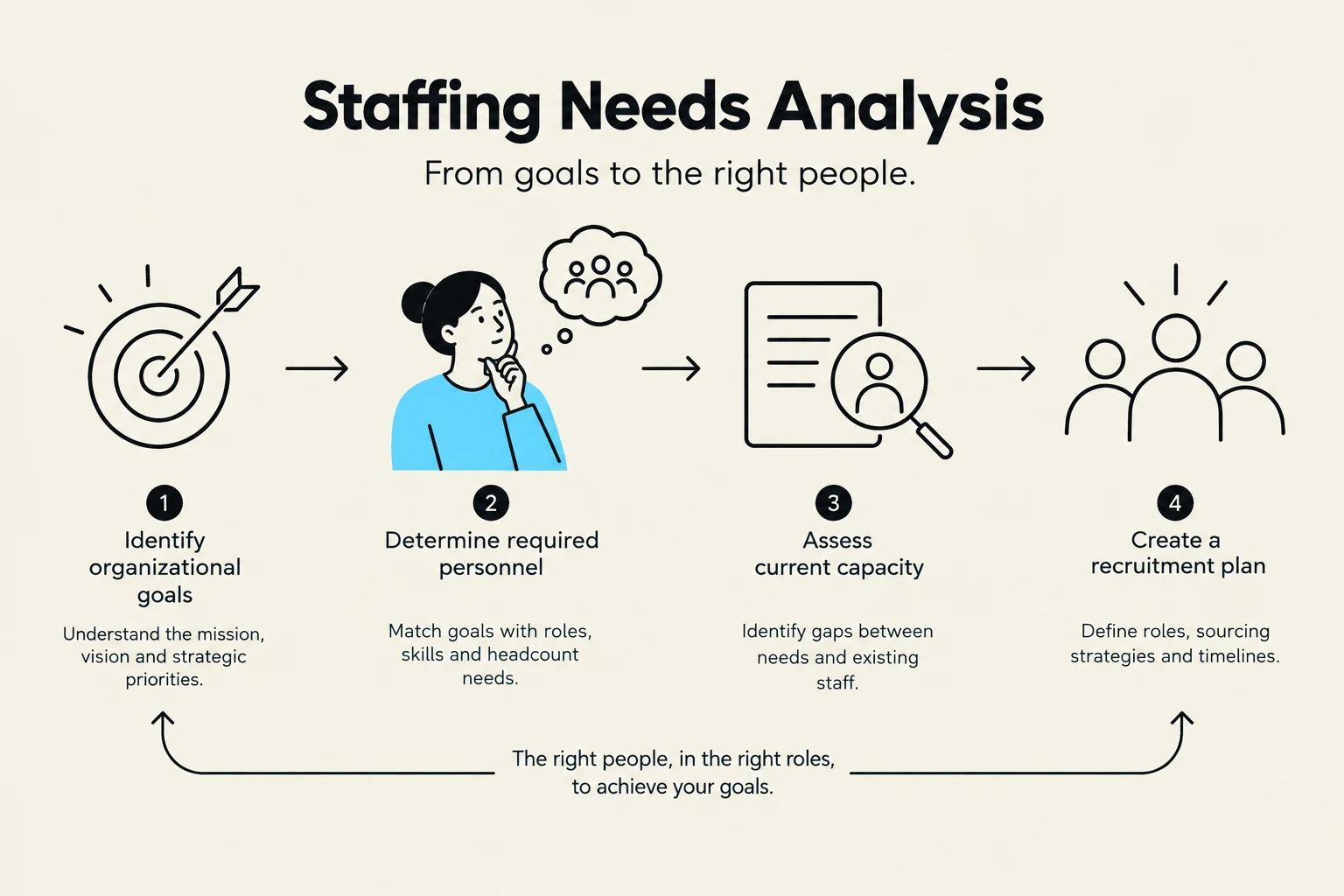
Before a single job advertisement is posted, a manager must conduct a thorough staffing needs analysis. This involves understanding the specific personnel requirements necessary to achieve the organization's goals. Effective personnel management requires determining the right number of people for specific tasks to ensure they produce the best work in the most efficient way.
To determine if your current staffing levels are appropriate, you should evaluate several diagnostic factors:
Staffing Ratios: Determine the appropriate staff-to-member or supervisor-to-frontline employee ratios to ensure productivity, customer service, and legal compliance.
Turnover Rate: Identify the turnover rate for specific positions to understand how frequently you will need to recruit for that role.
Labor Availability: Assess whether the local market provides an abundance of trained professionals or if you will be competing for a limited pool of untrained labor.
Exam Tip: When calculating staffing needs, always consider the intersection of productivity and legal compliance. For example, having too few supervisors for a large number of frontline employees may violate safety or operational standards.
This diagram outlines the four key steps in a staffing needs analysis: identifying organizational goals, determining required personnel, assessing current capacity, and creating a recruitment plan. It emphasizes aligning the right people with the right roles to achieve organizational objectives.
The Foundation: Job Descriptions and Performance Expectations
Once the need for a position is identified, the next step is to formalize a job description. A well-crafted job description is a tool that defines the technical skills, experiences, and responsibilities required for the role. It serves two critical purposes: it acts as the blueprint for the recruitment process and provides the basis for setting performance expectations.
Organizational Alignment: How the role contributes to the mission, vision, and culture of the facility.
Operational Duties: The day-to-day tasks and responsibilities.
By establishing these expectations early, managers create a framework for future coaching and goal setting. This ensures that once a candidate is hired, they understand exactly how their success will be measured.
Utilizing Industry and Marketplace Benchmarks
To attract high-quality candidates, your compensation and recruitment strategy must be competitive. This requires using industry and marketplace employment benchmarks to inform your planning.
Wage and Salary Benchmarking
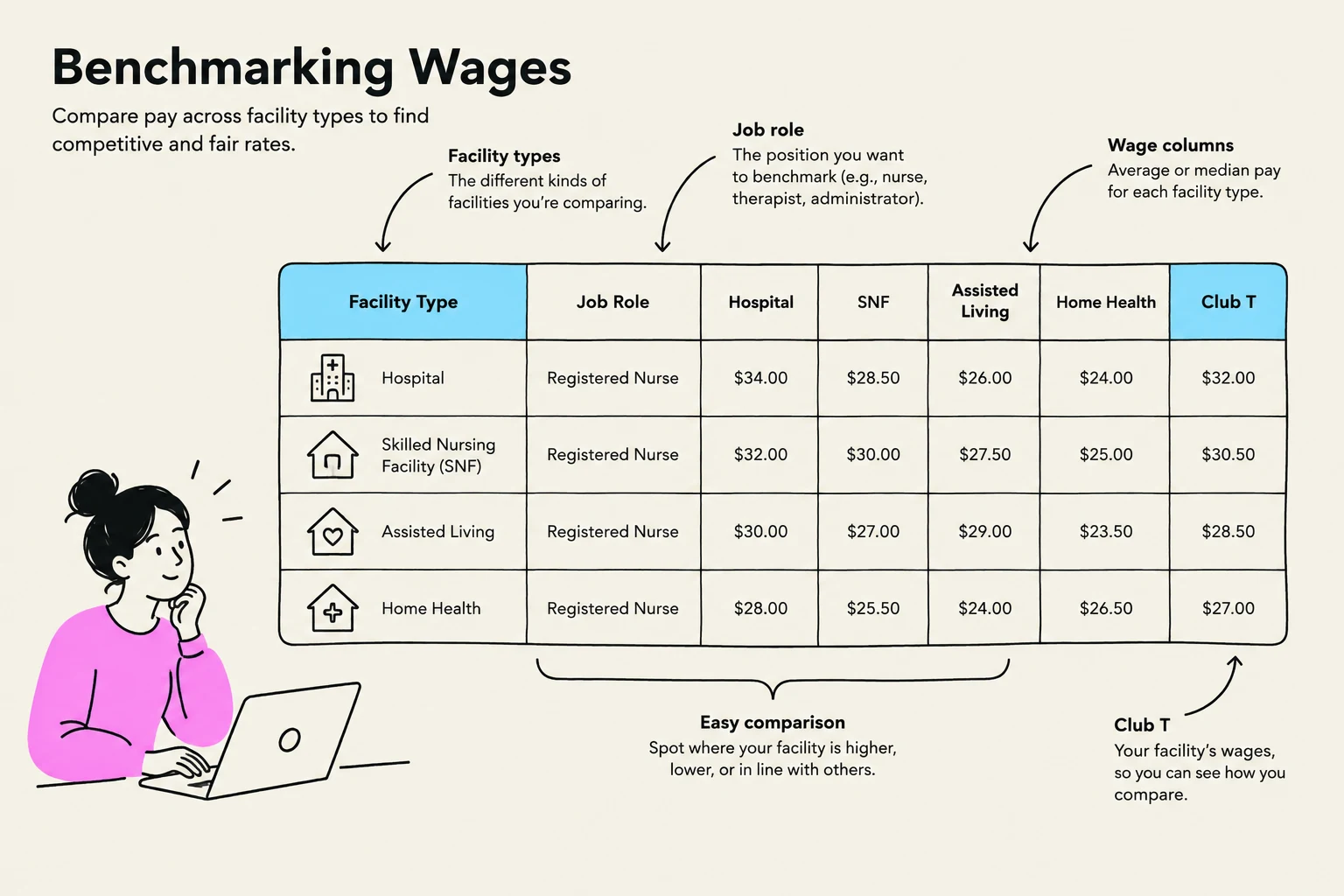
You cannot set wages in a vacuum. You must compare your compensation, benefits, and hours against similar club types—such as multipurpose clubs versus boutique personal training studios. Organizations like the IHRSA or professional bodies like the NSCA, ACSM, and ACE provide valuable salary data that can help you position your offers effectively.
Market and Trend Analysis
Beyond just pay, managers must evaluate:
Market Analysis: The availability of trained versus untrained labor in your specific geographic area.
Trend Evaluation: Assessing past, current, and predicted future employment trends to allow for proactive strategic planning.
This chart compares average wages for registered nurses across different healthcare facility types, including hospitals, skilled nursing facilities, assisted living, home health, and Club T.
Implementing Efficient Recruiting Processes
The recruiting process should be a structured journey from the initial advertisement to the final selection. This includes screening and reviewing applications to narrow down the pool of candidates.
When choosing which applicants to move forward, consider five key variables:
Technical Skill Scarcity: How hard is it to find these specific skills?
Recruitment Budget: How much can you spend on advertising and sourcing?
Urgency: How quickly must the position be filled?
Geographic Reach: Do you need local candidates or can you recruit nationally?
Compensation Range: Does the pay scale allow for a wide range of talent levels?
Advanced Interview Techniques and Selection
The interview is where most hiring decisions are made, yet it is also where many managers fail due to incompetence or asking vague questions. To avoid these pitfalls, managers should use positive profiling—developing thoughtful questions that elicit specific information about a candidate's work style, talents, and alignment with the organization's values.
Structured Interviewing
Instead of casual conversation, use questions categorized by intent:
Experience: "Describe your professional experience. How does it apply to this position?"
Motivation: "What is it about this position that interests you?"
Work Ethic: "What was the hardest job you’ve ever had? Why?"
Legal Warning: Avoid all questions regarding age, religion, race, ethnicity, gender, or marital status. In the United States, asking questions like "Are you pregnant?" or "Where were you born?" is both unethical and illegal.
The Rating System
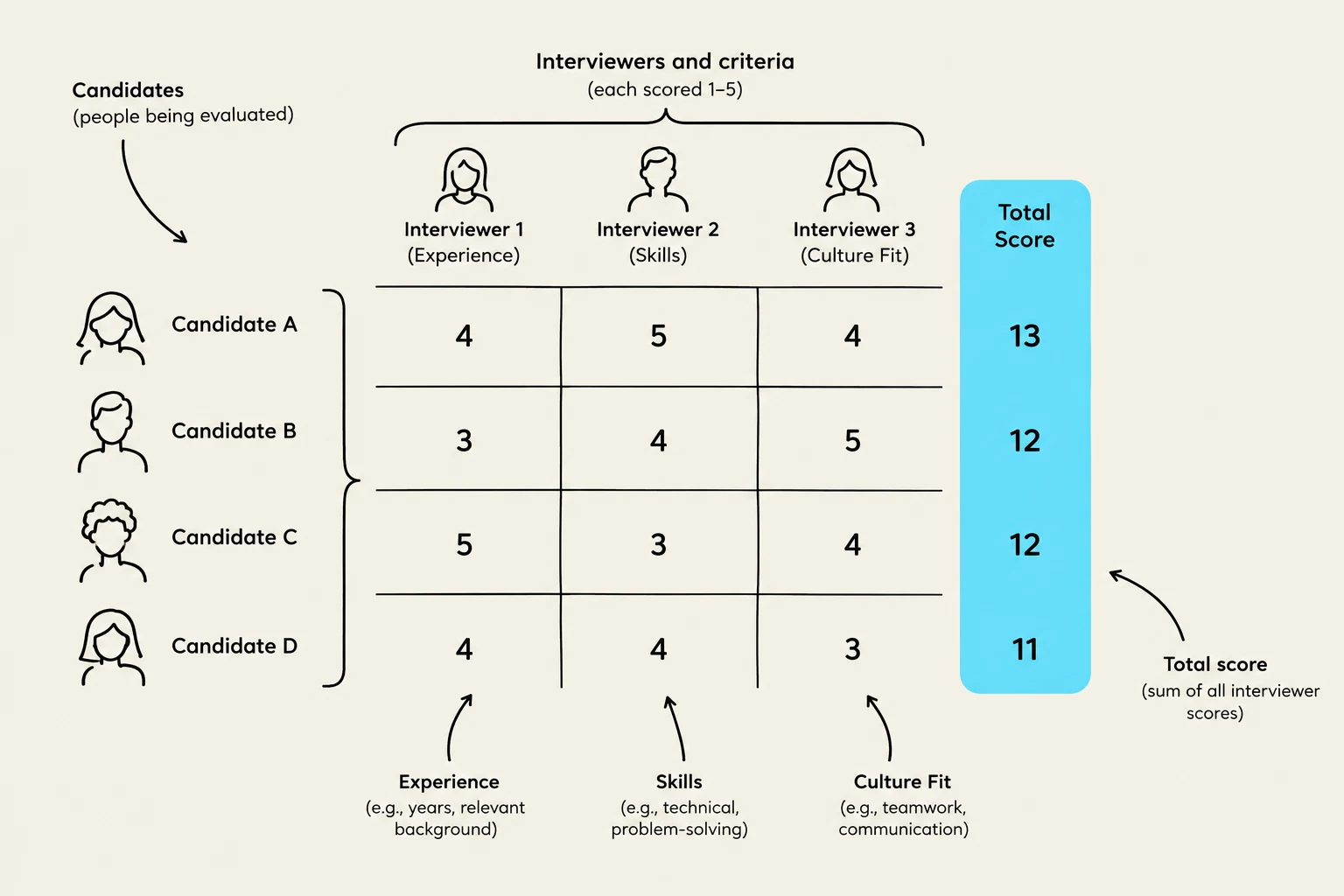
To ensure objectivity, especially when using a hiring committee, implement a rating system. This allows different interviewers to score candidates on a standardized scale (e.g., 1 to 5) based on critical criteria such as:
Relevant experience
Technical skills
Personality characteristics
Likelihood of long-term tenure
A table illustrating a candidate evaluation process, showing scores from three interviewers across experience, skills, and culture fit, with a total score for each candidate.
By combining thorough needs analysis, competitive benchmarking, and structured interviewing, managers can move beyond simply "filling a hole" and begin building a high-performing team that shares the organization's vision and drives long-term success.
Keep reading for free.
Create an account to finish this reading and make it part of your study routine.