This content explains strategies for mapping and cloning genes, including linkage analysis, LOD scores, polymorphic markers, linkage disequilibrium, Genome-Wide Association Studies (GWAS), chromosomal anomalies, and DNA libraries.
Mapping and cloning genes is a fundamental necessity in modern medicine. With the human nuclear genome consisting of approximately 3.2 billion base pairs, physicians and researchers cannot simply scan the entire sequence to find the cause of a disorder. Instead, they must use strategic approaches to locate the causes of genetic disorders, determine the identity of gene products, and understand how specific mutations lead to disease effects. This process involves moving from broad chromosomal locations to specific molecular sequences through linkage analysis, association studies, and library screening.
Linkage Analysis and the LOD Score
Linkage analysis relies on the fact that chromosomes reorganize during meiosis through crossing over. When two genes are physically close to one another on a chromosome, they are likely to be inherited together because the probability of a recombination event occurring between them is low. This distance is measured in centimorgans (cM), where 1 cM represents a $1%$ recombination frequency.
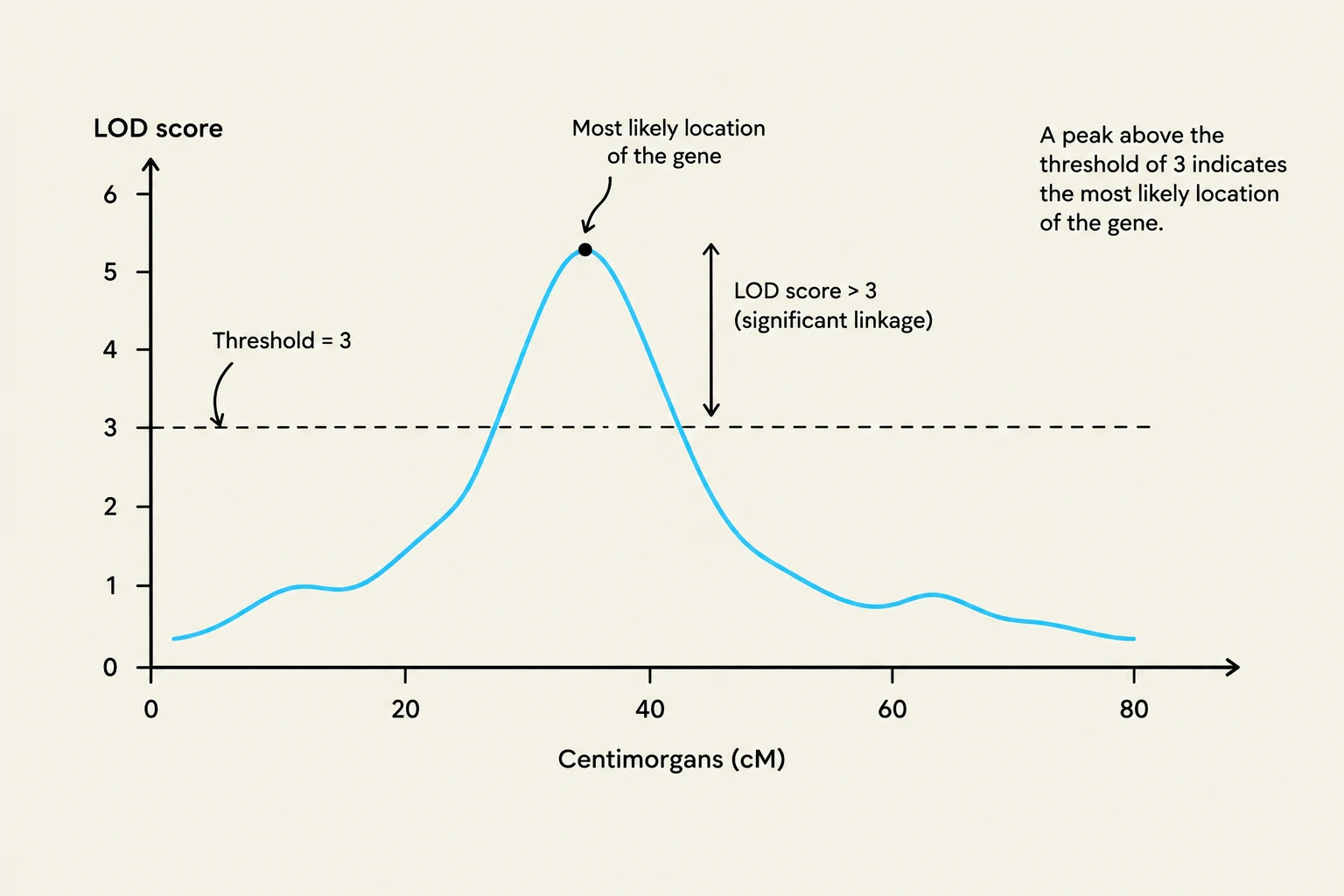
To determine if two genes are truly linked, scientists use statistical methods to compare different hypotheses. They calculate the likelihood that the observed inheritance pattern fits a hypothesis of linkage versus a hypothesis that the genes are unlinked. This comparison results in a likelihood ratio, which is then converted into a LOD score (Logarithm of Odds).
The LOD score is a base-10 logarithm of the likelihood ratio. For example, if the likelihood of linkage is 1000 times greater than the likelihood of no linkage, the LOD score is 3.
LOD score=log10(Likelihood of no linkageLikelihood of linkage)
Exam Tip: A LOD score of 3 or higher is considered statistically significant for linkage, indicating the genes are likely linked. Conversely, a LOD score of -2 suggests no linkage, meaning the data is 100 times more likely to occur if the genes are not linked.
A graph illustrating the concept of LOD score in genetics, showing the relationship between LOD score and centimorgans (cM) to identify the most likely location of a gene. A threshold of 3 is used to determine significant linkage.
Polymorphic Markers and Linkage Phase
To track genes through a family, researchers use polymorphic markers—DNA sequences that vary significantly between individuals, such as microsatellites. These markers allow researchers to determine the linkage phase, which refers to knowing which specific alleles of linked genes are located on the same DNA strand as a mutated gene.
However, not all marker data is useful. An uninformative mating occurs when an individual is homozygous for a marker allele (having the same allele on both chromosomes). In this scenario, it is impossible to track which parental chromosome was passed to the offspring, making the marker ineffective for determining linkage phase.
Linkage Disequilibrium vs. Genetic Association
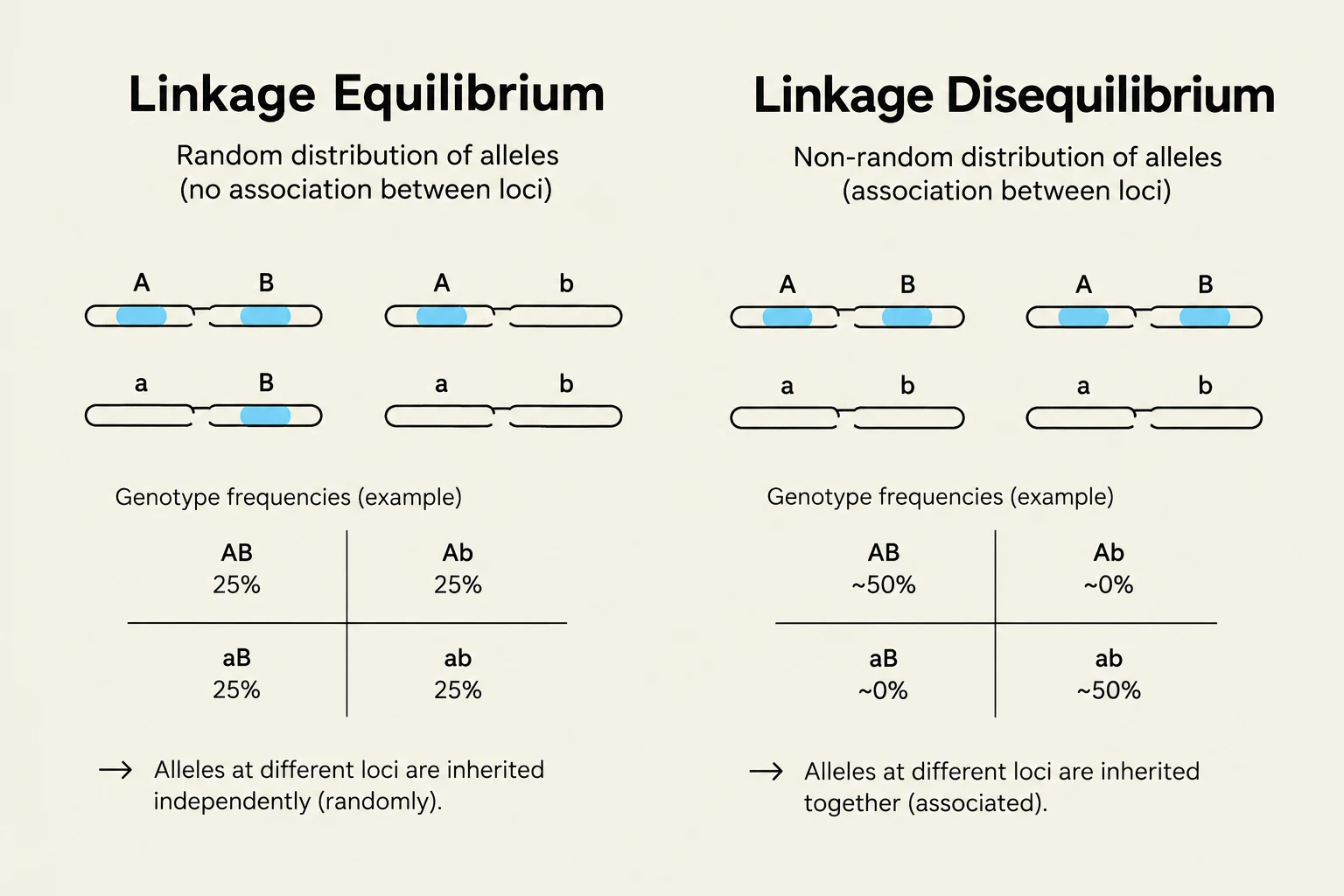
The relationship between alleles changes over time due to recombination. When a new mutation occurs, it is initially linked to specific nearby alleles on the same chromosome. This state is known as linkage disequilibrium. Over many generations, recombination events slowly separate the mutation from its neighboring markers until the alleles are distributed randomly in the population, a state called linkage equilibrium.
It is crucial to distinguish between linkage and association:
Linkage: Refers to genes being physically close on a chromosome and inherited together.
Association: Occurs when a specific allele is found more frequently in affected individuals than in the general population, potentially because the allele itself causes the disease (e.g., HLA-B27 and Ankylosing spondylitis), rather than being physically linked to the causative gene.
Genome-Wide Association Studies (GWAS)
Modern genetics often utilizes Genome-Wide Association Studies (GWAS) to locate genes by screening many markers across many people simultaneously. These studies frequently employ microarrays, which allow for the high-throughput testing of thousands of Single Nucleotide Polymorphisms (SNPs).
Instead of testing every single SNP, researchers can use haplotypes—groups of alleles that are inherited together—to reduce the computational burden. By hybridizing labeled sample DNA to microscopic spots of DNA on a slide and scanning with a laser, researchers can rapidly identify which genetic variations correlate with specific traits or diseases.
This illustration compares linkage equilibrium, where alleles at different loci are inherited independently, with linkage disequilibrium, where alleles are inherited together.
Chromosomal Anomalies in Mapping
When linkage analysis provides a broad region, chromosomal anomalies can be used to narrow the search to much smaller segments.
Deletions: By studying different patients who all share a specific disease but have different chromosomal deletions, researchers can identify the "overlap" region where all deletions occur; the causative gene must reside in that shared segment.
Translocations: The breakpoints of a translocation (where a piece of one chromosome breaks off and attaches to another) may occur directly within a specific gene, pinpointing its location.
DNA Libraries and Candidate Genes
Once a region is identified, researchers use DNA libraries to find the specific sequence. A library is a collection of DNA clones inserted into vectors like plasmids or Bacterial Artificial Chromosomes (BACs).
Library Type
Composition
Purpose
Genomic Library
Contains all DNA from an organism's chromosomes
To study non-coding regions and the entire genome structure
cDNA Library
Contains only copies of genes expressed in a specific tissue
To study the protein-coding sequences (exons) of active genes
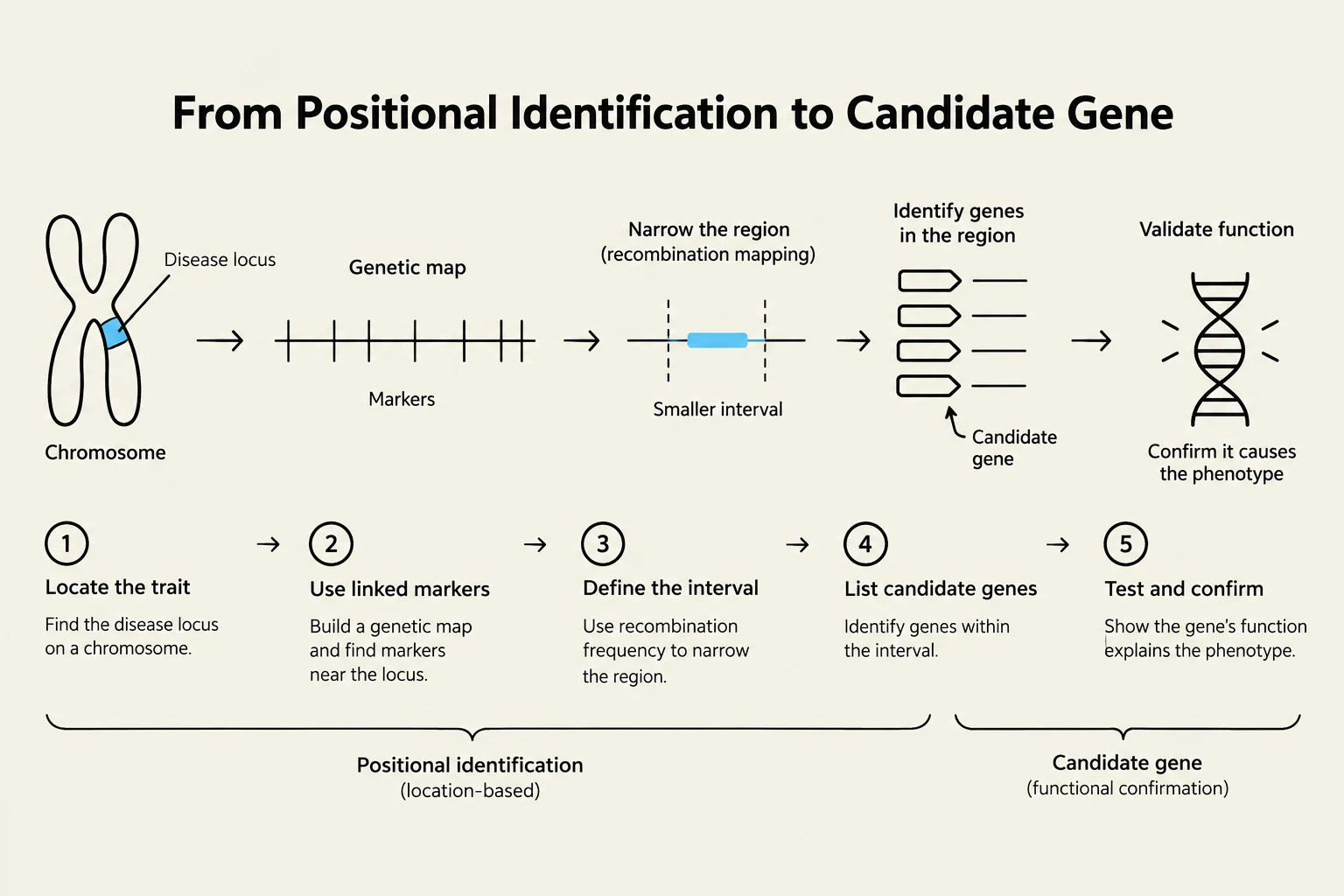
This diagram illustrates the process of identifying a candidate gene, starting from locating a disease locus on a chromosome and progressing through genetic mapping, interval definition, candidate gene listing, and functional validation.
Finally, researchers must select candidate genes—sequences that are likely responsible for a trait. This is done through two main approaches:
Positional Identification: The location is known, and the entire region is sequenced to find likely candidates.
Functional Identification: The likely function of the disease is known, and researchers look for genes that match that function and are located on the correct chromosome.
To confirm a candidate gene, scientists compare its sequence between normal and mutant individuals, check for appropriate tissue expression, and eventually express the gene to determine its specific biological product.
Keep reading for free.
Create an account to finish this reading and make it part of your study routine.