Reactive Energy Balance and Steam Tables in Chemical Engineering
This article explains how to perform energy balances in reactive systems and utilize steam tables to find necessary thermodynamic properties for chemical engineering processes. It covers steady-state open systems, kinetic energy considerations, and the importance of the heat of reaction.
In chemical engineering, understanding how energy moves through a system is just as critical as tracking the mass of the chemicals themselves. Whether you are designing a reactor where bonds are breaking and forming, or a boiler where water is being converted to steam, you must account for every joule of energy. This article explores how to perform energy balances in reactive systems and how to utilize steam tables to find the necessary thermodynamic properties.
The Steady-State Open Process System
Most industrial processes are "open systems," meaning mass flows in and out across the system boundaries. When we analyze these systems at "steady state," we assume that the conditions inside the system (like temperature, pressure, and mass) do not change over time; therefore, the accumulation of mass and energy is zero.
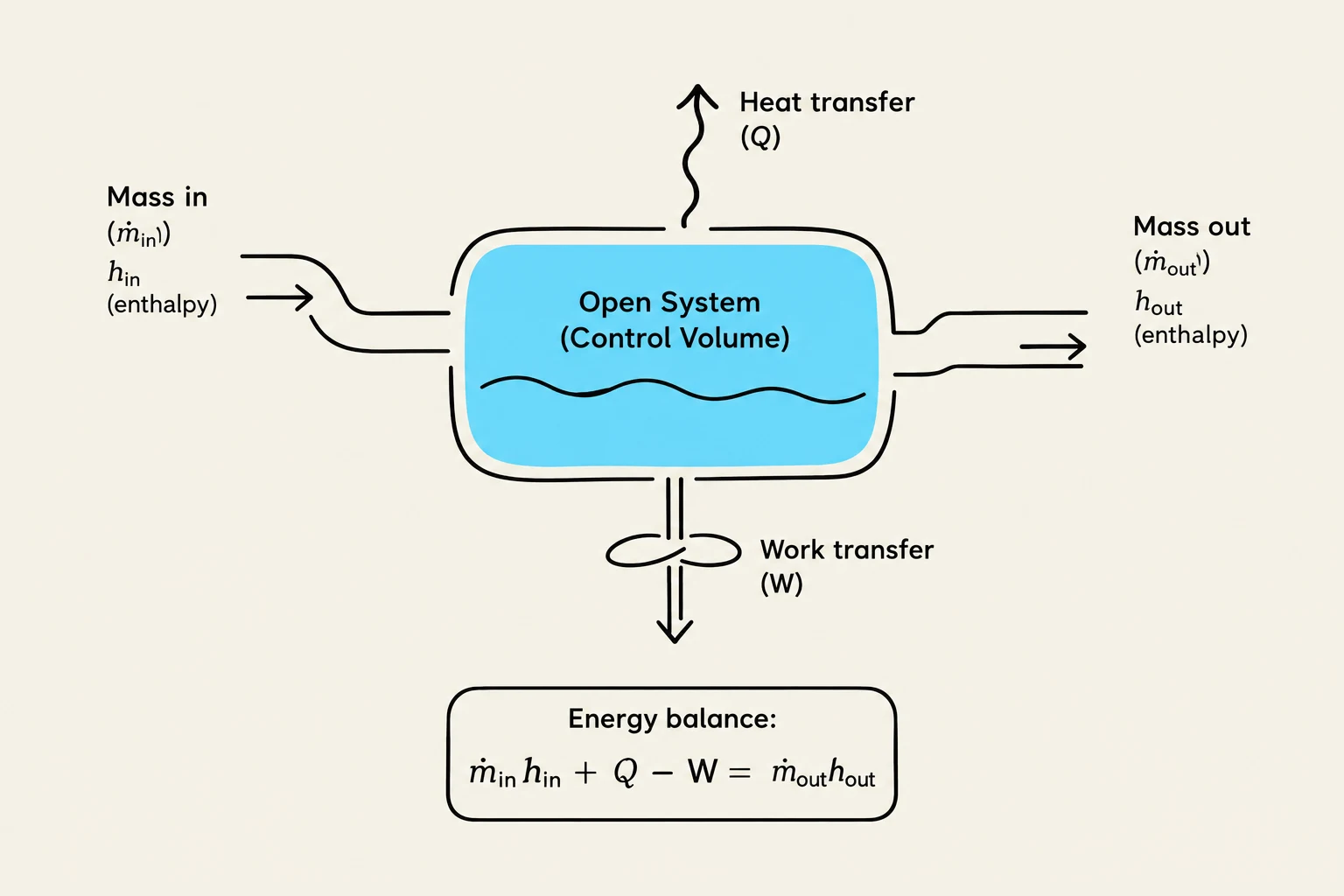
The general energy balance for a steady-state open process is expressed as:
Q˙+W˙=ΔH˙+ΔE˙K+ΔE˙P
Where:
Q˙ is the rate of heat transfer.
W˙ is the rate of work.
ΔH˙ is the change in enthalpy.
ΔE˙K is the change in kinetic energy.
ΔE˙P is the change in potential energy.
In many practical engineering problems, work, potential energy, and kinetic energy are often negligible, simplifying the equation to Q˙=ΔH˙. However, this is a dangerous assumption if the fluid is moving at high velocities.
Kinetic Energy Considerations
If steam is exiting a pipe at high speed, the kinetic energy cannot be ignored. Kinetic energy is calculated using the formula:
E˙K=21m˙u2
Where m˙ is the mass flow rate and u is the velocity.
Diagram illustrating the energy balance for an open system (control volume), showing mass in, mass out, heat transfer, and work transfer.
Reactive Energy Balances
When a chemical reaction occurs within the system, the energy balance must account for the energy released or absorbed by the reaction itself. This is known as the heat of reaction (ΔHR∘).
If we choose reference conditions such that the heat of reaction data is based on those same conditions, the energy balance for a steady-state process can be written as:
∑H˙output streams−∑H˙input streams+αΔHR∘=Q˙
In this equation, α represents the extent of the reaction. In a non-reactive system, the term αΔHR∘ simply becomes zero.
Exam Tip: Always check if the problem mentions a chemical reaction. If it does, you cannot simply use Q˙=ΔH˙; you must include the heat of reaction term to account for the chemical energy change.
Using Steam Tables and Specific Enthalpy
To solve these balances, you need to know the energy content of the fluids. For water and steam, we use specific enthalpy (h), which is the enthalpy per unit mass. Because the properties of water change drastically with temperature and pressure, we rely on Steam Tables.
Saturated Steam
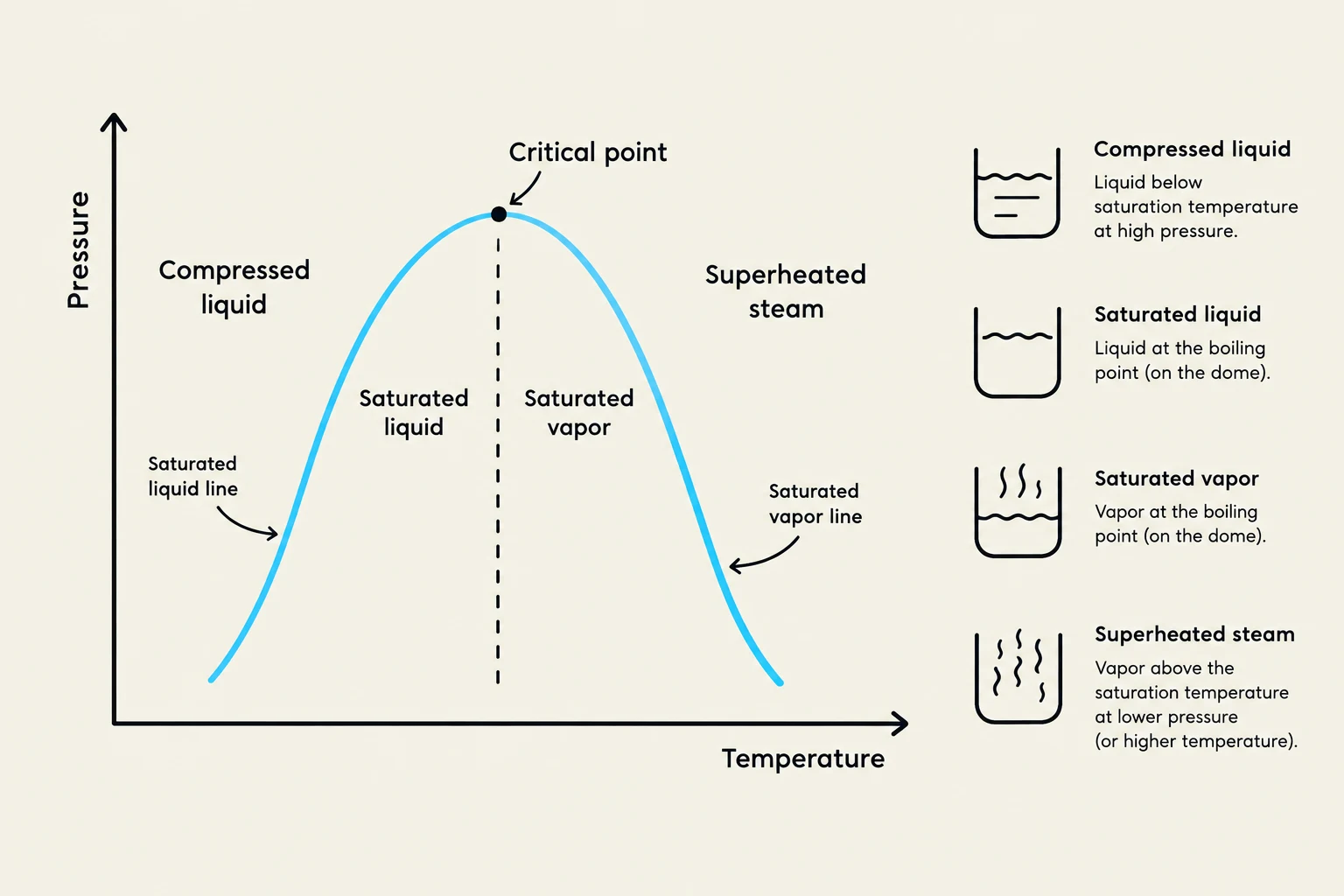
Saturated tables are used when water and steam are in equilibrium at a specific temperature or pressure. There are two critical states to identify:
Saturated Liquid ($'$): The state of water at its boiling point just before any vapor begins to form.
Saturated Vapour ($''$): The state of steam at its condensation point where no liquid remains.
Superheated Steam
If the steam is heated to a temperature higher than its saturation temperature for a given pressure, it enters the superheated region. In this state, the steam exists entirely as a single phase and is no longer in equilibrium with liquid water.
This diagram illustrates the phase transitions of a substance, showing regions of compressed liquid, saturated liquid, saturated vapor, and superheated steam on a pressure-temperature phase diagram. It also depicts the saturated liquid line, saturated vapor line, and the critical point.
Worked Example: The Boiler Problem
To see these concepts in action, let's look at a common industrial scenario: a boiler.
Problem Statement:
Two streams of water are mixed to form the feed to a boiler.
Stream 1: 120 kg/min at 30∘C
Stream 2: 175 kg/min at 65∘C
The boiler operates at 17 bar (absolute).
The emerging steam is saturated at the boiler pressure and exits through a 6-cm ID pipe.
Calculate the required heat input (Q˙) if we include kinetic energy.
Step 1: Mass Balance
First, determine the total mass flow rate of the output. Since it is a steady-state process:
m˙out=m˙in,1+m˙in,2=120+175=295 kg/min
Step 2: Determine Specific Enthalpies (h)
Using steam tables:
Step 4: Kinetic Energy (ΔE˙K)
To find the velocity (u) of the steam in the 6-cm pipe, we use the mass flow rate and the density (or specific volume V):
u=AV˙=Am˙V
After calculating u≈202 m/s, we find:
E˙K,out=21m˙u2≈6.02×10³ kJ/min
Step 5: Final Energy Balance
Assuming W˙=0 and ΔE˙P=0:
Q˙=ΔH˙+ΔE˙KQ˙=7.61×10⁵+6.02×103=7.67×10⁵ kJ/min
By combining mass balances, enthalpy calculations from steam tables, and accounting for kinetic energy, we arrive at a complete energy profile for the system.
Keep reading for free.
Create an account to finish this reading and make it part of your study routine.