Learn about radiometric dating, a method used to determine the absolute age of rocks and minerals by measuring the decay of radioactive isotopes. Understand the physics behind atomic clocks, how radiometric ages are calculated, and the importance of choosing the right isotopic system for different geological materials.
To understand the history of our planet, geologists need more than just a sequence of events; they need a precise calendar. While the stratigraphic record tells us the order in which rocks were deposited, it does not inherently provide absolute ages. To bridge this gap, scientists use radiometric dating, a method that utilizes the predictable decay of radioactive isotopes to calculate the numerical age of minerals and rocks. By measuring the ratio of unstable atoms to stable ones, we can unlock the "clocks" embedded within the Earth's crust.
The Physics of the Atomic Clock
At the heart of radiometric dating is the behavior of isotopes. An isotope is an atom that possesses the same number of protons as other atoms of that element but contains a different number of neutrons. While some isotopes are stable and remain unchanged forever, others are radioactive (unstable) and will spontaneously disintegrate over time.
This process of disintegration involves two key players:
Parent Isotope: The original, unstable radioactive atom that undergoes decay.
Daughter Isotope: The stable product that remains after the parent atom has decayed.
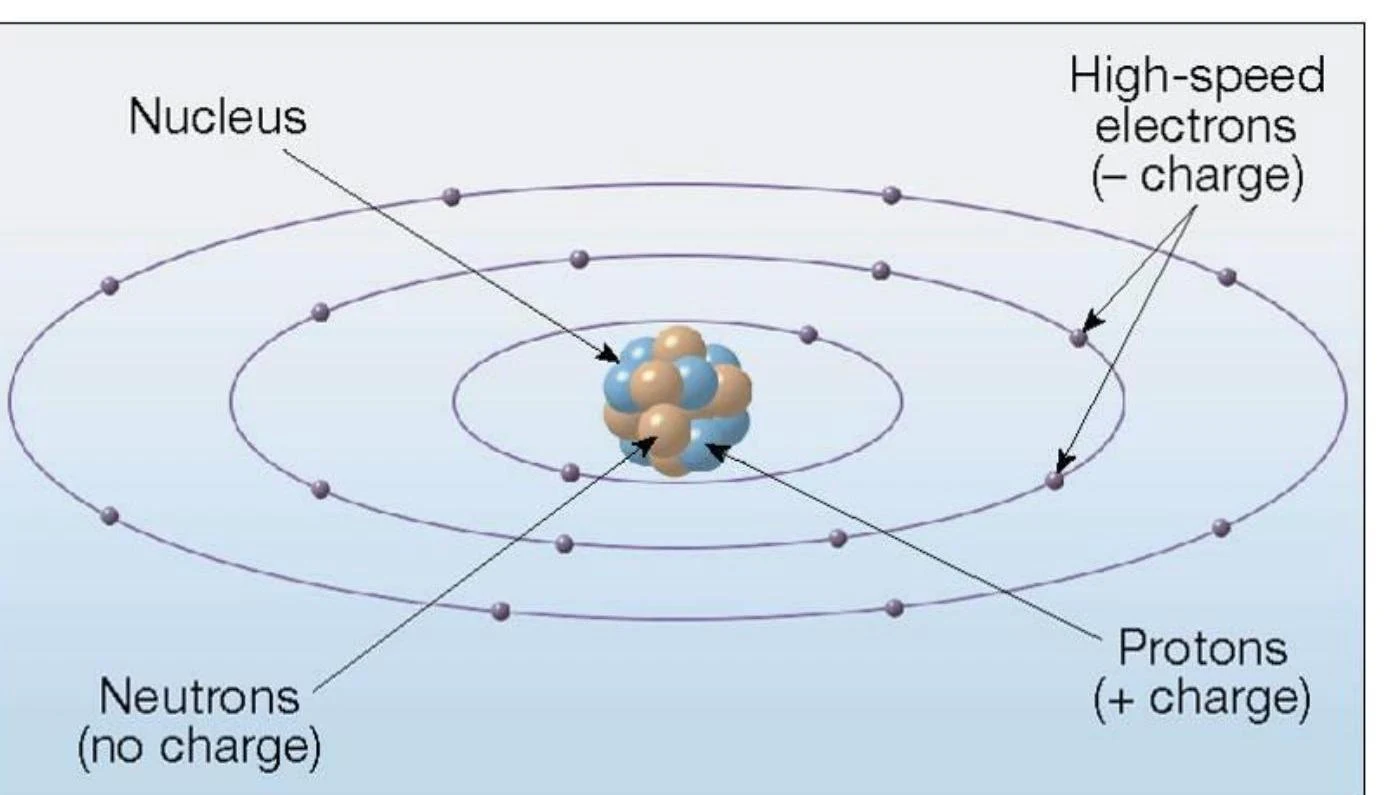
This diagram illustrates the basic structure of an atom, showing a central nucleus composed of protons and neutrons, surrounded by electrons orbiting in shells.
The rate at which this decay occurs is constant and is measured by the half-life (t1/2): the specific amount of time required for exactly half of the parent isotope atoms in a sample to decay into daughter atoms.
As time progresses, the number of parent atoms decreases exponentially, while the number of radiogenic daughter atoms increases. Crucially, the total number of atoms (parent + daughter) remains constant throughout the process.
Exam Tip: Remember that a longer half-life means a slower decay rate. If you are asked to rank isotopes by decay speed, the one with the largest half-life is the slowest.
Calculating Radiometric Ages
To determine an age, scientists use high-precision instruments called (Accelerator) Mass Spectrometers to measure the exact isotope ratios within a mineral sample. By knowing the ratio of daughter to parent atoms and the known half-life of the parent, the age can be calculated.
Worked Example: Step-by-Step Calculation
Problem: A rock contains 2,500 atoms of radioactive parent isotope A and 7,500 atoms of stable daughter isotope B. The half-life of A is 6 million years. What is the age of the rock?
Step 1: Find the total number of atoms.
Since the total number of atoms remains unchanged:
Total atoms=Parent+DaughterTotal atoms=2,500+7,500=10,000
Step 2: Determine how many half-lives have passed.
We look at the percentage of the parent remaining:
\text{Percentage of parent left} = \frac{2,500}{10,000} = 0.25 \text{ (or 25%)}
Step 3: Match the percentage to the number of half-lives.
0 half-lives: 100%
1 half-life: 50%
2 half-lives: 25%
Step 4: Multiply the number of half-lives by the half-life duration.Age=2 half-lives×6,000,000 years/half-life=12,000,000 years
Choosing the Right Isotopic System
Not all "clocks" are suitable for all rocks. Different isotopic systems are used depending on the age of the sample and the mineral being studied.
Parent Isotope
Daughter Isotope
Half-Life
Effective Range
Common Minerals
Uranium-238
Lead-206
4.4 billion years
10 Ma – 4.6 Ga
Zircon, Apatite
Potassium-40
Argon-40
1.3 billion years
50,000 – 4.6 Ga
Muscovite, Biotite
Carbon-14
Nitrogen-14
5,730 years
100 – 70,000 years
Organic matter (bone, wood)
Igneous vs. Sedimentary Dating
Radiometric dating is most effective in igneous and metamorphic rocks. This is because these rocks often represent the moment a mineral formed from a melt or reached a "chemically closed" state, meaning it began preserving its isotopic composition.
In contrast, sedimentary rocks cannot be dated directly using these methods. This is because sedimentary rocks are composed of older fragments (clasts) that have already been weathered and transported, meaning the minerals within them are often much older than the rock layer itself.
Radiocarbon Dating and the Biological Cycle
While most radiometric methods look at deep geological time, radiocarbon dating is used for much more recent history (within the last 70,000 years). This method specifically measures the time of death of an organism.
The process works through the biological carbon cycle:
14C is produced in the upper atmosphere and becomes 14CO2.
Plants and algae absorb this 14CO2 during photosynthesis.
Animals eat the plants, incorporating the 14C into their tissues.
When the organism dies, it stops taking in new carbon. The 14C already in its body begins to decay, acting as a timer that tracks how long ago the organism died.
The Geologic Timescale
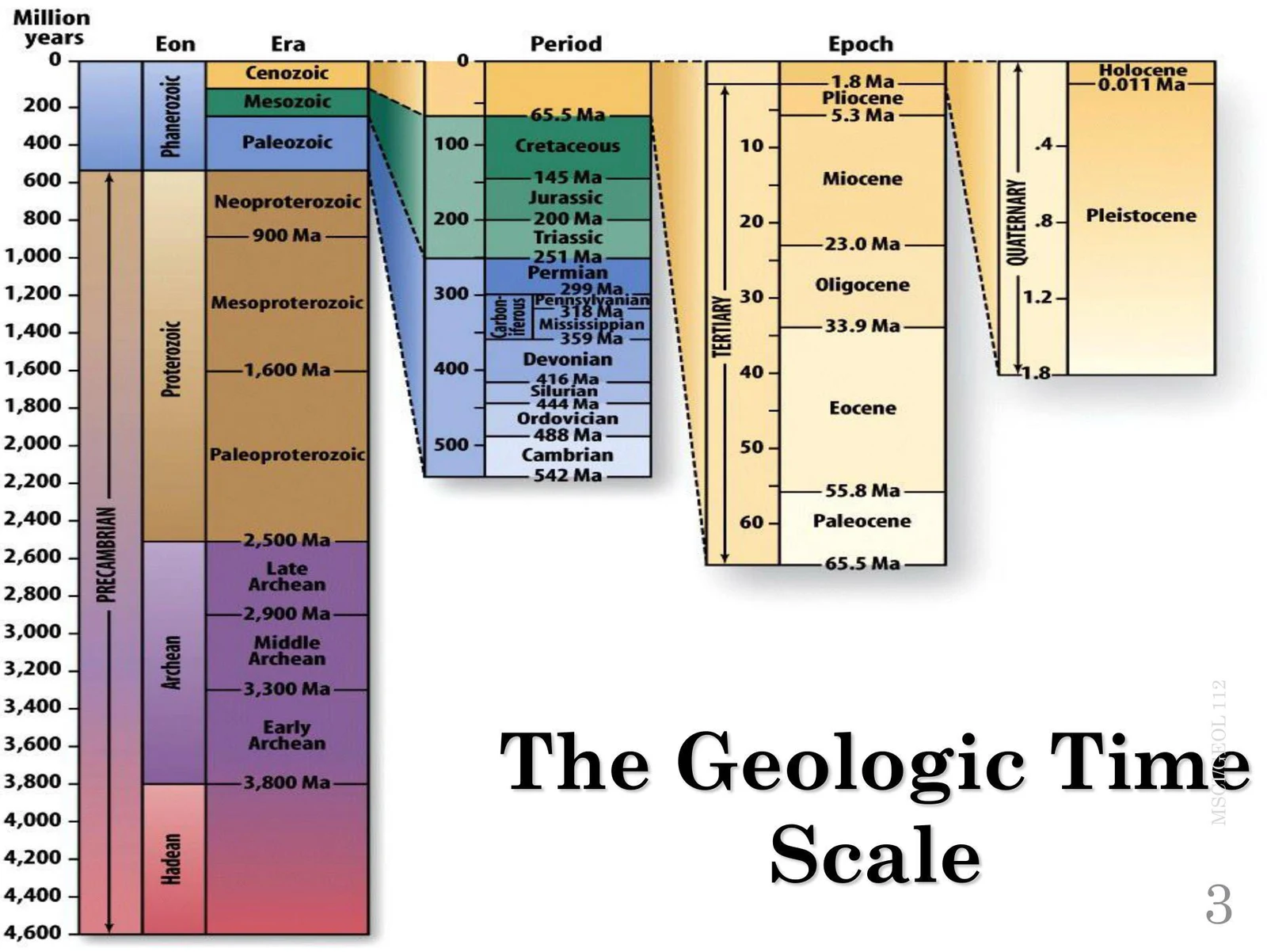
The ages obtained from radiometric dating allow us to construct the Geologic Time Scale, Earth's "calendar". This scale is organized into a hierarchy of time blocks:
Eons: The largest subdivisions (e.g., Hadean, Archean, Proterozoic, Phanerozoic).
Eras: Subdivisions of eons (e.g., Paleozoic, Mesozoic, Cenozoic).
Periods: Subdivisions of eras (e.g., Jurassic, Cretaceous).
Epochs: The smallest subdivisions (e.g., Holocene, Pleistocene).
The Geologic Time Scale illustrates the history of Earth, dividing it into eons, eras, periods, and epochs based on geological and biological events.
By combining these numerical ages with observations of tectonic deformation, metamorphism, and stratigraphy, geologists can reconstruct the entire history of the Earth, from the formation of the solar system (~4.56 Ga via meteorites) to the rise of modern humans.
Keep reading for free.
Create an account to finish this reading and make it part of your study routine.