Radical Stability and Halogenation Selectivity in Organic Chemistry
Explore the concepts of radical stability, hyperconjugation, and inductive effects in organic chemistry. Understand how these factors influence the selectivity of halogenation reactions like chlorination and bromination, and learn to predict product distributions using relative reactivity.
In organic chemistry, predicting the outcome of a reaction is often a tug-of-war between two competing forces: how much a reaction "wants" to happen (thermodynamics/stability) and how many opportunities it has to happen (statistics). When we perform radical halogenation on an alkane, we aren't just picking a random hydrogen to replace with a halogen; we are navigating a landscape of varying bond strengths and radical stabilities. Understanding this balance is essential for predicting whether you will end up with a single pure product or a messy mixture of isomers.
The Foundation: Radical Stability
A radical is a species containing an unpaired electron, making it highly reactive and electron-deficient. Because the carbon atom in a radical is not sharing its electron in a full covalent bond, it seeks stability through nearby electron density. This stability is achieved via hyperconjugation and inductive effects from adjacent alkyl groups.
The more alkyl groups attached to the radical carbon, the more "help" it receives in delocalizing that electron deficiency. Consequently, we rank radical stability based on the degree of substitution:
In a practical sense, if you are asked to rank compounds by stability, always look for the carbon with the most non-hydrogen substituents. A tertiary radical is significantly more stable than a primary one, which in turn is more stable than a methyl radical.
Case Study: 3-Methylpentane
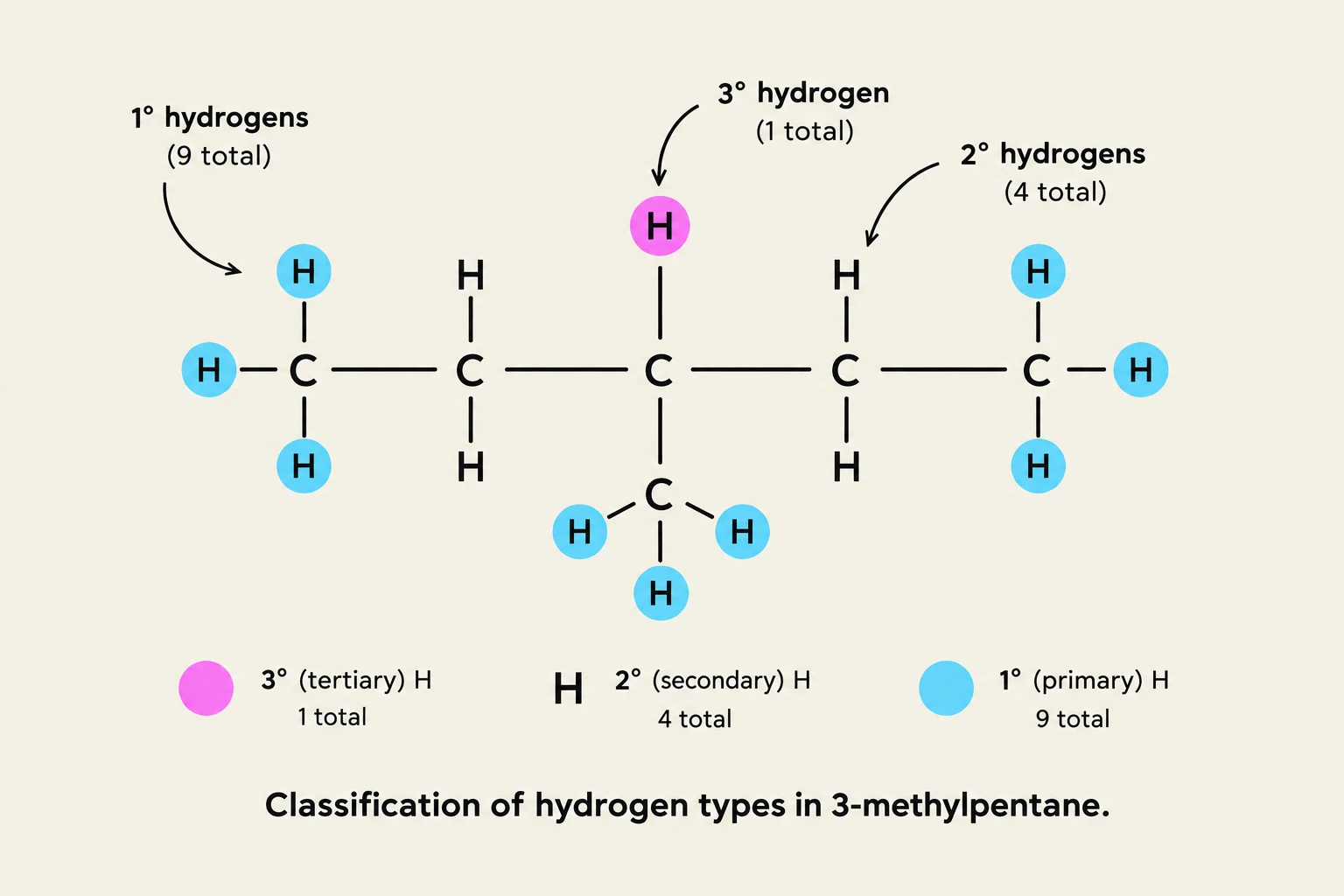
Classification of hydrogen types in 3-methylpentane.
To see how stability and statistics interact, let's analyze 3-methylpentane. Before we can predict products, we must identify the different types of hydrogens available in the molecule. We classify hydrogens based on the carbon they are attached to:
Tertiary (3∘) Hydrogens: There is one hydrogen on the C3 carbon (the carbon with the methyl branch). Replacing this leads to a 3∘ radical.
Secondary (2∘) Hydrogens: There are two different sets of CH2 groups. One set is at C2 and the other is at C4. These provide four 2∘ hydrogens in total.
Primary (1∘) Hydrogens: There are three methyl groups (CH3). One is the branch at C3, and the other two are at the ends of the pentane chain. This gives us a total of nine 1∘ hydrogens.
When we perform monochlorination or bromination, each of these distinct sites can produce a different constitutional isomer.
The Competition: Chlorination vs. Bromination
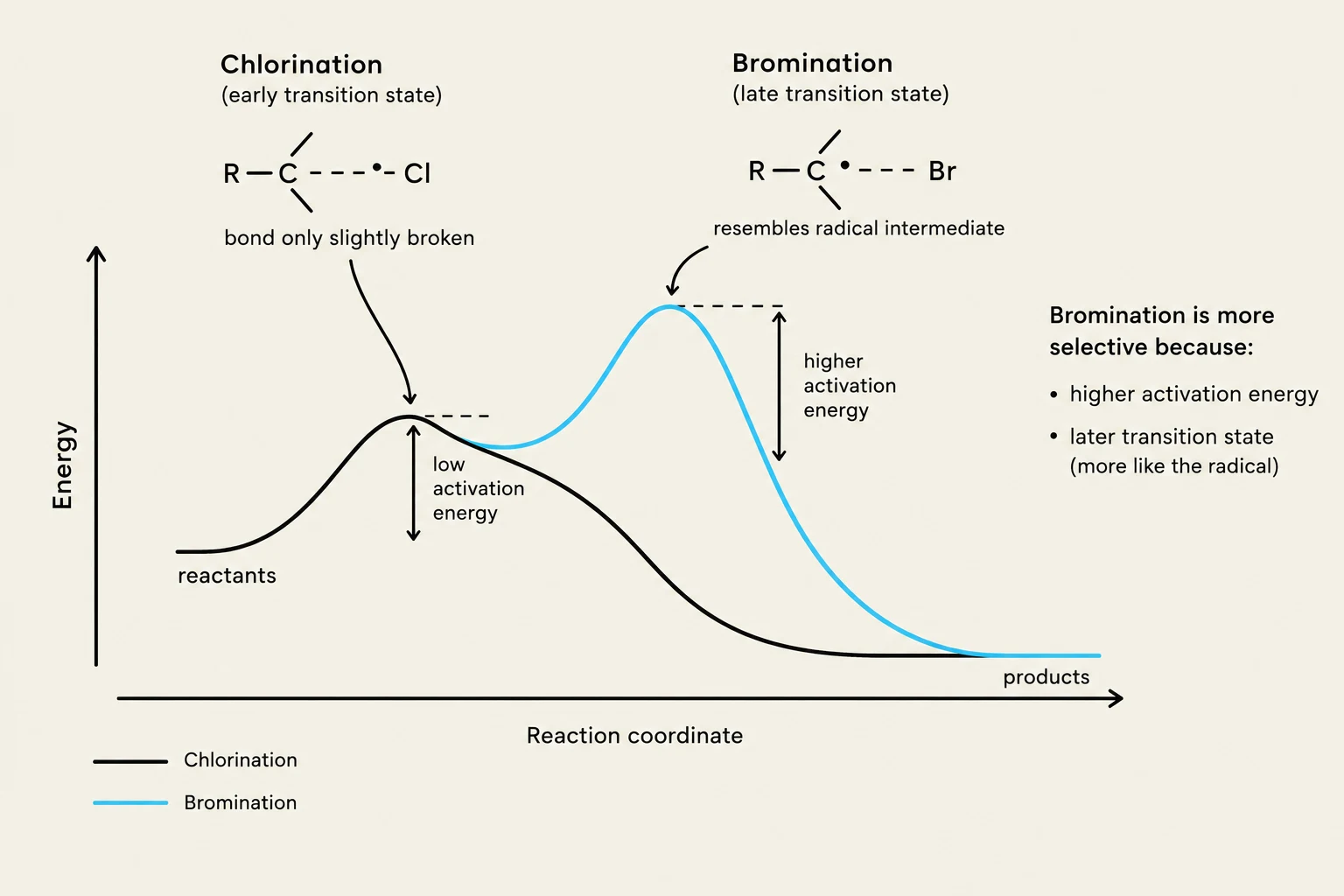
This diagram illustrates the energy profiles for chlorination and bromination reactions, highlighting differences in activation energy and transition states that contribute to bromination's higher selectivity.
The "selectivity" of a halogen refers to its ability to "choose" the most stable radical path over the statistically more likely path.
Monochlorination: The Unselective Path
Chlorine is highly reactive. In the transition state of a chlorination reaction, the bond to the hydrogen is only partially broken. Because the transition state does not look very much like the final radical, the energy difference between forming a 1∘, 2∘, or 3∘ radical is relatively small.
Because chlorine is "impatient," it often reacts with whatever hydrogen it hits first. While it still prefers more stable radicals, the sheer number of 1∘ hydrogens (nine) compared to the single 3∘ hydrogen (one) means that chlorination often produces a complex mixture of many different products.
Bromination: The Selective Path
Bromine is much less reactive and far more "picky." The transition state for bromine abstraction occurs much later in the reaction coordinate. This means the transition state closely resembles the actual radical intermediate.
Because the transition state "feels" the stability of the radical, the energy barrier to form a 3∘ radical is much lower than the barrier for a 1∘ radical. Consequently, bromination is highly regioselective. Even if there are nine 1∘ hydrogens and only one 3∘ hydrogen, bromine will almost exclusively target the 3∘ position.
Exam Tip: If a question asks which reagent is better for synthesizing a specific tertiary halide, the answer is almost always Bromine due to its high selectivity.
Quantitative Selectivity and Relative Reactivity
To move from qualitative predictions ("more stable is better") to quantitative ones ("what percentage of product X will I get?"), we use relative reactivity values. These values represent the rate at which a specific type of hydrogen reacts compared to a standard (usually methyl hydrogens).
To calculate the predicted percentage of a product, use the following formula:
Relative Yield=(Number of equivalent hydrogens)×(Relative reactivity of that type)
Example Calculation Workflow
If you were provided with a relative reactivity table (for example: 1∘=1, 2∘=3.8, 3∘=5), you would follow these steps for 3-methylpentane:
Calculate the percentage for the 3∘ product:%3∘=(29.25)×100≈17.1%
Note that in bromination, the relative reactivity values for 3∘ hydrogens are much higher (often >1600), which is why the 3∘ product dominates the yield regardless of the low number of hydrogens available.
Summary Table
Feature
Chlorination (Cl2/hν)
Bromination (Br2/hν)
Reactivity
High
Low
Selectivity
Low
High
Transition State
Early (resembles reactants)
Late (resembles radical)
Major Product
Mixture (Statistical + Stability)
Most stable radical (3∘)
Synthetic Utility
Poor for specific isomers
Excellent for specific isomers
Keep reading for free.
Create an account to finish this reading and make it part of your study routine.