Explores the dual wave-particle nature of electrons in quantum mechanics, introducing concepts like standing waves, quantization, quantum numbers, and their role in atomic structure and spectroscopy.
In classical physics, we often imagine electrons as tiny billiard balls orbiting a nucleus like planets around a sun. However, quantum mechanics reveals a much more complex and fascinating reality. Electrons are not merely particles; they are quantum objects that exhibit both particle-like and wave-like properties. Understanding how these "matter waves" behave is the key to unlocking the structure of the atom, the nature of chemical bonding, and the periodic trends that govern the elements.
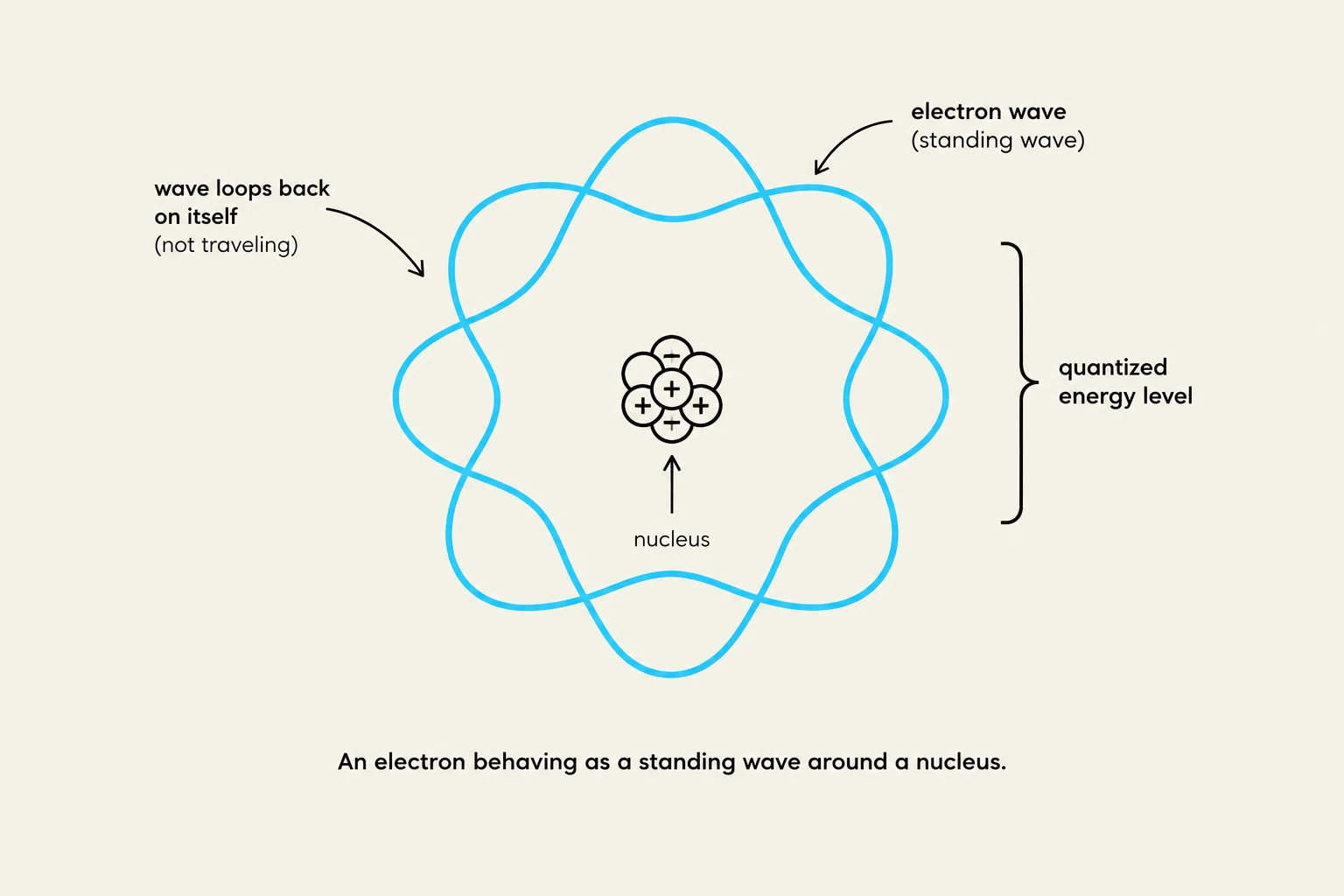
An illustration depicting an electron as a standing wave around a nucleus, illustrating quantized energy levels.
The Electron as a Standing Wave
Unlike a wave in the ocean that travels across the water, an electron in an atom behaves as a standing wave. Imagine plucking a guitar string: the wave doesn't travel away; it vibrates in place, creating a stable pattern of peaks and valleys.
Because electrons are confined to the space around a nucleus, they can only exist in specific patterns where the wave "loops" back on itself perfectly. This phenomenon is known as quantization. Only whole numbers of wave loops are permitted; if a wave pattern does not form a complete, continuous loop, it cannot exist.
Nodes and Wave Density
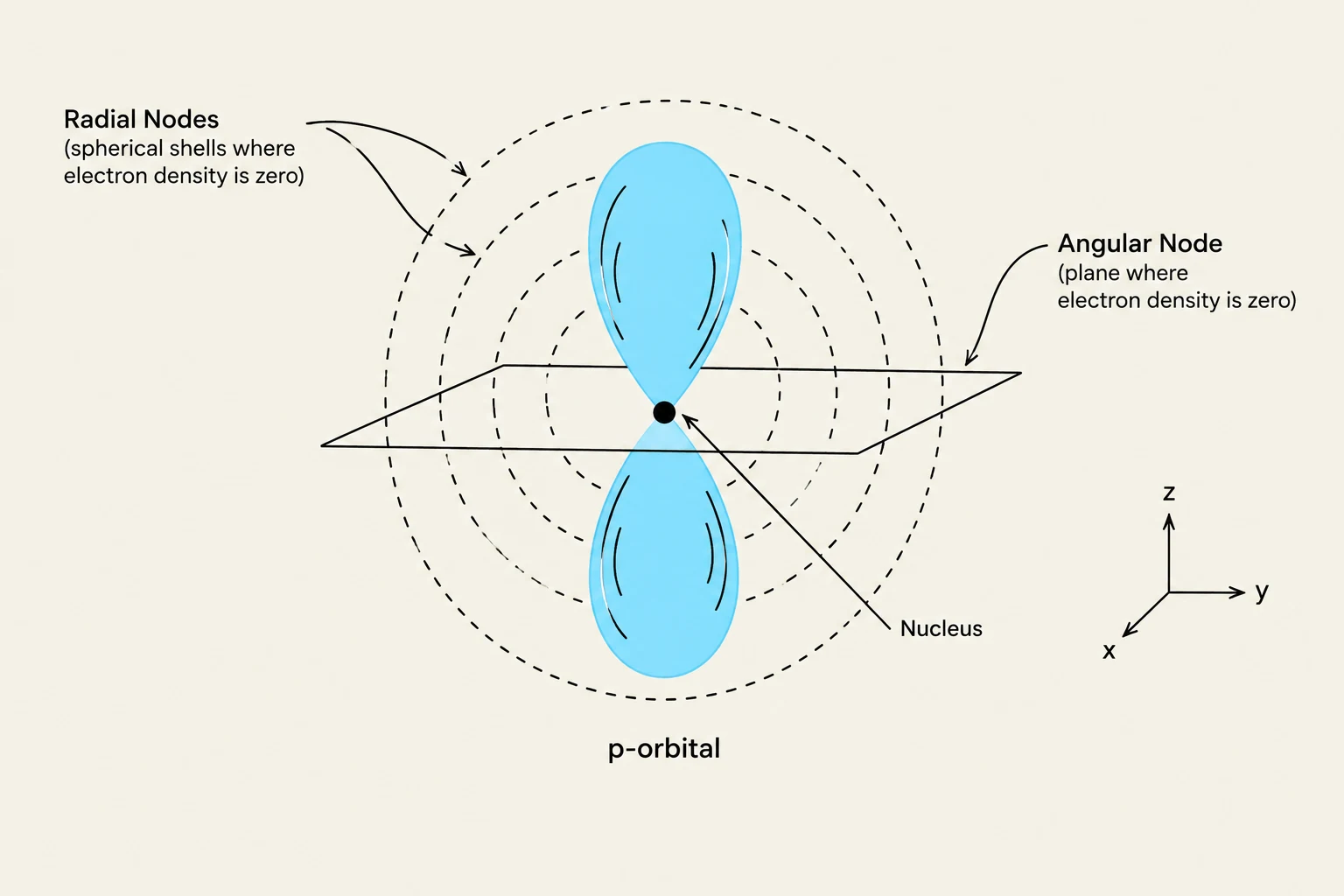
Illustration of a p-orbital, showing the nucleus, radial nodes, and an angular node where electron density is zero.
Within these standing wave patterns, there are specific regions called nodes. A node is a point where the probability of finding an electron is zero—essentially, a place where there is no wave density.
Radial Nodes: These are spherical layers, much like the layers of an onion, where the electron density drops to zero.
Angular Nodes: These are flat planes or cones that pass through the nucleus, dividing the electron cloud into different sections.
Describing the Electron: Quantum Numbers
To define the unique state of an electron wave, we use four specific values known as quantum numbers. These numbers act like a "GPS coordinate" for the electron, describing its energy, shape, and orientation.
Principal Quantum Number (n): This determines the overall energy level and the size of the electron wave. As n increases, the electron is further from the nucleus, the wave becomes larger, and the energy (En) increases.
Angular Momentum Quantum Number (l): This defines the shape of the subshell (or orbital type), such as $s, p, d,$ or f.
Magnetic Quantum Number (ml): This describes the spatial orientation of the orbital in 3D space (e.g., whether a p orbital points along the x, y, or z axis).
Spin Quantum Number (ms): This represents the intrinsic magnetic spin of the electron, which can only be +21 (spin up) or −21 (spin down).
Exam Tip: The Pauli Exclusion Principle
Always remember that no two electrons in the same atom can have the exact same set of four quantum numbers. This rule is why an orbital can hold a maximum of only two electrons, and they must have opposite spins.
Orbital Occupancy and Rules
When filling an atom with electrons, we follow three fundamental principles to ensure the most stable, lowest-energy configuration:
The Aufbau Principle: Electrons occupy the lowest energy states available first.
Hund's Rule: When filling degenerate orbitals (orbitals of the same energy, like the three p orbitals), electrons will occupy empty orbitals singly with parallel spins before they begin to pair up. This minimizes electron-electron repulsion.
The Pauli Exclusion Principle: As mentioned above, this prevents multiple electrons from occupying the same state.
Light, Energy, and Spectroscopy
The relationship between light and electron waves is defined by resonance. Energy is only transferred between light and matter when the frequency of the light matches the energy gap between electron states.
Absorption and Emission
This diagram illustrates the absorption of a photon by an electron, causing it to transition from an initial state (E1) to an excited state (E2). The energy of the photon is equal to the energy gap between these two states.
Absorption Spectroscopy: An electron absorbs a photon to jump from a lower energy state to a higher one. For this to happen, the photon's energy must exactly match the difference in energy between the two states:
Ephoton=ΔE=Efinal−Einitial=hν
where h is Planck's constant and ν is frequency.
Emission Spectroscopy: When an electron drops from a high-energy state to a lower one, it releases the excess energy as a photon of light.
The Photoelectric Effect and Ionization
If the energy provided by a photon is greater than the ionization energy (the energy required to completely remove an electron from the atom), the electron is ejected. In this scenario, the excess energy is converted into the electron's kinetic energy (KE):
Ephoton=IE+KE
Periodic Trends: Shielding and Effective Nuclear Charge
In multi-electron atoms, the experience of an electron is not determined solely by the nucleus. Shielding occurs when inner-shell electrons act as a barrier, reducing the attraction between the nucleus and the outer (valence) electrons.
This leads to the concept of Effective Nuclear Charge (Zeff), which is the actual net positive charge felt by a valence electron.
Subshell Energy: Because s orbitals penetrate closer to the nucleus than p orbitals, they are less shielded. Consequently, a $2p$ electron is higher in energy than a $2s$ electron in the same shell because it feels less of the nuclear charge.
Ionization Energy Trends:
Down a Group: As n increases, the electron wave becomes larger and further from the nucleus, making it easier to remove. Thus, ionization energy decreases.
Across a Period: As we move right, the number of protons increases, raising Zeff and pulling the electron waves closer. This makes the electrons harder to remove, so ionization energy generally increases.
Magnetism in Atoms
The arrangement of electron spins determines how an atom interacts with magnetic fields:
Paramagnetism: Atoms with one or more unpaired spins are paramagnetic and will be attracted to a magnetic field.
Diamagnetism: Atoms where all electrons are paired (having opposite spins that cancel out) are diamagnetic and show no response to a magnetic field.
Keep reading for free.
Create an account to finish this reading and make it part of your study routine.