This article provides a foundational overview of quantum mechanics and data science, their mathematical underpinnings, and how they converge in emerging technologies like quantum computing and cryptography.
The intersection of quantum mechanics and data science represents two of the most transformative frontiers in modern science. While quantum mechanics explores the fundamental, probabilistic nature of reality at the subatomic scale, data science provides the mathematical and computational frameworks required to extract meaningful patterns from complex information. This article provides a foundational overview of both fields, their mathematical underpinnings, and how they converge in emerging technologies.
1. Fundamental Principles of Quantum Mechanics
Quantum mechanics departs from classical physics by introducing a world governed by probability rather than certainty. At the heart of this field are several core concepts that challenge our macroscopic intuition.
1.1 Wave-Particle Duality and Superposition
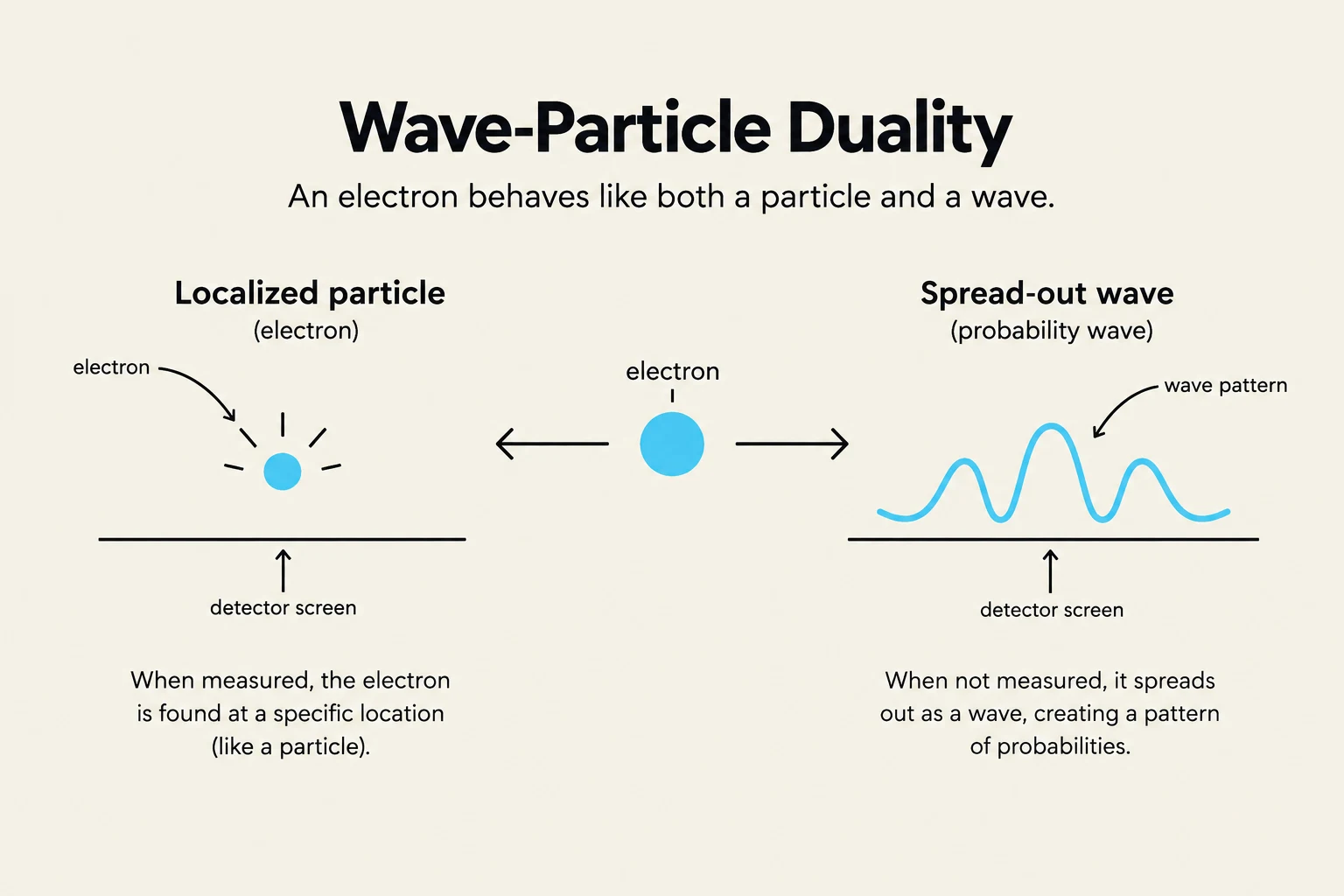
One of the most striking features of the quantum realm is wave-particle duality, where entities such as electrons and photons exhibit both wave-like and particle-like properties. Closely related is the principle of superposition, which posits that a quantum system can exist in multiple states simultaneously until an observation or measurement is made.
This diagram illustrates the concept of wave-particle duality, explaining how an electron can behave as both a localized particle and a spread-out wave.
1.2 The Heisenberg Uncertainty Principle
Even with perfect instruments, there are fundamental limits to what we can know. The Heisenberg Uncertainty Principle states that it is impossible to simultaneously determine the exact position (x) and momentum (p) of a particle with absolute precision. This is expressed mathematically as:
Δx⋅Δp≥2ℏ
where Δx is the uncertainty in position, Δp is the uncertainty in momentum, and ℏ is the reduced Planck constant.
1.3 The Schrödinger Equation and Dirac Notation
To describe how these quantum states evolve, physicists use the Schrödinger equation, which governs the time-dependent behavior of the wave function Ψ(r,t):
iℏ∂t∂Ψ(r,t)=H^Ψ(r,t)
In this equation, H^ represents the Hamiltonian operator, which corresponds to the total energy of the system. To manage these complex states efficiently, scientists use Dirac notation (or bra-ket notation), representing a quantum state as a "ket" vector, written as ∣ψ⟩.
Exam Tip: When working with the Schrödinger equation, remember that the Hamiltonian operator H^ is central to determining the energy levels of the system.
2. Foundations of Data Science
While quantum mechanics deals with the nature of matter, data science focuses on the nature of information. It is a multidisciplinary field that utilizes statistical methods and computational power to interpret data.
2.1 Data Collection and Analysis
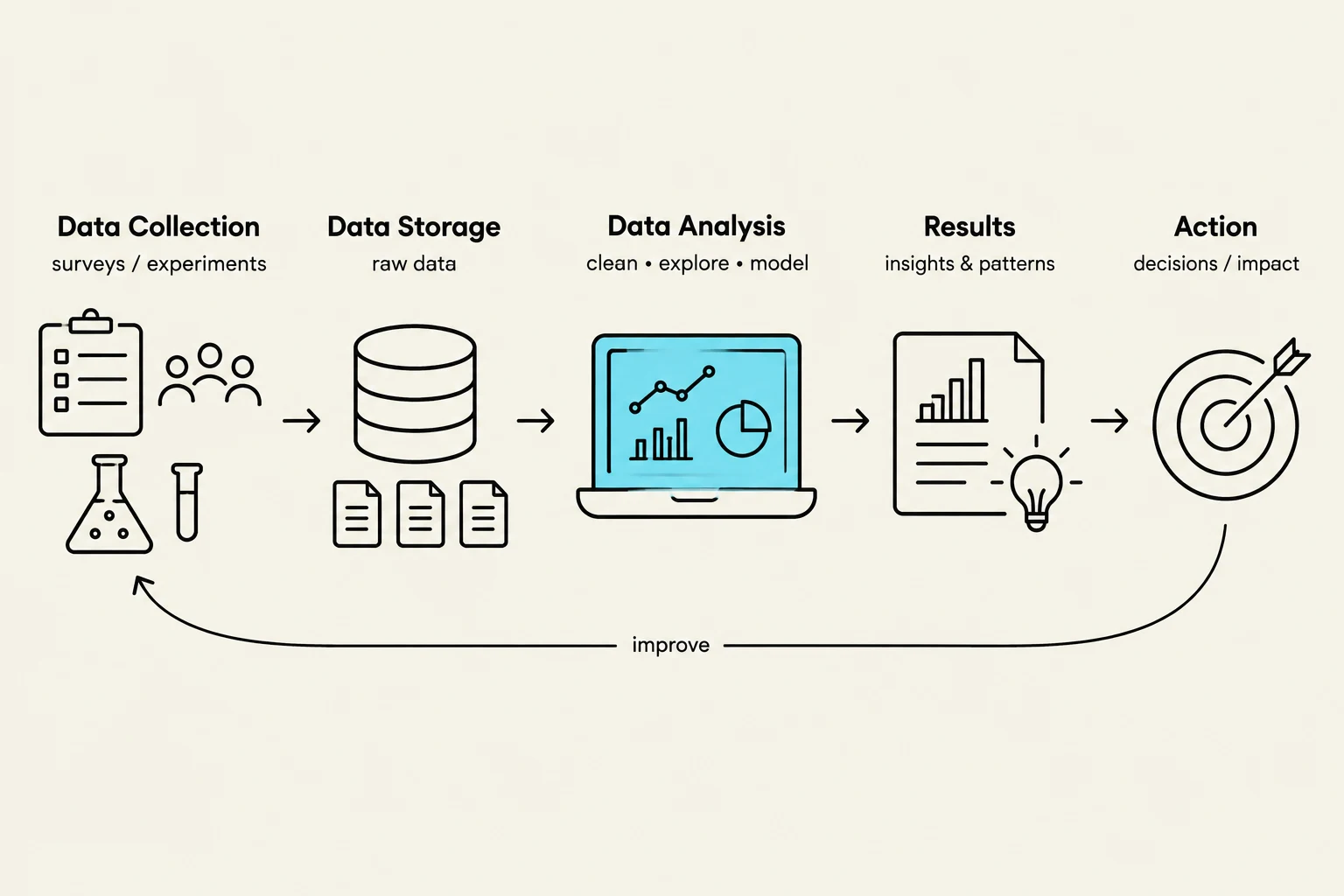
The lifecycle of a data science project begins with Data Collection, the process of gathering information from various sources such as surveys, experiments, or observational studies. Once collected, the data undergoes Data Analysis to transform raw numbers into actionable insights.
2.2 Statistical Frameworks
Data science relies heavily on two branches of statistics:
Descriptive Statistics: These are used to summarize and describe the basic features of a dataset, often using measures like mean, median, and mode.
Inferential Statistics: This involves taking a sample of data and making broader predictions or generalizations about a larger population.
This diagram illustrates the data science lifecycle, encompassing data collection, storage, analysis, results interpretation, and action, with a feedback loop for improvement.
2.3 Machine Learning
A subset of data science, Machine Learning involves using sophisticated algorithms to identify patterns within data and make autonomous predictions. This allows systems to "learn" from experience without being explicitly programmed for every specific task.
3. Convergence: Practical Applications
The synergy between quantum physics and data science is most evident in the development of next-generation technologies.
3.1 Quantum Computing
Quantum Computing leverages the principles of superposition and entanglement to perform calculations that are fundamentally impossible for classical computers. Instead of classical bits (0 or 1), quantum computers use qubits, which can represent multiple states at once, allowing for massive parallel processing power.
3.2 Quantum Cryptography
Security is another major application. Quantum Cryptography uses quantum mechanics to secure communications. A primary method is Quantum Key Distribution (QKD), which uses the properties of quantum states to ensure that any attempt to intercept a cryptographic key is immediately detectable.
Comparison of a classical bit, which can be either 0 or 1, and a quantum qubit, which can exist in a superposition of both 0 and 1 states, represented by a Bloch sphere.
4. Summary Table
Concept
Field
Primary Function
Superposition
Quantum Mechanics
Allows multiple simultaneous states
Uncertainty Principle
Quantum Mechanics
Defines limits of measurement precision
Machine Learning
Data Science
Identifies patterns and makes predictions
Qubits
Quantum Computing
The fundamental unit of quantum information
By mastering these fundamental principles—from the wave-like behavior of subatomic particles to the statistical modeling of large datasets—researchers can continue to push the boundaries of what is computationally and scientifically possible.
Keep reading for free.
Create an account to finish this reading and make it part of your study routine.