An overview of quantitative research methods in kinesiology, covering research designs, variables, validity, and assessment techniques. Learn how to design and evaluate studies using numerical data and statistical analysis.
In the field of kinesiology, understanding how the human body moves, performs, and responds to various stimuli requires more than just observation; it requires rigorous, structured investigation. Quantitative research provides the framework for this investigation by focusing on numerical data, measurable variables, and statistical analysis. By utilizing systematic designs, researchers can move beyond mere description to uncover the underlying causes of physiological or behavioral phenomena.
The Foundation: Purpose and Variables
Every scientific inquiry begins with a clear direction. The purpose statement serves as the foundation for the entire study design. Once the purpose is established, the researcher must define the relationship between different elements of the study, specifically the variables.
The most critical distinction in experimental research is between the independent variable (IV) and the dependent variable (DV). The independent variable is the factor that the researcher manipulates or introduces (such as a specific exercise program or a medication) to observe its effect. The dependent variable is the outcome or the effect being measured (such as body weight, heart rate, or muscle strength).
Exam Tip: When analyzing a study, always ask: "What is being changed?" (Independent Variable) and "What is being measured as a result?" (Dependent Variable).
Hierarchy of Research Designs
Research designs in kinesiology exist on a spectrum of complexity and control. The choice of design depends on whether the researcher wants to describe a population, find associations, or establish cause-and-effect relationships.
Non-Experimental and Descriptive Studies
Non-experimental designs are used when the researcher cannot or does not manipulate the independent variable. These are often descriptive studies used to report correlations or observations. Common types include:
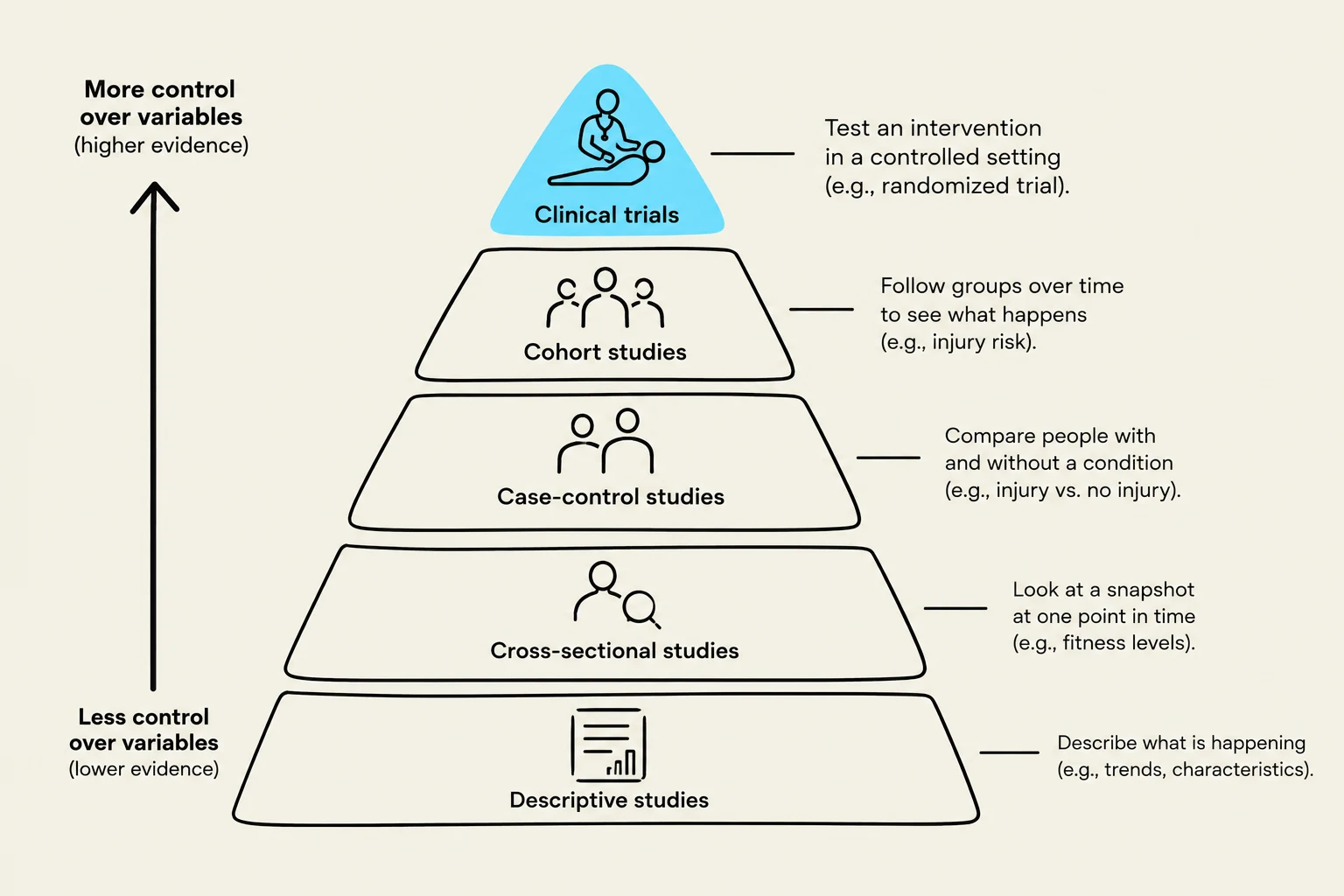
Cross-sectional studies: Observing a population at a single point in time.
Longitudinal studies: Following the same subjects over an extended period.
Case-control studies: Comparing individuals with a specific condition to those without it to look for past exposures.
Cohort studies: Following a group (cohort) over time to see how certain exposures affect future outcomes.
Experimental Designs: Seeking Causality
To move from "association" to "causation," researchers use experimental designs. True experimental designs are the most powerful tools for identifying cause-and-effect relationships. They typically occur in controlled environments, such as laboratories, to maximize control over the environment.
A hallmark of a true experiment is randomization—the process of assigning participants to groups using chance. This ensures that groups are similar at the start, reducing selection bias and balancing confounding variables.
This pyramid illustrates different types of research studies, ordered by their level of control over variables and evidence. Clinical trials offer the highest control and evidence, followed by cohort studies, case-control studies, cross-sectional studies, and descriptive studies, which offer the least control and evidence.
There are two primary ways to assign participants in these designs:
Independent Groups (Between-Participants): Different people are in each condition (e.g., Group A does cycling, Group B does nothing).
Repeated Measures (Within-Participants): The same people receive all treatments (e.g., the same person performs both a high-intensity and a low-intensity session).
Quasi-Experimental and Pre-Experimental Designs
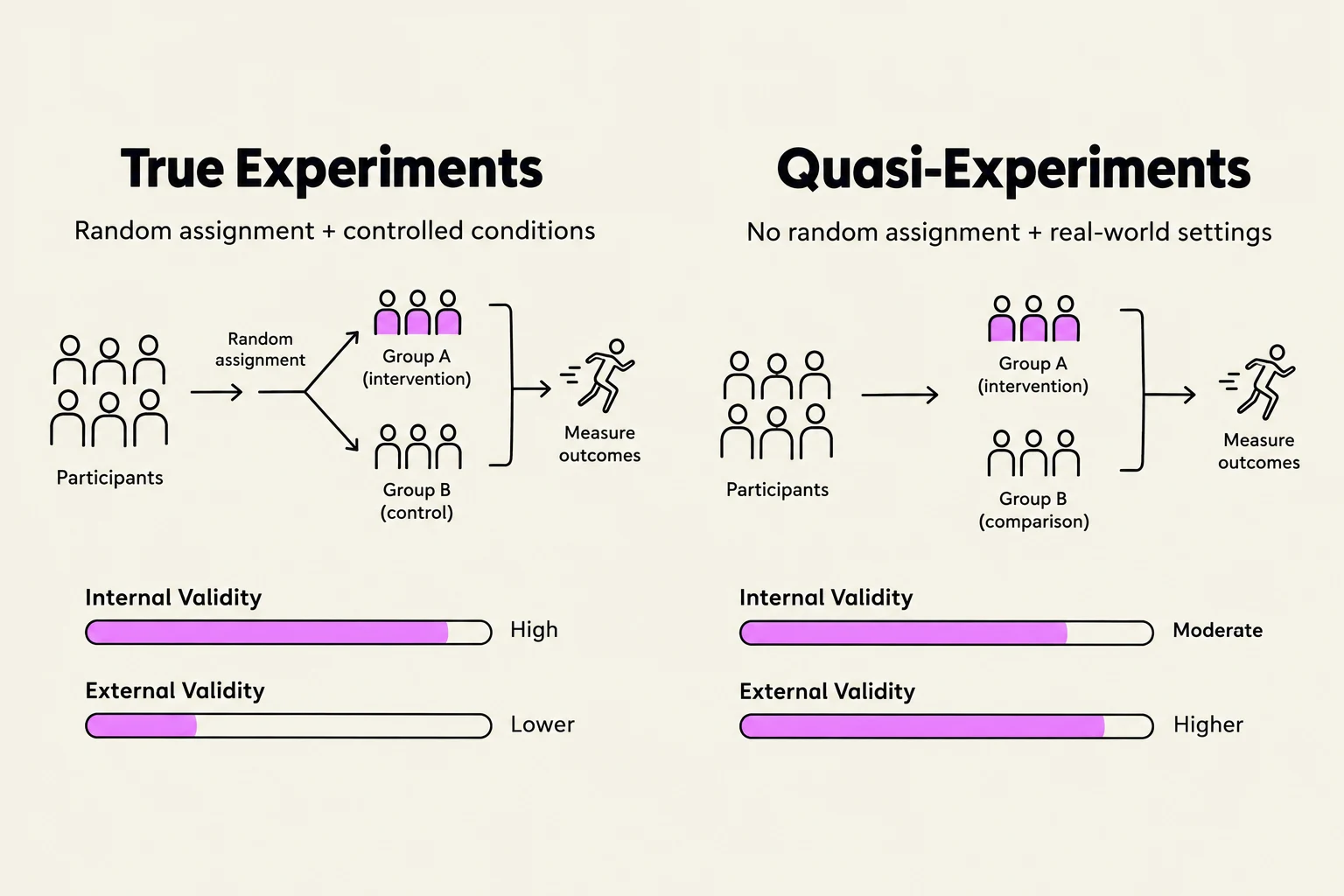
When randomization is not possible—often because the study takes place in a "real-world" setting—researchers use quasi-experimental designs. While these are useful for practical applications, they have lower internal validity than true experiments. Pre-experimental designs are even weaker and are often used as "prequels" or pilot studies to test feasibility before committing to a large-scale randomized controlled trial (RCT).
Validity: Internal vs. External
A critical part of evaluating any quantitative study is assessing its validity. Validity refers to how accurately a study measures what it intends to measure and how applicable its results are.
Internal Validity: This refers to the degree of confidence that the change in the dependent variable was actually caused by the manipulation of the independent variable, rather than some other outside factor. True experiments have high internal validity because of control and randomization.
External Validity: This refers to the extent to which the findings can be generalized to other populations, settings, or times. Interestingly, quasi-experimental studies often have higher external validity because they study people in real-world environments rather than artificial labs.
Comparison of true experiments with random assignment and controlled conditions versus quasi-experiments without random assignment in real-world settings, illustrating differences in internal and external validity.
Methods of Assessment and Measurement
To conduct quantitative research, one must convert observations into numerical data. This is achieved through various assessment methods:
Observation ("Watching"): This can be direct (the researcher is present) or indirect (using film or video).
Measurement ("Assessing"): This involves using instruments to collect data. In kinesiology, this often includes:
Physical measures: Height, weight, BMI, or heart rate.
Cognitive measures: Neuropsychological tests or oral interviews.
Affective measures: Assessing opinions, emotions, or motivations.
Questioning ("Asking"): Using structured or unstructured questionnaires, checklists, or interviews. A specialized method is the Delphi Technique, which seeks a consensus view from a group of experts.
Once data is collected, it is categorized into different scales (nominal, ordinal, interval, or ratio) and processed using statistical analyses to determine if the results are significant.
Summary Table: Experimental Design Elements
Element
Description
Participant Selection
How subjects are chosen and assigned (Random vs. Non-random)
Variables
Selection of the Independent (IV) and Dependent (DV) variables
Statistics
Identifying the appropriate mathematical methods for analysis
Procedures
The step-by-step plan for the experimental intervention
Keep reading for free.
Create an account to finish this reading and make it part of your study routine.