


In the metabolic landscape of the cell, the transition from glycolysis to the Citric Acid Cycle (TCA cycle) represents a critical junction. This transition is governed by the Pyruvate Dehydrogenase Complex (PDHC), a massive multimeric enzyme located within the mitochondrial matrix. The PDHC catalyzes the irreversible oxidative decarboxylation of pyruvate to generate acetyl-CoA. This reaction is essential because it converts the product of glycolysis into a form that can enter the TCA cycle to drive oxidative phosphorylation and ATP production.
The Architecture of the Complex
The PDHC is not a single enzyme but a sophisticated multi-enzyme complex. Its structure is designed to maximize efficiency through "substrate channeling," where intermediates are passed directly from one active site to the next without diffusing away into the mitochondrial matrix.
The complex consists of three distinct enzymatic subunits:
- Pyruvate Dehydrogenase (E1): Responsible for the initial decarboxylation of pyruvate.
- Dihydrolipoyl Transacetylase (E2): Forms the structural core of the complex and facilitates the transfer of the acetyl group to Coenzyme A.
- Dihydrolipoyl Dehydrogenase (E3): Responsible for reoxidizing the enzyme components to reset the cycle for the next reaction.
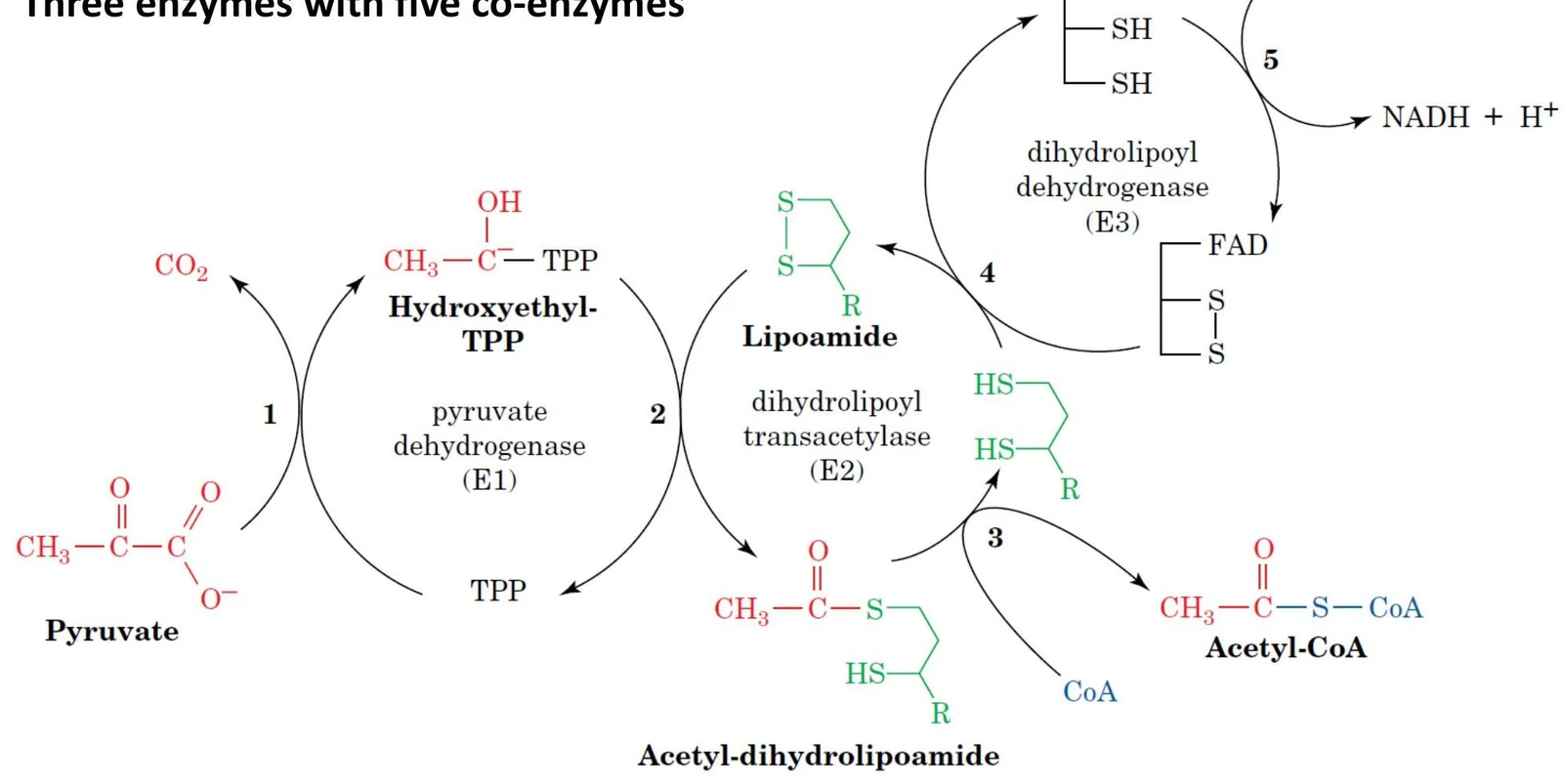
The E2 subunit forms a massive core—in mammals, this core contains 60 subunits—while E1 and E3 subunits are attached to the outer layer of this core.
The Five Essential Cofactors
To perform its complex task, the PDHC requires five different cofactors. These can be categorized into prosthetic groups (permanently bound to the enzyme) and substrates (which enter and leave the reaction).

Keep reading for free.
Create an account to finish this reading and make it part of your study routine.
Continue reading freeAlready have an account? Log in
Updated