Purchasing and Procurement Management Fundamentals
An introduction to the core concepts of purchasing and procurement management, covering the purchasing cycle, warehousing, stock control, quantity management, and payment methods.
In the world of business, efficiency is the difference between profit and loss. At the heart of this efficiency lies Purchasing and Procurement Management. While many people use these terms interchangeably, procurement is a strategic process that ensures a business acquires everything it needs to operate effectively.
The ultimate goal of a successful procurement department is to ensure the business receives:
The right supplier
The right quality
The right quantity
The right time
The right place
The best price
The Purchasing Cycle
Procurement is not a single event but a continuous cycle of activities designed to meet the needs of the business. A streamlined cycle prevents shortages and ensures that production or service delivery is never interrupted.
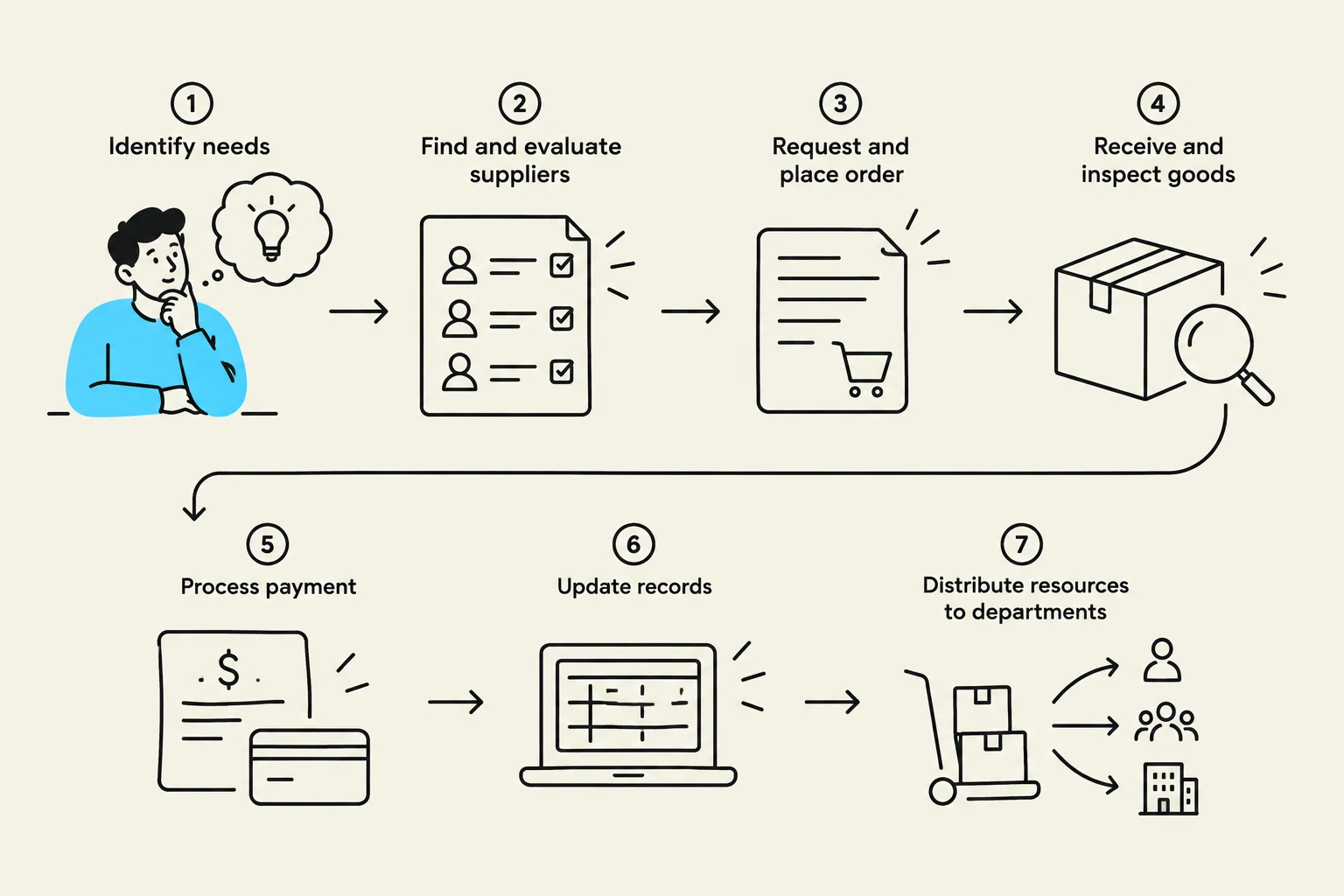
The typical steps in the purchasing cycle include:
Identify business needs: Determining what materials or services are required.
Assess and select supplier: Evaluating potential vendors based on reliability, price, and quality.
Place order: Formally requesting the goods from the chosen supplier.
Receiving of order: Taking delivery of the goods and checking them for accuracy.
Assessing orders against invoices: Verifying that the goods received match what was billed.
Send resources to departments or warehouse: Distributing the items to where they are needed for use.
This diagram illustrates the seven steps of a procurement process: identifying needs, finding and evaluating suppliers, requesting and placing an order, receiving and inspecting goods, processing payment, updating records, and distributing resources to departments.
Exam Tip: When asked about supplier selection, remember that "the cheapest price" is not always the best choice. A supplier must also meet requirements for quality, capacity, and timing.
Warehousing and Stock Control
Once goods are purchased, they must be managed carefully. This involves two distinct but related functions: warehousing and stock control.
Warehousing Functions
Warehousing is more than just "storing things." It serves several critical logistical functions:
Storage: Keeping goods safe until they are needed.
Consolidate: Combining small shipments from different suppliers into one large shipment to save on transport costs.
Break-bulk: Taking large shipments and breaking them down into smaller quantities for individual customers or departments.
Mixing: Combining different products to create a specific assortment.
Postponement: Delaying the final configuration of a product until an order is received.
Types of Stock
Not all inventory is the same. A business must categorize its stock to manage it effectively:
Raw materials: Basic substances used in production.
Semi-finished goods: Items that have undergone some processing but are not yet complete.
Finished goods: Completed products ready for sale.
Perishable stock: Goods that decay quickly (e.g., food).
Capital goods: Long-term assets used in the business (e.g., machinery).
Dangerous material: Flammable, toxic, or hazardous substances that require special handling.
This diagram illustrates the different types of stock in a supply chain, including raw materials, semi-finished goods, finished goods, and special stock.
Quantity Management
How much should a business buy? This is the core question of quantity management. Buying too much ties up cash and increases storage costs, while buying too little can halt production.
Economic Ordering Quantity (EOQ)
Businesses often use the Economic Ordering Quantity (EOQ) model to find the "sweet spot." The goal is to minimize the total costs associated with ordering (the cost of placing an order) and carrying (the cost of holding stock in a warehouse).
Just-in-Time (JIT) System
The JIT system is an alternative approach where materials are ordered and received only when they are needed for production. This minimizes the need for large warehouses and reduces the amount of capital tied up in stock. However, it requires extremely reliable suppliers, as there is very little "safety stock" to fall back on.
Economies and Diseconomies of Scale
The size of a business's purchasing operations can significantly impact its costs.
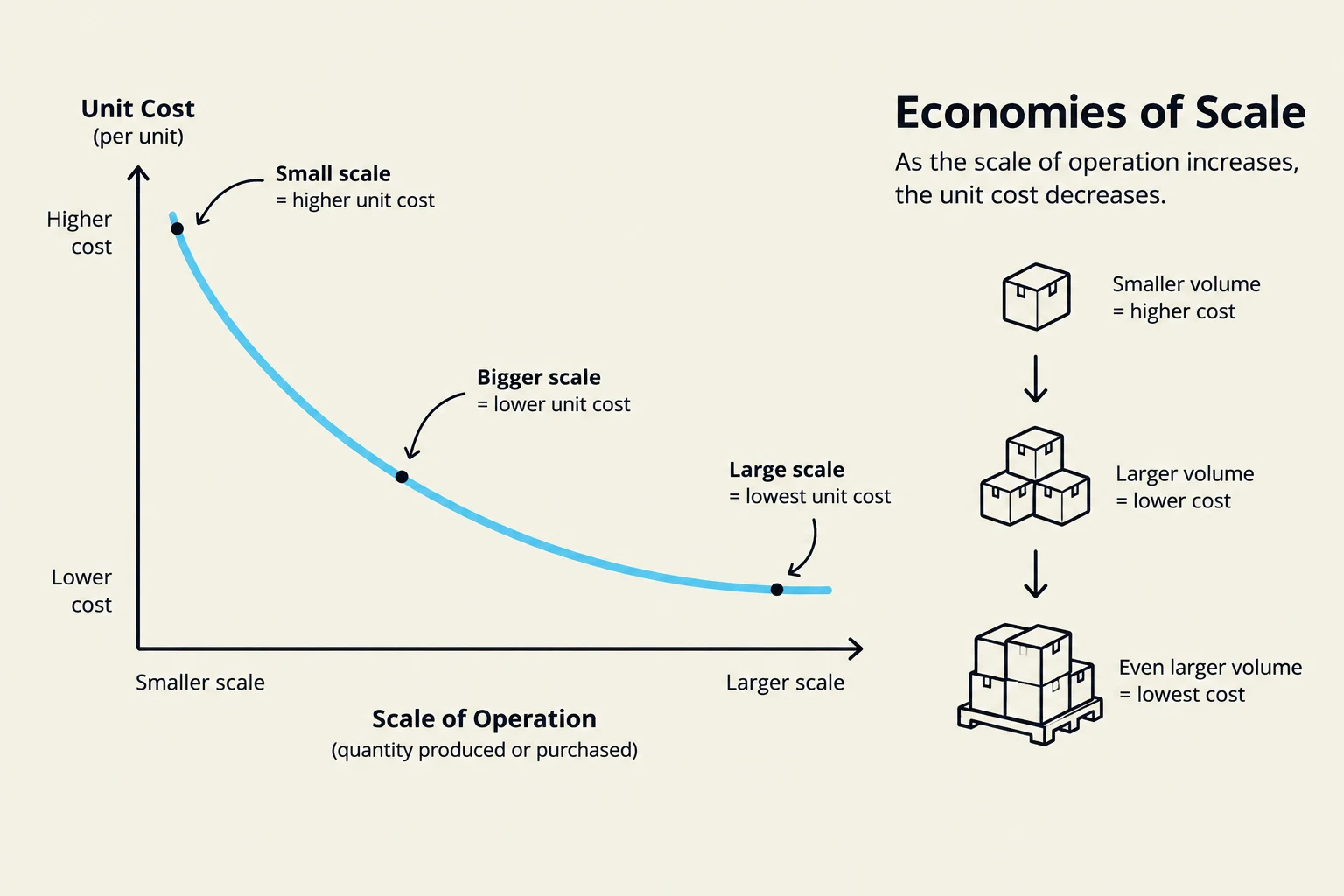
Economies of Scale occur when a business benefits from the size of its operations. For example, buying in massive quantities often allows a business to negotiate lower unit prices, reducing the overall cost of production.
Conversely, Diseconomies of Scale can occur if a business grows too large and becomes inefficient. This might happen due to communication breakdowns, management complexities, or the increased cost of coordinating massive logistics networks.
This diagram illustrates the concept of economies of scale, showing how unit costs decrease as the scale of operation increases, with corresponding visual representations of increasing volume and decreasing costs.
Purchasing Methods: Cash vs. Credit
Finally, businesses must decide how to pay for their procurement:
Cash Purchases: Paying immediately. This is often cheaper as it avoids interest, but it reduces the immediate cash available for other needs.
Credit Purchases: Buying now and paying later. This improves the cash flow of a business, allowing it to use its money for other operations while waiting to pay the supplier. However, it may involve finance charges or interest.
Keep reading for free.
Create an account to finish this reading and make it part of your study routine.