


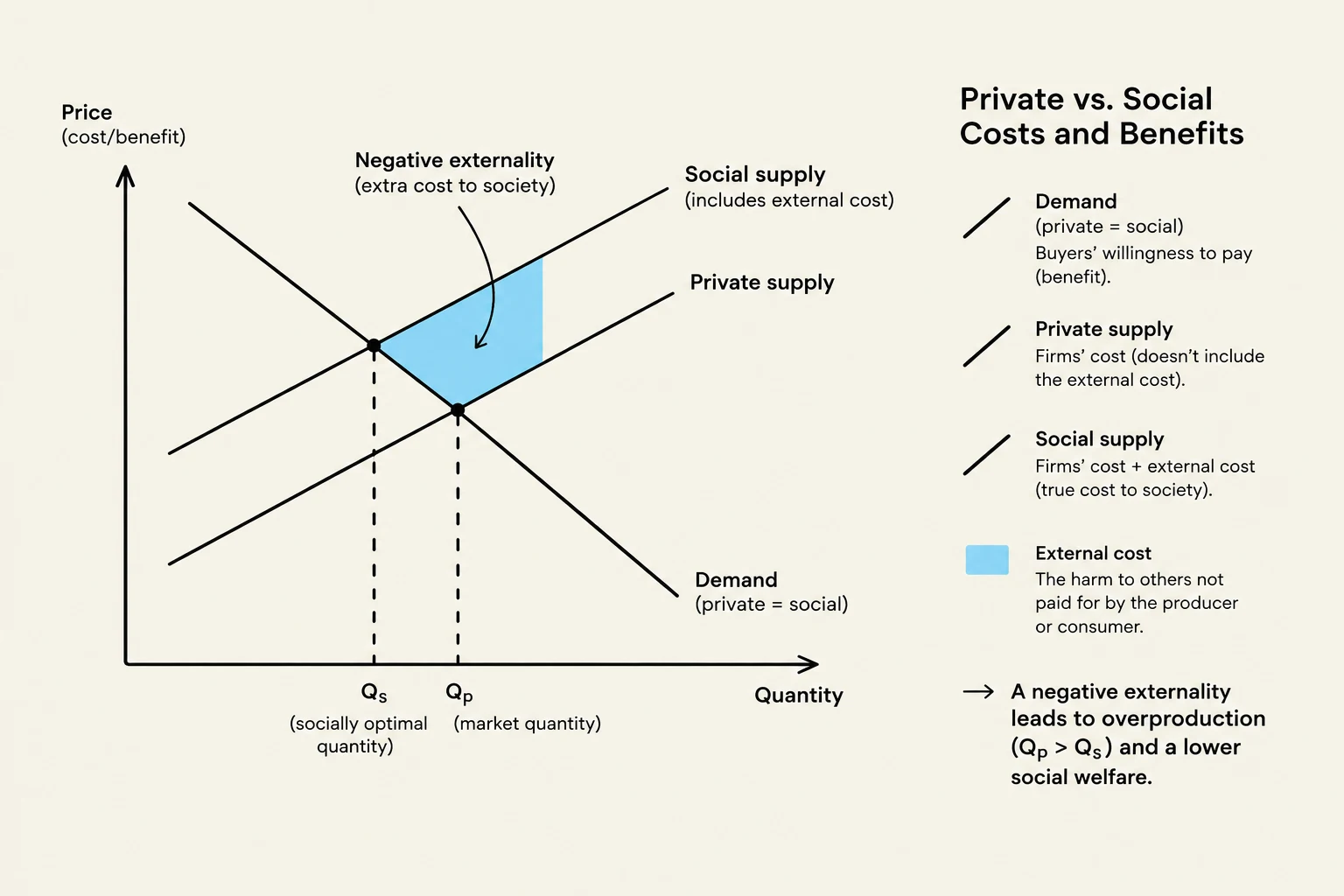
In a perfect market, prices act as signals that guide resources to where they are most valued, ensuring that goods are produced in the right quantities. However, the real world is often messy. Sometimes, the act of buying or producing a good affects people who aren't even involved in the transaction. When this happens, the market fails to reach an efficient outcome. This article explores why certain goods—like national defense or clean water—don't follow standard market rules, and how "externalities" can lead to social problems like pollution or underfunded education.
The Four Types of Goods
To understand why markets fail, we must first classify goods based on two fundamental attributes: excludability and rivalry.
- Excludability: Can the supplier prevent people who do not pay from using the good? (e.g., you can prevent someone from eating a cheeseburger if they don't pay).
- Rivalry: Does one person's consumption of the good reduce the ability of others to consume it? (e.g., if you eat a cheeseburger, no one else can eat that same burger).
Using these two attributes, we can categorize all goods into four distinct groups:
- Private Goods: Both excludable and rival (e.g., wheat, jeans, or a cheeseburger). These are efficiently provided by competitive markets.
- Public Goods: Non-excludable and non-rival (e.g., national defense, street signs, or a lighthouse). Because people can "free-ride" without paying, private markets often underprovide these goods.
- Common Resources: Non-excludable but rival (e.g., clean water, fish in the ocean, or a congested highway). These are prone to overuse because individuals ignore the depletion they cause for others.
- Artificially Scarce Goods: Excludable but non-rival (e.g., on-demand movies or Wi-Fi). While markets provide these, they often do so at an inefficiently low level due to the price charged.

Keep reading for free.
Create an account to finish this reading and make it part of your study routine.
Continue reading freeAlready have an account? Log in
Updated