Psychology as a Science: Research Methods and Reasoning
An introduction to the scientific method in psychology, covering deductive, inductive, and hypothetico-deductive reasoning, variable definition, and descriptive versus experimental research methods.
Understanding psychology requires more than just observing people; it requires a disciplined approach to inquiry. While many people offer "pop psychology" advice based on intuition, true psychology is a science. A science is defined as any discipline that relies on the scientific method to discover and sharpen knowledge, built upon the fundamental belief that the universe operates according to natural laws that can be discovered and tested.
The Foundations of Scientific Reasoning
To discover these natural laws, psychologists rely on the scientific method, which utilizes various forms of logical reasoning derived from philosophy. Depending on the goal of the study, a researcher might use one of three primary reasoning types:
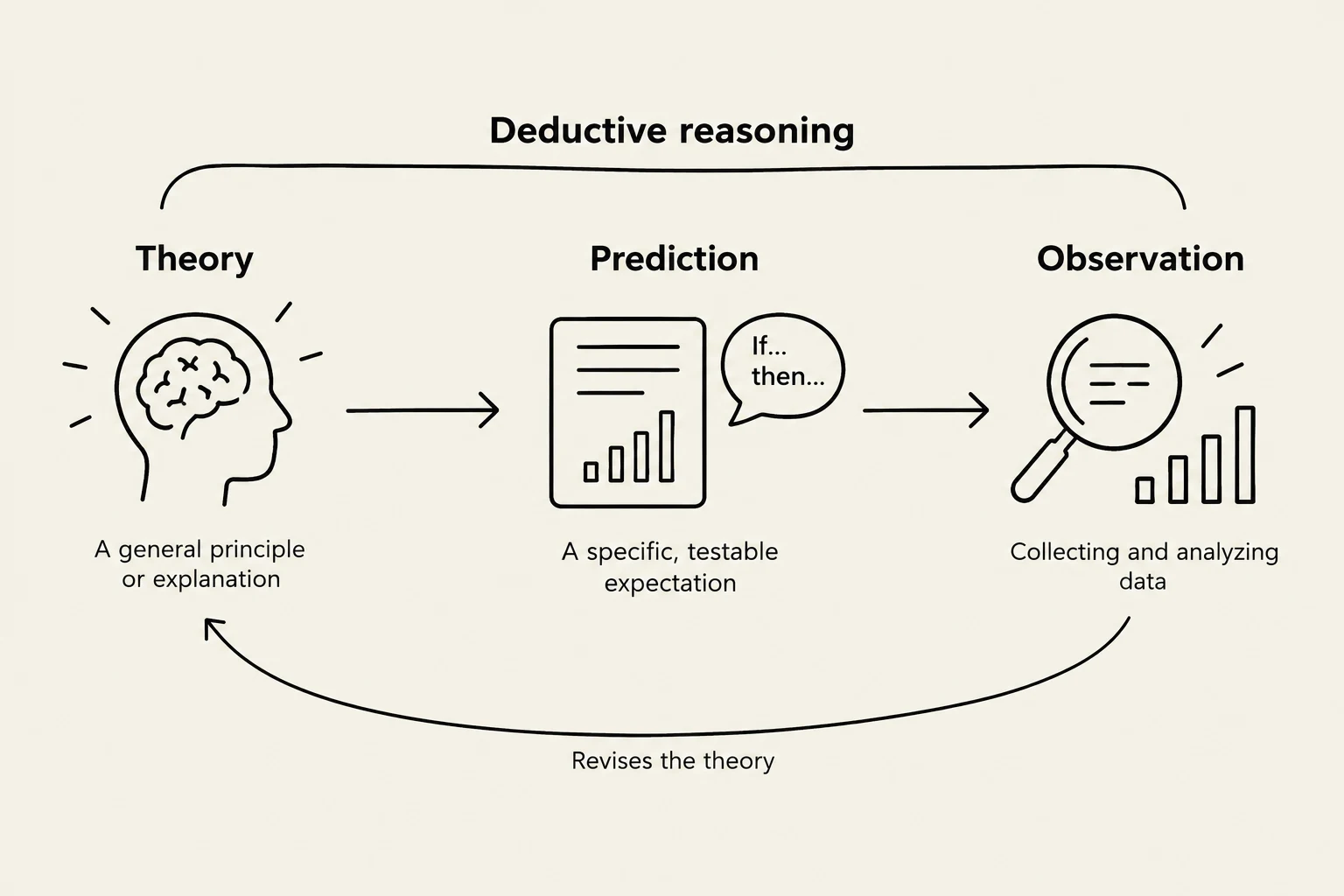
Deductive Reasoning: This involves proceeding from broad, established principles or theories to specific, predictable situations.
Inductive Reasoning: This is the opposite process, where a researcher moves from specific observations or small situations to develop more general truths or theories.
Hypothetico-deductive Reasoning: This is a common approach in modern science. It begins with an "educated guess" (a hypothesis) that is then tested through controlled observations to see if the guess is supported or invalidated.
A diagram illustrating the process of deductive reasoning, starting with a theory, leading to a prediction, followed by observation and data analysis, which then revises the theory.
Exam Tip: If a question asks about moving from a "general rule" to a "specific case," think Deductive. If it moves from "specific observations" to a "general rule," think Inductive.
Defining Variables and Measurement
Once a researcher has a hypothesis, they must identify the variables involved. In any study, there are two main types of variables that interact with one another:
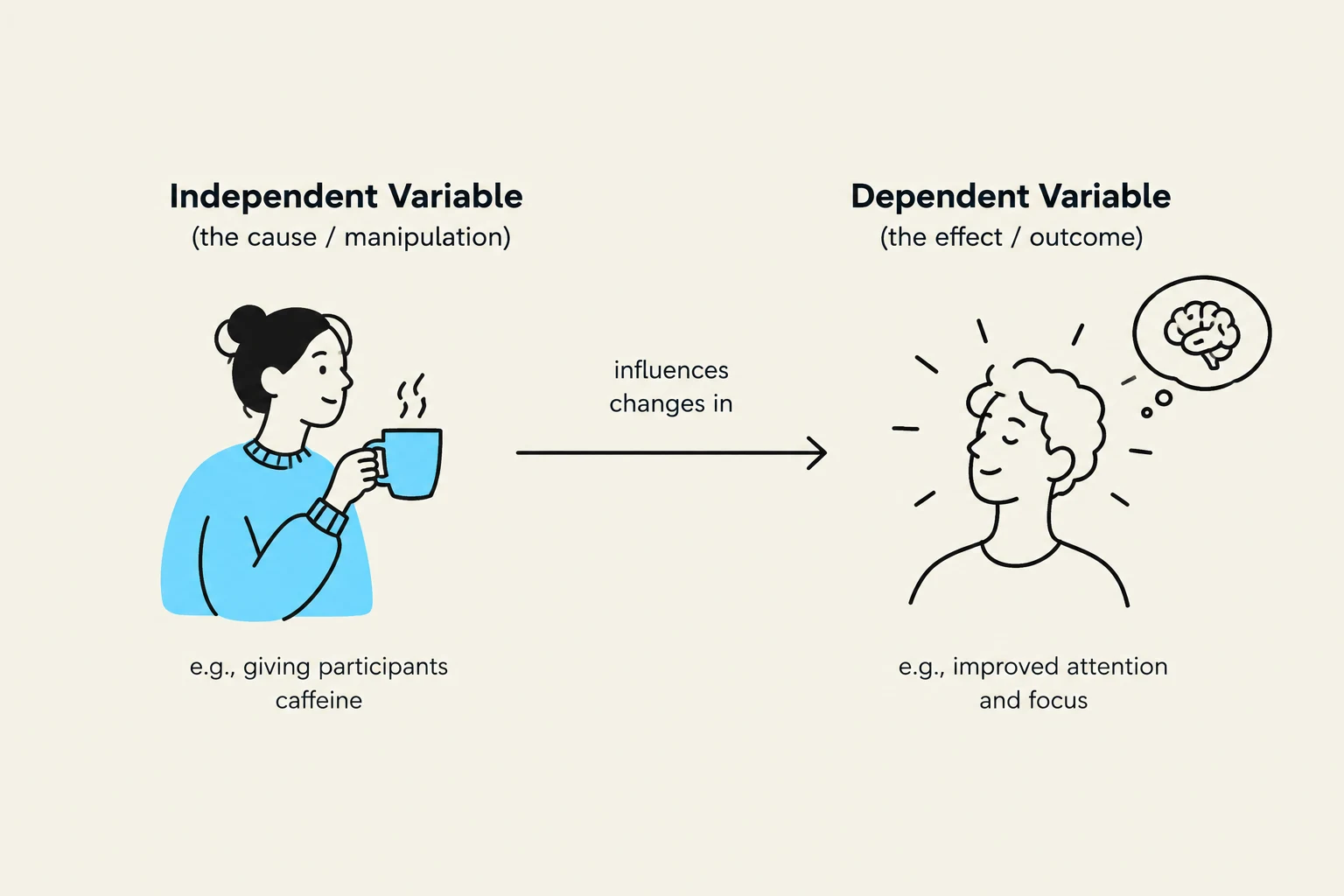
Independent Variable (IV): The variable that affects, influences, or is manipulated by the researcher.
Dependent Variable (DV): The variable that is affected or measured; it "depends" on the changes made to the IV.
For example, if you are studying whether the amount of sleep affects test scores, the "hours of sleep" is your IV, and the "test scores" are your DV.
Because concepts like "aggression" or "happiness" are abstract, researchers must use operational definitions. An operational definition specifies exactly how a researcher decides to measure a variable. For instance, instead of just saying "sleep," an operational definition might be "the number of hours an individual remains unconscious between 11:00 PM and 7:00 AM."
This diagram illustrates the relationship between an independent variable (the cause or manipulation) and a dependent variable (the effect or outcome), using the example of caffeine intake influencing attention and focus.
Participants: Populations and Samples
Researchers rarely study every single person in existence. Instead, they focus on a population, which is the entire group of interest (e.g., all college students in the world). Because studying a whole population is impossible, researchers select a sample, which is a smaller portion of that population used for the actual study.
To ensure the sample is a fair representation of the population and to minimize sampling bias, researchers use random selection. This means every member of the population has an equal chance of being chosen for the study.
Descriptive Research Methods
Descriptive research is used to observe, collect, and record data to describe behavior. While these methods are excellent for developing early ideas and reflecting actual behavior, they have one major limitation: they cannot explain cause and effect.
Common descriptive methods include:
Case Studies: An intensive, detailed study of one or two individuals. This is useful for studying rare behaviors, but results cannot be generalized to the wider population.
Naturalistic Observation: Systematically watching and recording how individuals behave in their natural environments. A risk here is the Hawthorne Effect, where people change their behavior because they know they are being watched.
Surveys: Using questionnaires to ask people directly about their own behaviors. This is a quick and cheap way to get data from large samples, though people may not always be truthful.
Experimental Research: Finding Causality
If a researcher wants to move beyond description and actually identify cause and effect, they must use experimental research. This method involves the active manipulation and control of variables.
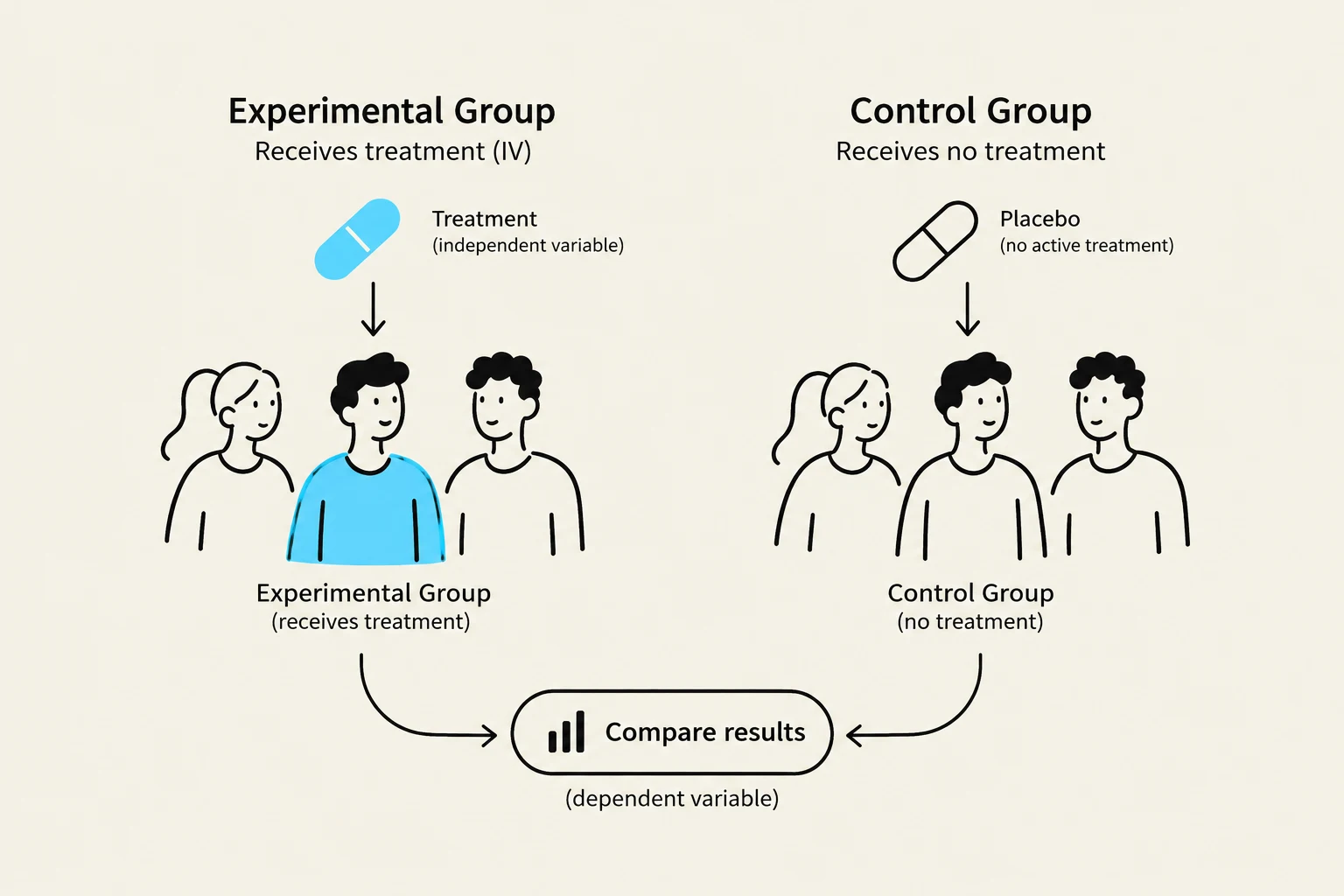
In a controlled experiment, participants are divided into two groups:
Experimental Group: The group that is exposed to the Independent Variable (the treatment or manipulation).
Control Group: The group that is not exposed to the IV. This group serves as a baseline to compare against the experimental group.
To ensure the groups are similar before the study begins, researchers use random assignment. This prevents pre-existing differences between people from skewing the results. To further reduce bias, researchers may use a double-blind procedure, where neither the participants nor the researchers know who belongs to which group.
This diagram illustrates the difference between an experimental group receiving a treatment (independent variable) and a control group receiving no treatment or a placebo, with results being compared as the dependent variable.
Summary Table: Descriptive vs. Experimental
Feature
Descriptive Research
Experimental Research
Goal
Observe and record
Identify cause and effect
Control
Little to no control
Precise control of variables
Methods
Case studies, Observation, Surveys
Manipulation of IV
Limitation
Cannot prove causation
Can be artificial or unethical
Keep reading for free.
Create an account to finish this reading and make it part of your study routine.