Psychology and the Frameworks of Scientific Thinking
An introduction to psychology as a scientific discipline, exploring its definition, the complexity of human behavior, and the principles of scientific thinking versus pseudoscience.
What is psychology? While many people use the term colloquially to describe "reading minds" or analyzing personalities, it is formally defined as the scientific study of the mind, brain, and behaviour. Unlike common sense or intuition, psychology relies on systematic and empirical investigations. This means that knowledge is acquired through direct observation (empirical) and follows a planned, objective method for collecting information (systematic).
The Complexity of Human Behaviour
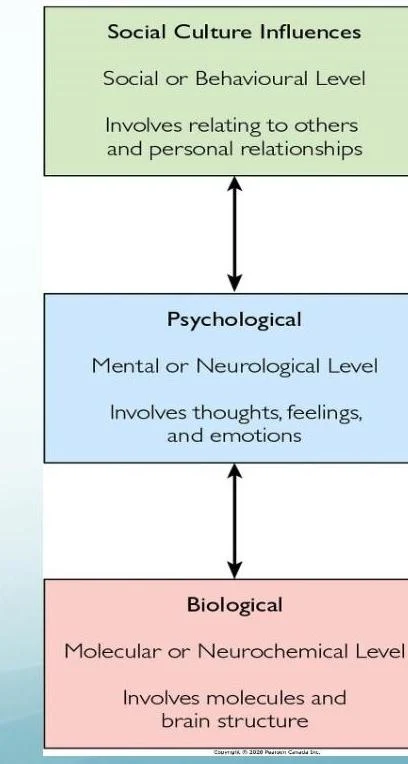
One of the primary challenges in psychology is that human behaviour is "multiply determined," meaning it is produced by a vast array of interacting factors. Because of this complexity, psychologists use different levels of analysis to understand a single phenomenon.
This diagram illustrates the biopsychosocial model, showing the interplay between social, psychological, and biological factors in influencing human experience.
These levels typically include:
Biological level: Examining brain functions, genetics, and neurochemistry.
Psychological level: Looking at individual thoughts, emotions, and personality.
Social-cultural level: Considering how the environment and culture shape behaviour.
Furthermore, variables in psychology are often interrelated through reciprocal determinism, a concept where people and their environments mutually influence each other's behaviour.
Exam Tip: When asked about the difficulty of predicting behaviour, remember that it is rarely caused by a single factor. Always look for the interaction between biological, psychological, and social variables.
Moving Beyond Common Sense
We often rely on "common sense" or proverbs to navigate life, but these can be deeply flawed. For instance, we might hear that "opposites attract," yet psychological research might suggest otherwise. We also struggle with naïve realism—the mistaken belief that we see the world exactly as it is.
A black top hat with a gold band.
Naïve realism makes us prone to errors in complex situations, such as politics, where we assume our perception is the objective truth. To combat this, science provides a structured method to move beyond these intuitive errors.
Science vs. Pseudoscience
A critical skill in psychology is distinguishing between science and pseudoscience—claims that appear scientific but lack the necessary safeguards.
The Building Blocks of Science
In true scientific inquiry, researchers use scientific theories to provide an explanatory framework for a large number of findings. From these theories, they derive a hypothesis: a specific, testable prediction.
Red Flags of Pseudoscience
Pseudoscience often relies on "proof" rather than evidence and frequently uses the following tactics:
Exaggerated claims: Promising "miracle cures" for complex ailments.
Anecdotes: Using personal stories or testimonials instead of controlled data.
Lack of self-correction: Having no mechanism to discard ideas when they are proven wrong.
Ad hoc immunizing hypotheses: Creating excuses to explain away contradictory evidence.
Warning: Beware of the Bandwagon Fallacy (believing something because many people do) and the Emotional Reasoning Fallacy (using your feelings to evaluate a claim's truth).
The Six Principles of Scientific Thinking
To maintain scientific skepticism—the practice of evaluating claims with an open mind but insisting on persuasive evidence—scientists follow six core principles:
Ruling out rival hypotheses: You must consider alternative explanations. If a person loses weight on a "miracle diet," you must rule out whether they also started exercising or changed other habits.
Correlation is not causation: Just because two variables are related (correlated) does not mean one causes the other. A third variable (C) might be causing both (A and B).
Falsifiability: For a claim to be scientific, it must be possible to disprove it. Metaphysical questions (e.g., "Does God exist?") are not scientific because they cannot be tested or falsified.
Replicability: Findings must be reproducible. If an experiment is conducted again and yields different results, the original finding may have occurred by chance.
Two figures using microscopes.
Extraordinary claims require extraordinary evidence: If a claim contradicts established scientific knowledge (e.g., alien abductions), the evidence provided must be exceptionally strong.
Occam's Razor (Parsimony): When multiple explanations exist, the simplest one—the one requiring the fewest unnecessary assumptions—is often the best.
The Goals of Science
Ultimately, the scientific approach aims to achieve four goals:
Description: Identifying and characterizing a phenomenon (e.g., describing symptoms of depression).
Explanation: Understanding why a phenomenon occurs (e.g., identifying the causes of behavior).
Prediction: Using known associations to forecast future outcomes (e.g., predicting road rage based on traffic conditions).
Control: Exerting influence over research settings or applying knowledge to real-world problems (e.g., developing treatments for mental health).
Historical Frameworks
Psychology has evolved through various theoretical frameworks, each offering a different lens on human nature:
Structuralism: Aimed to identify the basic "elements" of experience (sensations, feelings) via introspection.
Functionalism: Focused on the purpose of thoughts and behaviors and how they help us adapt.
Behaviourism: Rejected the study of the "mind" as a black box, focusing strictly on observable, verifiable behavior.
Cognitivism: Re-opened the "black box" to study internal mental processes like memory, language, and reasoning.
Psychoanalysis: Proposed that unconscious drives and memories dictate our behavior.
While these frameworks differ, modern psychology often integrates them to provide a more complete picture of the human experience.
Keep reading for free.
Create an account to finish this reading and make it part of your study routine.