Psychodrama in Group Counseling: Theory and Practice
An exploration of psychodrama as a dynamic, action-oriented approach to group counseling, detailing its key concepts, basic elements, phases, and therapeutic techniques. It also discusses applications in school settings and with multicultural populations, along with its strengths and limitations.
Psychodrama is a dynamic, action-oriented approach to group counseling that moves beyond traditional "talk therapy" by inviting members to act out their internal experiences. Rather than simply discussing a problem, participants use movement, role-playing, and creative expression to explore past traumas, present conflicts, or future aspirations. This method is designed to foster direct experience, providing a unique laboratory for personal growth and emotional healing.
Key Concepts of Psychodrama
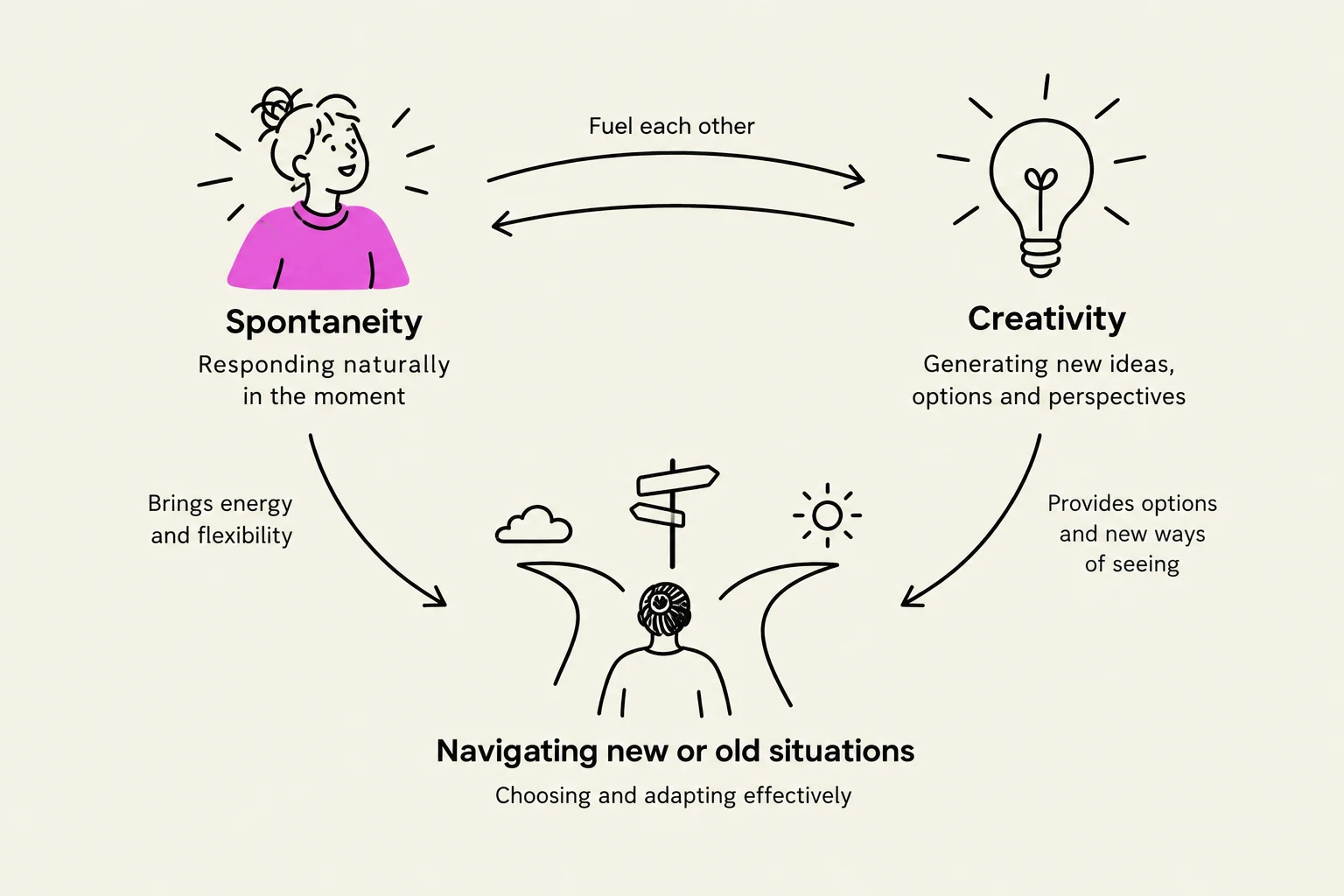
To understand how psychodrama functions, one must first grasp the psychological principles that underpin the method. At its core, psychodrama relies on creativity and spontaneity—the ability to respond to a new situation in a new way, or an old situation in a new way.
The process is driven by several foundational concepts:
Tele: The process of perceiving and responding to the emotional states of others, facilitating a sense of connection within the group.
Surplus Reality: The practice of acting out things that are not currently happening, such as "what if" scenarios, unexpressed feelings, or idealized versions of reality.
Catharsis and Insight: Through action, participants often experience a release of pent-up emotions (catharsis), which leads to a deeper understanding of themselves (insight).
Role Theory: The idea that our identities are composed of various roles we play in life; psychodrama allows us to examine and reshape these roles.
Reality Testing: While the work may involve "surplus reality," it remains grounded in the ability to distinguish between the enactment and actual reality.
Study Tip: When preparing for exams, remember that "Spontaneity" is not just about being "silly"; it is a therapeutic capacity to react flexibly to life's demands.
This diagram illustrates the relationship between spontaneity and creativity in navigating new or old situations, highlighting how they fuel each other and contribute to effective adaptation.
The Basic Elements of the Psychodrama Group
A psychodrama session is structured around specific roles and a physical space that facilitates the work.
The Participants
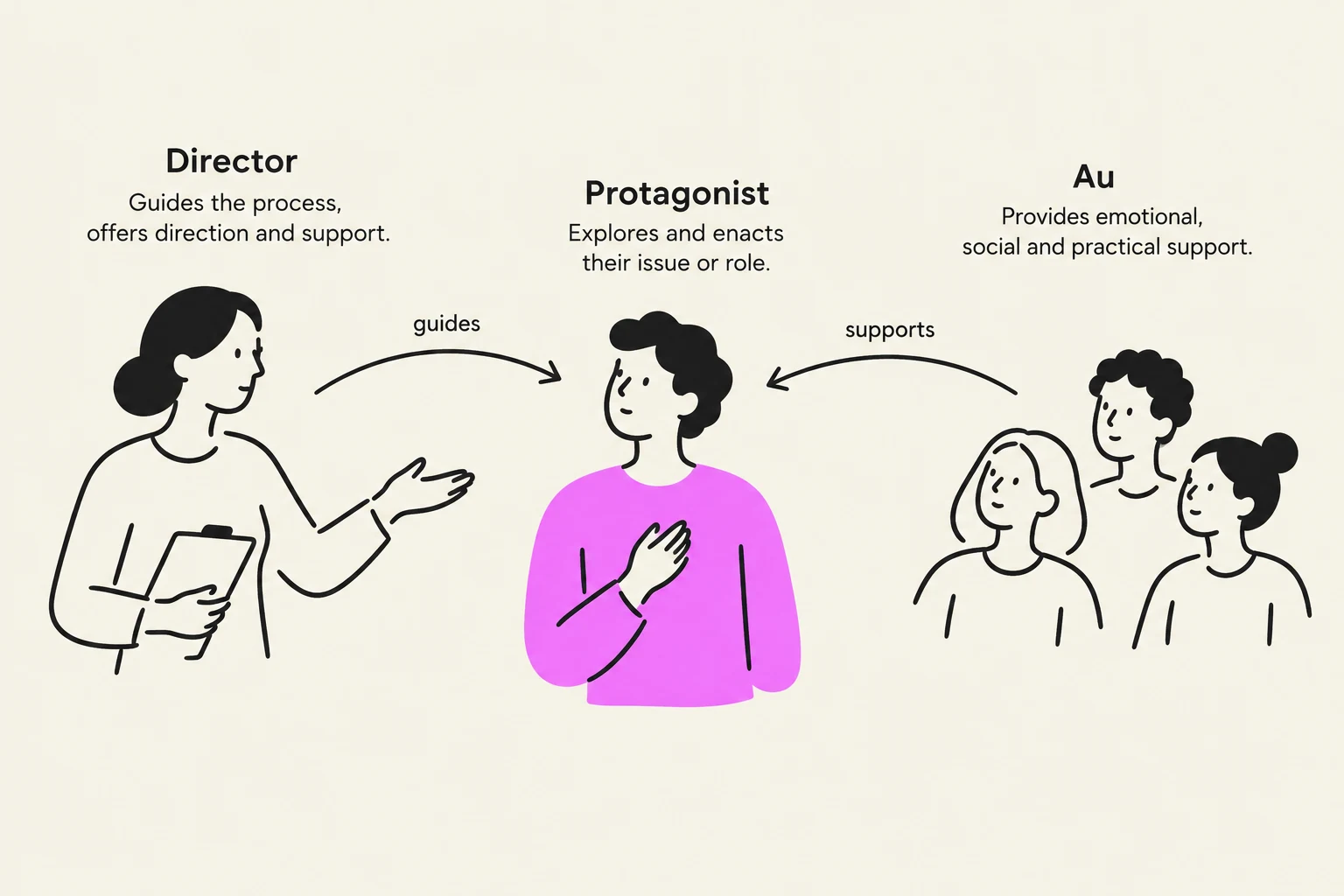
The Protagonist: The central figure or "main player" who selects the specific life event or theme to be explored.
Auxiliary Egos: Supporting players from the group who step into roles to represent significant people or aspects of the protagonist's life (e.g., a parent, a boss, or even an emotion like "fear").
The Director: The group therapist who facilitates the session, guides the process, and ensures the safety of the enactment.
The Audience: The remaining group members who observe the enactment. They are not passive; they provide support and participate in the sharing phase.
The Setting
The Stage is the designated area where the enactment occurs. This physical boundary helps participants transition from their everyday selves into the "action" mode of the therapy.
This diagram illustrates the roles of a Director, Protagonist, and Au (audience/support group) in a process, showing guidance and support dynamics.
The Three Phases of the Psychodrama Process
A standard psychodrama session follows a structured progression to ensure emotional safety and therapeutic efficacy:
The Warm-Up Phase: The goal here is to increase the involvement of the entire group and establish an atmosphere of spontaneity. This phase helps members transition from their daily lives into a state of readiness for action.
The Action Phase: This is the heart of the process. The protagonist enacts a past, present, or anticipated event. Through techniques like role-playing and role reversal (where the protagonist takes the place of another person to see their perspective), the participant works through the core issue.
The Sharing and Discussion Phase: After the action, the group moves into a period of reflection. Members share their own feelings and reactions to the enactment. This phase is crucial for helping the protagonist, the auxiliaries, and the rest of the group find closure.
Therapeutic Techniques
Psychodrama offers a rich toolkit of techniques to deepen the work. Some common methods include:
Role Reversal: A cornerstone technique where the protagonist and an auxiliary ego switch places to foster empathy and new perspectives.
The Magic Shop: A technique where participants "enter" a shop to trade in old, unwanted traits or behaviors for new, desired qualities.
Mirror Technique: Allowing the protagonist to observe their own behavior by watching an auxiliary ego act out their role.
Future Projection: Acting out how a participant might handle a future challenge to build self-efficacy.
Applications and Limitations
Schools and Multicultural Populations
In school settings, "classical" psychodrama may be too intense for younger students. Instead, counselors use role-playing to help students develop psychosocial skills, build empathy through role reversal, and clarify core values via the magic shop technique.
When working with multicultural populations, psychodrama can be particularly powerful. For example, inviting members to speak in their first language can lead to profound emotional work. However, leaders must be culturally sensitive, exploring members' values and any hesitations they may have regarding certain techniques.
Evaluation
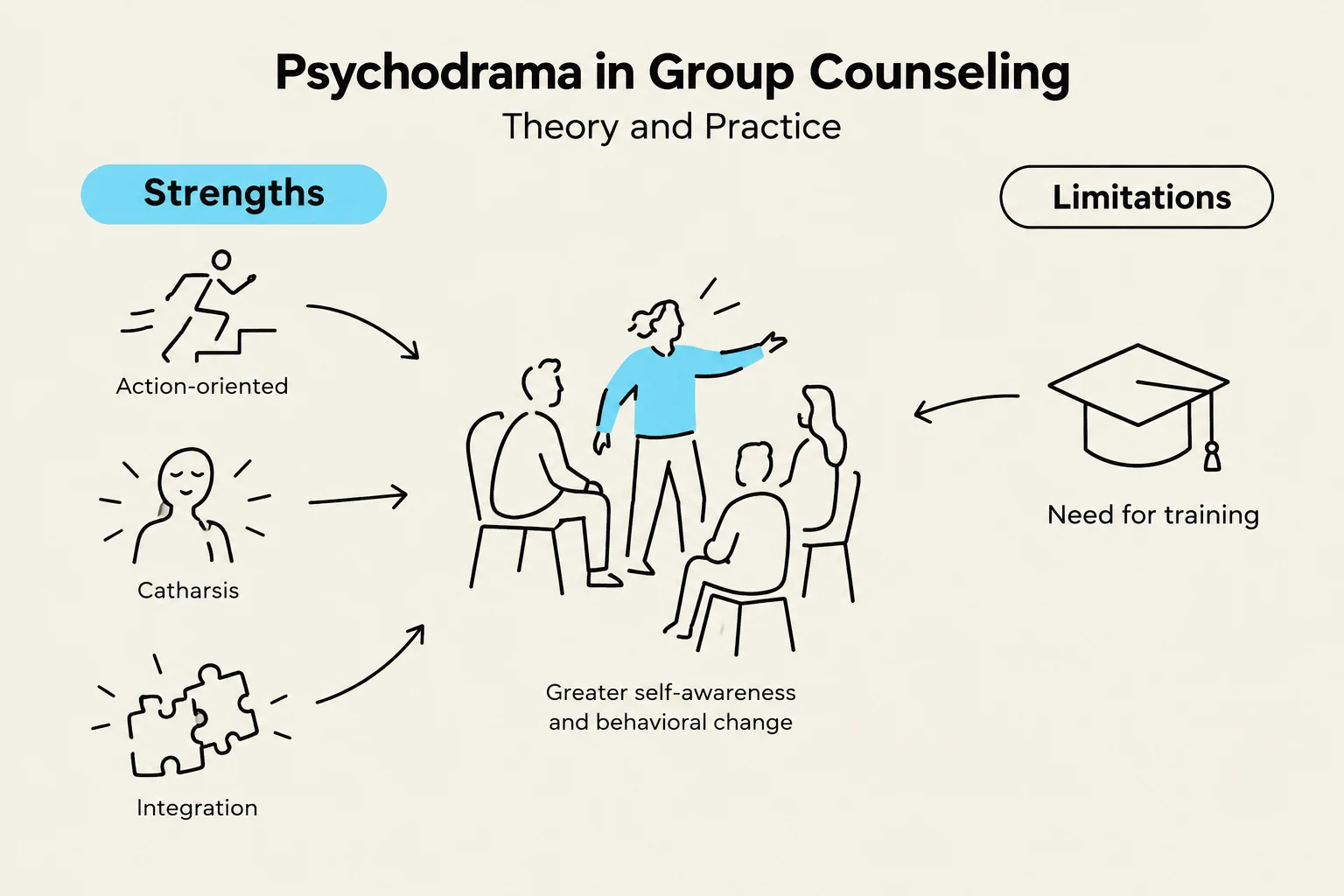
Strengths:
It is an active, action-oriented approach that fosters direct experience.
It provides alternative ways to deal with life's problems and can be integrated with other therapeutic modalities.
Limitations:
It requires highly trained and supervised leaders who possess significant self-awareness.
Techniques must be used with caution to avoid overwhelming participants.
There is currently limited research regarding its overall effectiveness.
This diagram illustrates the strengths and limitations of psychodrama in group counseling, highlighting aspects like action-orientation, catharsis, integration, and the need for training.
Keep reading for free.
Create an account to finish this reading and make it part of your study routine.