In the vast tree of animal life, the distinction between major groups often begins at the very first moments of existence. For animals with bilateral symmetry—those possessing a front, back, top, and bottom—the way an embryo develops determines its entire evolutionary lineage. One of the most significant divisions in the animal kingdom is the split between Protostomes and Deuterostomes. Understanding this division is essential to studying diverse groups ranging from the highly intelligent cephalopods to the microscopic, often parasitic, roundworms.
The Protostome Blueprint
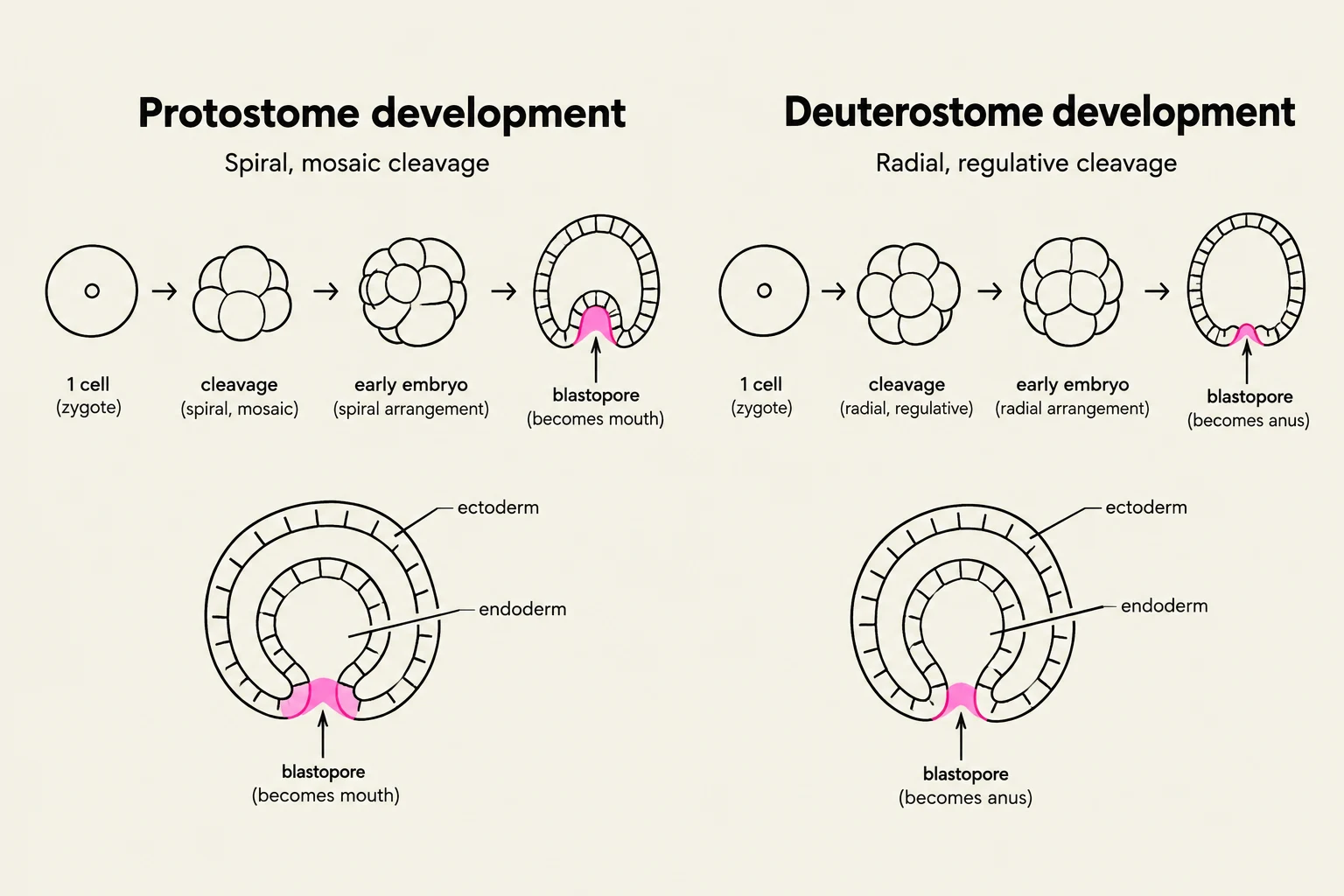
Protostomes are defined by specific patterns in their early embryonic development. Unlike deuterostomes, which use radial and regulative cleavage, protostomes exhibit two defining characteristics: spiral cleavage and mosaic cleavage.
In spiral cleavage, the cells divide in a way that they sit in the grooves between the cells below them. This is paired with mosaic (determinate) cleavage, meaning the fate of each embryonic cell is determined very early in development. Because the "blueprint" is set so early, the asymmetrical distribution of cytoplasm means that if you were to remove a single cell from a developing protostome embryo, that cell could not compensate, and the embryo would die.
Furthermore, the name "protostome" refers to the fate of the blastopore (the first opening in the embryo). In protostomes, the blastopore eventually becomes the mouth.
Diagrams illustrating the developmental differences between protostomes and deuterostomes, focusing on cleavage patterns and blastopore formation.
Exam Tip: If a question asks how to distinguish a protostome from a deuterostome, look for three key developmental markers: the fate of the blastopore (mouth vs. anus), the cleavage pattern (spiral vs. radial), and the cell fate determination (mosaic vs. regulative).
Major Protostome Clades: Ecdysozoans and Lophotrochozoans
The protostome lineage branches into two primary clades: the Ecdysozoans and the Lophotrochozoans.
Ecdysozoans and the Process of Ecdysis
Ecdysozoans are characterized by a unique method of growth. Unlike Lophotrochozoans, which tend to grow incrementally, Ecdysozoans grow by ecdysis. Ecdysis is the process of molting—shedding a hard exoskeleton or a tough cuticle to allow the body to expand. This clade includes highly successful groups like the Phylum Arthropoda (insects, spiders, and crustaceans).
Lophotrochozoans: Diversity in Form
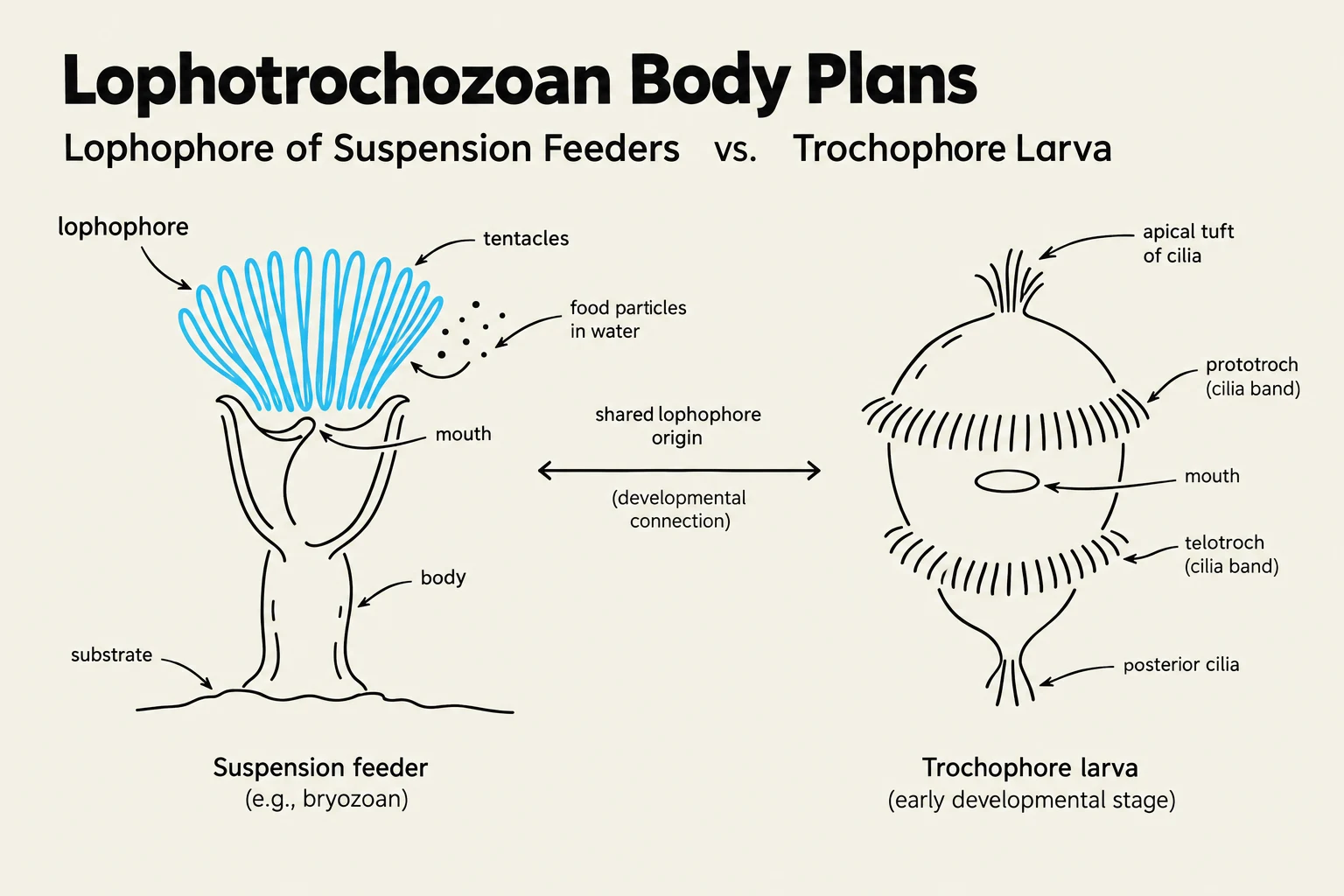
The Lophotrochozoan clade is incredibly diverse and is often identified by the presence of a lophophore (a ring of ciliated tentacles used for suspension feeding) or a trochophore larva (a free-swimming larval stage). This group includes:
Phylum Rotifera: Microscopic freshwater organisms that use a "corona" of cilia to feed.
Phylum Platyhelminthes: Flatworms that are often acoelomate (lacking a body cavity) and have a two-way gut.
Phylum Annelida: Segmented worms, such as earthworms (Oligochaeta) and marine worms (Polychaeta).
Phylum Mollusca: A highly diverse group with specialized structures like the mantle, shell, radula, and foot.
Diagram illustrating the body plans of Lophotrochozoans, comparing a suspension feeder with a lophophore to a trochophore larva, highlighting their shared lophophore origin and developmental connection.
Phylum Nematoda: The Roundworms
While not always grouped with the Lophotrochozoans in every classification, Phylum Nematoda (roundworms) represents a significant group of protostomes. Nematodes are characterized as pseudocoelomates, meaning they possess a body cavity that is not fully lined by mesoderm.
Nematodes are incredibly versatile; they can be free-living in various environments or highly specialized parasites. Their classification is often based on their mouthparts or molecular data.
Parasitic Nematodes and Human Health
Many nematodes have evolved complex life cycles that involve infecting human hosts, often leading to severe medical conditions:
Elephantiasis: A condition caused by several different nematode species that results in the clogging of the host's lymphatic system.
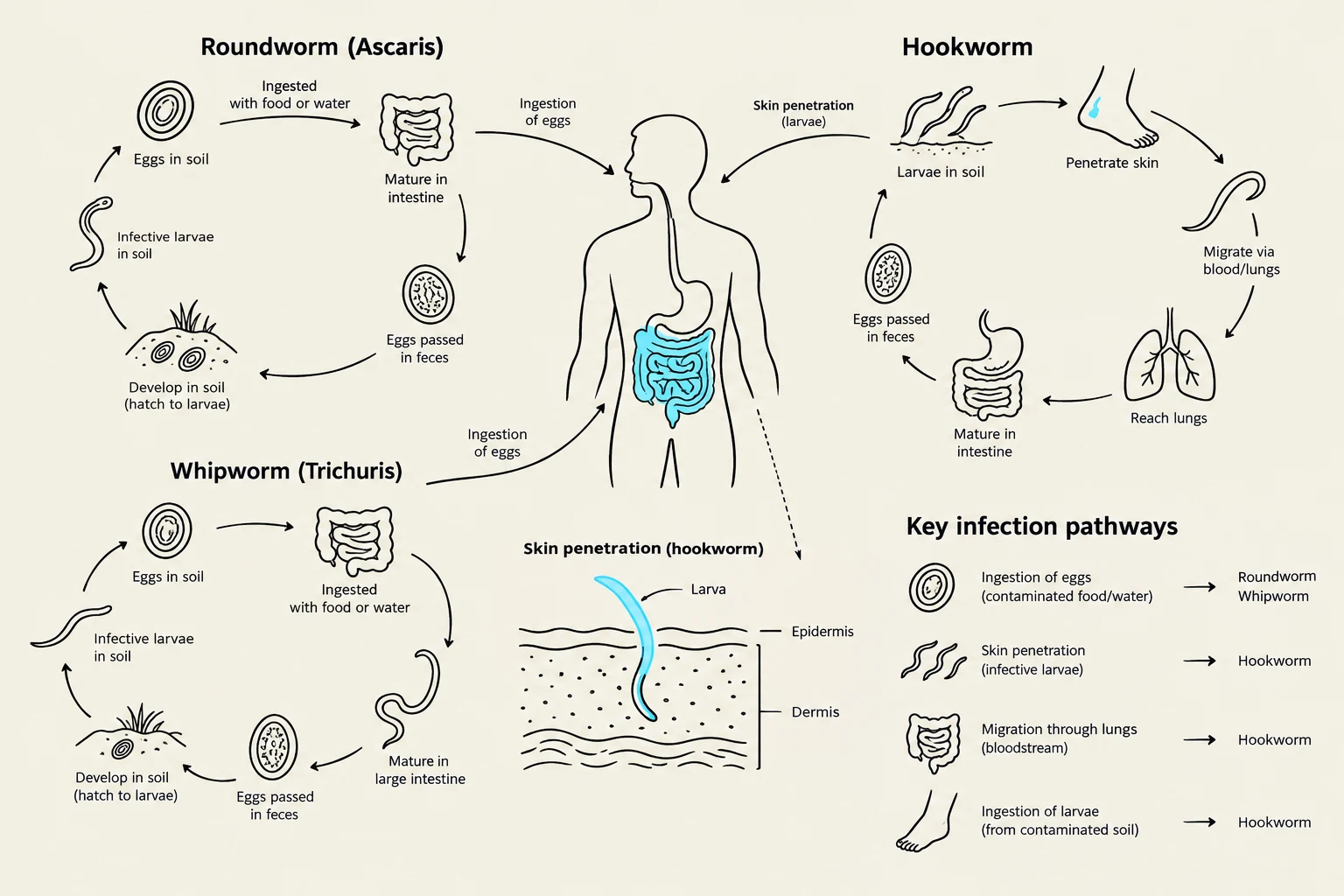
Hookworm: An intestinal parasite that drinks host blood. Infection typically occurs when larvae in the soil penetrate the skin of a person walking barefoot; the larvae then travel through the bloodstream to the lungs, are swallowed, and eventually settle in the intestines.
Pinworm: A common intestinal parasite, particularly in children (affecting roughly 20% of children in the USA). They spread via the fecal-oral route, as they lay eggs in the host's anus.
Guinea Worm: Humans become infected by drinking water contaminated with small organisms hosting the larvae. The adult female can grow up to a meter long and migrates to the host's skin to deposit eggs when it senses water.
Diagrams illustrating the life cycles and infection pathways of Roundworm (Ascaris), Hookworm, and Whipworm (Trichuris).
Deep Dive: Phylum Mollusca
To understand the complexity of Lophotrochozoans, one must look at the Phylum Mollusca. Mollusks are defined by four key synapomorphies (shared derived traits):
Mantle: A tissue layer that secretes the shell.
Shell: Provides structural support and protection.
Radula: A specialized, rasping organ used for feeding.
Foot: A muscular structure used for movement or, in some cases, prey capture.
Classes of Mollusca
Mollusks are organized into distinct classes based on how these anatomical features have been modified over time:
Class
Common Examples
Key Characteristics
Polyplacophora
Chitons
Marine; possess 7 or 8 shell plates.
Bivalvia
Clams, Mussels, Oysters
Two shells; have lost the radula; non-cephalized; filter feeders.
Gastropoda
Snails, Slugs
Move via foot contractions; undergo torsion; some have lost shells and use chemical defenses instead.
Cephalopods represent the pinnacle of molluscan evolution. To support their predatory lifestyle, they have developed advanced sensory organs (eyes convergent with vertebrates), jet propulsion via a mantle siphon, and sophisticated defense mechanisms like ink, chromatophores (for color change), and photophores (for bioluminescence).
Keep reading for free.
Create an account to finish this reading and make it part of your study routine.