This content explains the fundamental concept of proton transfer, which is the basis of acid-base chemistry. It details the nature of the proton (H+), the mechanism of proton transfer between acids and water, the formation of the hydronium ion (H3O+), and classifies acid-base reactions. It also provides an example of w
In the study of chemistry, one of the most fundamental ways that substances interact is through the movement of particles. While some reactions involve the exchange of electrons or the formation of solid precipitates, many of the most critical reactions in biological and aqueous systems involve the movement of a single, tiny particle: the proton. This process, known as proton transfer, is the cornerstone of acid-base chemistry. Understanding how an acid "gives away" a hydrogen ion to a water molecule is essential for mastering everything from pH scales to complex metabolic pathways.
The Nature of the Proton ($H^+$)
To understand proton transfer, we must first look at the structure of a hydrogen atom. A standard hydrogen atom consists of one proton and one electron. When a hydrogen atom loses its only electron, it becomes a bare proton, represented chemically as $H^+$.
Because a proton is significantly smaller than any other atom or ion, its movement can drastically change the chemical properties of a solution. In an aqueous (water-based) environment, this $H^+$ ion does not actually wander around alone. Instead, it immediately seeks out a partner to stabilize its positive charge.
Exam Tip: When you see $H^+$ in a chemical equation, think of it as a "naked" proton. In reality, it is almost always attached to a water molecule, forming the hydronium ion (H_3O+).
Diagram illustrating the formation of a hydrogen ion (H+) from a hydrogen atom by the removal of an electron.
The Mechanism of Proton Transfer
The most common way we observe proton transfer is through the interaction between an acid and water. According to the Brønsted-Lowry definition, an acid is a substance that can donate a proton, while a base is a substance that can accept a proton.
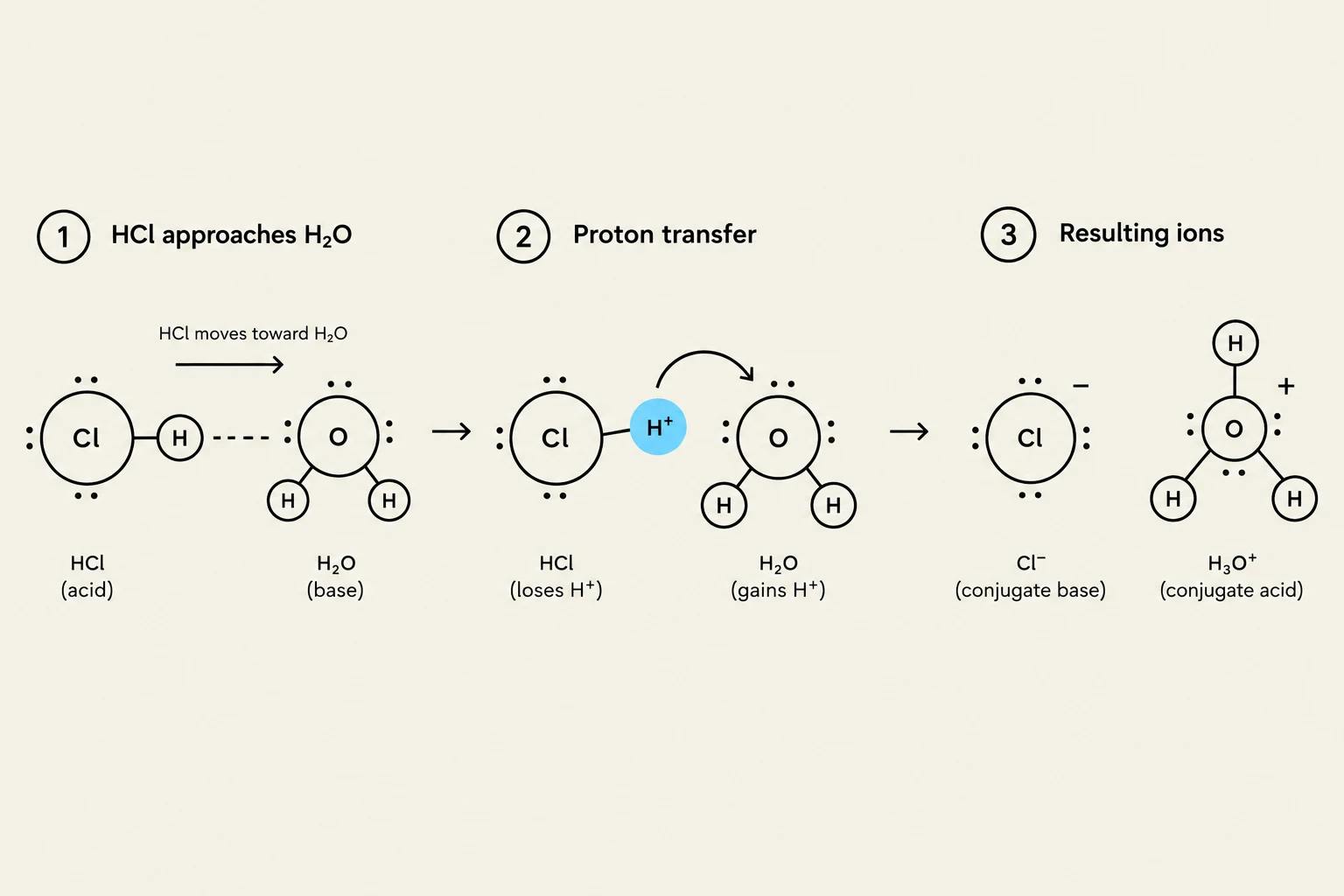
When an acid (such as hydrochloric acid, HCl) is dissolved in water, the acid molecule approaches a water molecule (H2O). The bond between the hydrogen and the rest of the acid molecule breaks, and the hydrogen nucleus (the proton) is transferred to the water molecule.
The reaction can be represented by the following equation:
HCl+H2O→Cl−+H3O+
In this process:
The HCl acts as the acid because it donates the $H^+$.
The H2O acts as the base because it accepts the $H^+$.
The resulting $Cl^-$ is the conjugate base (the species left over after the acid has donated its proton).
The resulting H_3O+ is the conjugate acid (the species formed after the base has accepted a proton).
This diagram illustrates the chemical reaction between hydrochloric acid (HCl) and water (H₂O), showing the proton transfer and the formation of chloride ions (Cl⁻) and hydronium ions (H₃O⁺).
Formation of the Hydronium Ion (H_3O+)
A common point of confusion for students is the distinction between $H^+$ and H_3O+. While many textbooks use $H^+$ as a shorthand to represent acidity, it is more accurate to describe the product of an acid-base reaction in water as the hydronium ion.
When the water molecule accepts the proton, the positive charge is distributed across the three hydrogen atoms and the single oxygen atom. This creates a stable, solvated ion. The concentration of these hydronium ions in a solution is what determines the pH level. The more hydronium ions present, the more acidic the solution becomes.
Acidity∝[H3O+]
Classifying the Reaction
Proton transfer is a distinct type of chemical reaction. In a laboratory setting, chemists often classify reactions into three main categories: precipitation, redox (reduction-oxidation), and acid-base.
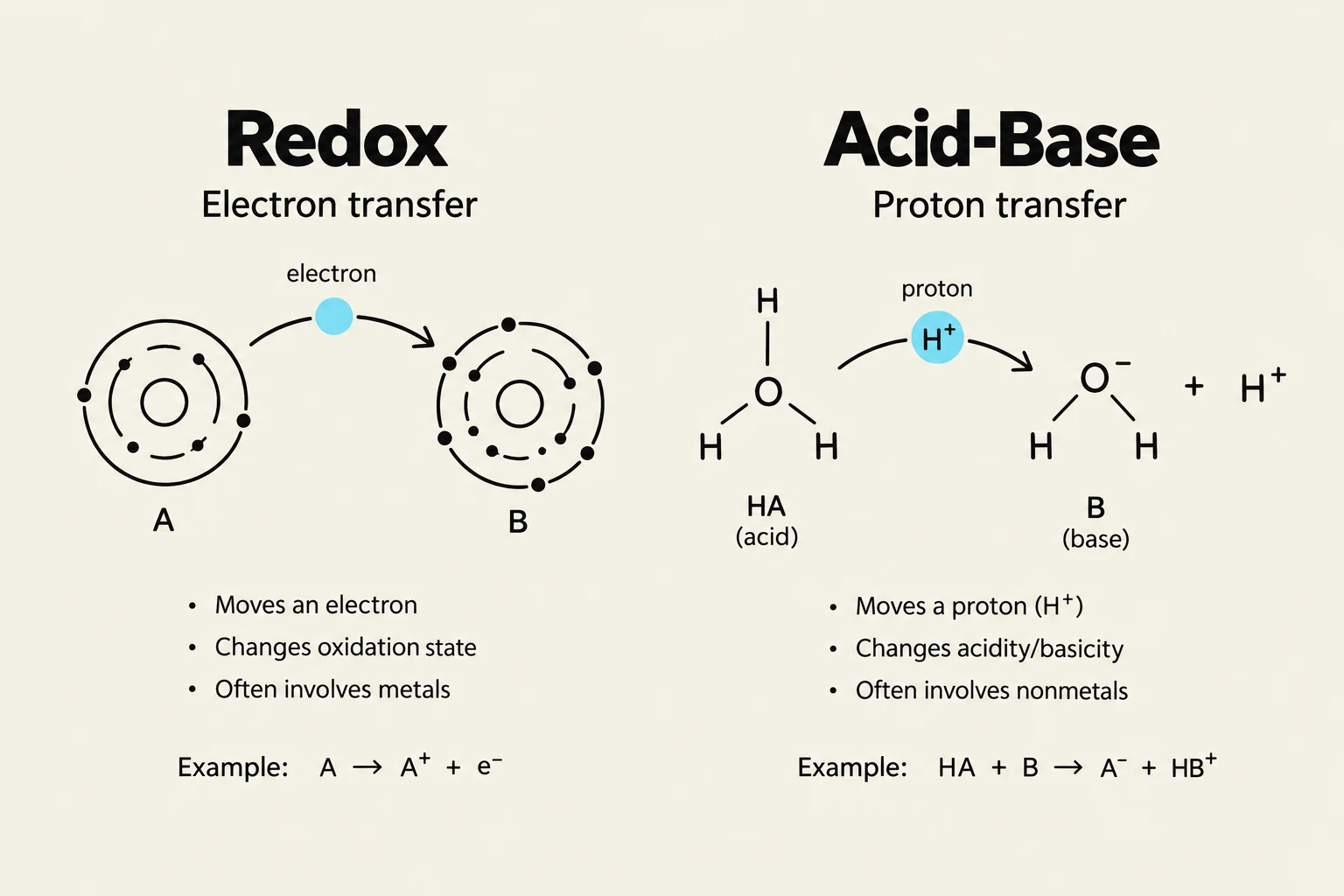
Unlike a precipitation reaction, where two solutions combine to form an insoluble solid, or a redox reaction, where electrons are transferred between species, an acid-base reaction is defined specifically by the "shuttling" of protons.
Reaction Type
Primary Mechanism
Result
Precipitation
Ion combination
Formation of a solid
Redox
Electron transfer
Change in oxidation states
Acid-Base
Proton transfer
Formation of conjugate pairs
This illustration compares Redox reactions, involving electron transfer, with Acid-Base reactions, involving proton transfer. It details the characteristics and provides examples for each type of chemical reaction.
Worked Example: Weak Acid Dissociation
Not all acids transfer their protons with the same intensity. Strong acids dissociate completely, while weak acids only partially transfer their protons to water. Let's look at acetic acid (CH3COOH), the acid found in vinegar.
When acetic acid is placed in water, a small fraction of the molecules will undergo proton transfer:
CH3COOH+H2O⇌CH3COO−+H3O+
The double arrow (⇌) indicates that the reaction is reversible. This means that while some acetic acid turns into acetate (CH3COO−) and hydronium, those ions can also collide and recombine to reform the original acetic acid. This equilibrium is a fundamental concept in understanding how buffers work in the human body to maintain constant pH levels.
Summary Checklist for Proton Transfer:
Identify the donor (the acid).
Identify the acceptor (the base).
Track the movement of the $H^+$ ion.
Write the resulting conjugate pairs.
Keep reading for free.
Create an account to finish this reading and make it part of your study routine.