Protective Factors and Resilience in Developmental Psychopathology
This content explains protective factors as positive developmental variables that buffer the impact of risks and stressors. It categorizes these factors into individual, microsystem, and macrosystem levels, highlighting their dynamic nature and role in fostering resilience against adversity.
In the study of developmental psychopathology, researchers often focus on risk factors—the conditions that increase the likelihood of developing a disorder. However, a more complete understanding of human development requires looking at the other side of the coin: protective factors. These are positive developmental variables that can buffer, offset, or mitigate the impact of early negative experiences or chronic stressors.
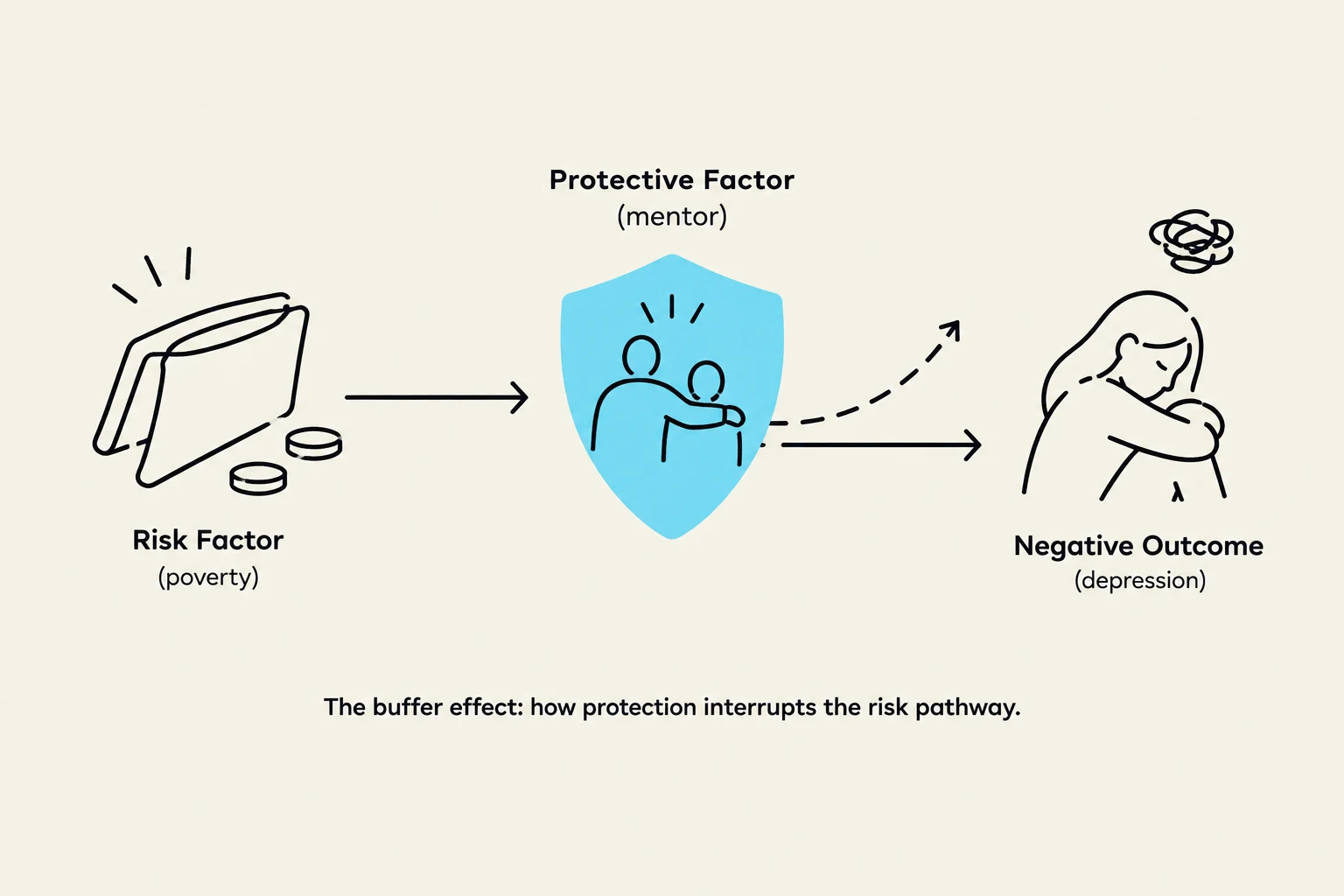
This diagram illustrates the buffer effect, showing how a protective factor like mentorship can interrupt the pathway from a risk factor such as poverty to a negative outcome like depression.
Rather than viewing development as a simple linear progression toward pathology, the concept of protective factors allows us to understand why two individuals can experience the same traumatic event, yet one may develop a clinical disorder while the other demonstrates remarkable resilience.
Understanding the Buffer Effect
The primary role of a protective factor is to act as a "buffer." In psychological terms, this means the factor interferes with the pathway between a risk (such as childhood neglect or poverty) and a negative outcome (such as unipolar depression).
It is important to note that protective factors do not necessarily remove the risk itself. For example, a supportive mentor cannot erase the reality of a child living in a high-crime neighborhood, but that mentor can provide the emotional regulation skills and social support necessary to prevent that environment from manifesting as a mental health disorder.
Exam Tip: When distinguishing between "risk" and "protection" on an exam, remember that risk increases the probability of a negative outcome, while protection decreases that probability by altering the developmental trajectory.
Levels of Protective Factors
This diagram illustrates Bronfenbrenner's ecological systems theory, showing the individual at the center and nested environmental systems: microsystem, mesosystem, exosystem, and macrosystem, each influencing development.
Protective factors are rarely isolated; they typically operate across multiple levels of an individual's ecosystem. To understand how they work, we can categorize them into three primary domains:
1. Individual Factors
These are internal to the person and often include cognitive, emotional, and biological traits.
Emotional Regulation: The ability to manage intense emotions and recover from setbacks.
Problem-Solving Skills: The capacity to approach challenges logically rather than reacting impulsively.
Self-Efficacy: A person's belief in their own ability to succeed in specific situations.
Temperament: Certain innate biological predispositions, such as an easy-going temperament, can act as a natural buffer against environmental stress.
2. Microsystem Factors (Relational)
These involve the immediate social circles surrounding an individual, most notably the family and peer groups.
Secure Attachment: A stable, responsive relationship with a primary caregiver is one of the most powerful protective factors in early childhood.
Social Support: Having a reliable network of friends or family members who provide emotional or instrumental aid.
Positive Peer Relationships: For adolescents, having a prosocial peer group can mitigate the effects of family dysfunction.
3. Macrosystem Factors (Environmental/Societal)
These are the broader social structures and community resources available to an individual.
Access to Quality Education: Schools that provide structured environments and mentorship.
Community Resources: Availability of healthcare, safe recreational spaces, and social services.
Cultural Values: Certain cultural frameworks may emphasize collective resilience and spiritual coping, providing a sense of meaning during hardship.
The Dynamic Nature of Protection
A common misconception is that protective factors are static traits. In reality, protection is dynamic. A factor that is protective in childhood may become a risk factor in adulthood, and vice versa.
For example, a highly "compliant" temperament might be protective in a strict, chaotic household because it prevents conflict. However, as that child enters adulthood, that same compliance might become a risk factor for depression if it prevents them from asserting their needs in interpersonal relationships.
Worked Example: The Path to Resilience
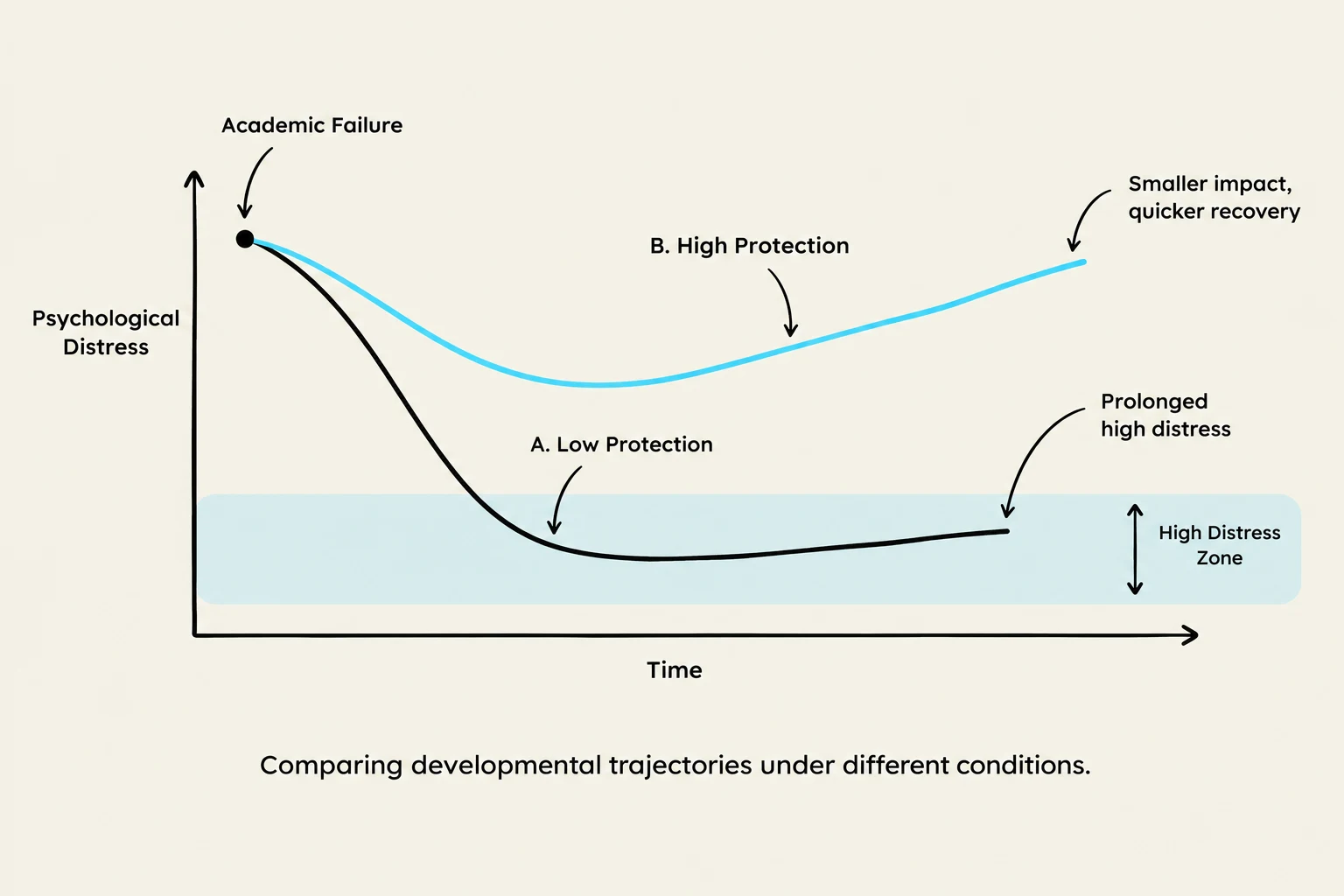
This graph illustrates two developmental trajectories, comparing the impact of low versus high protection on psychological distress over time, particularly in response to academic failure.
To visualize how this works in a clinical context, consider the following scenario:
The Risk: A child experiences significant academic failure and social isolation in middle school.
Scenario A (High Risk, Low Protection): The child has a volatile home life, lacks coping mechanisms, and perceives their failure as a permanent character flaw. This trajectory increases the likelihood of developing unipolar depression.
Scenario B (High Risk, High Protection): The child experiences the same academic failure but has a supportive teacher who provides extra tutoring (Environmental Factor) and has learned to view mistakes as learning opportunities (Individual Factor). The negative impact of the failure is significantly mitigated.
Summary Table: Risk vs. Protection
Feature
Risk Factors
Protective Factors
Primary Function
Increase vulnerability to disorder
Buffer or offset negative impact
Focus of Intervention
Reducing exposure or impact
Strengthening existing assets
Developmental Goal
Prevention of pathology
Promotion of resilience
By identifying these positive variables, clinicians and educators can move beyond simply "fixing what is wrong" and instead focus on "building what is right," fostering the strengths that allow individuals to thrive despite adversity.
Keep reading for free.
Create an account to finish this reading and make it part of your study routine.