


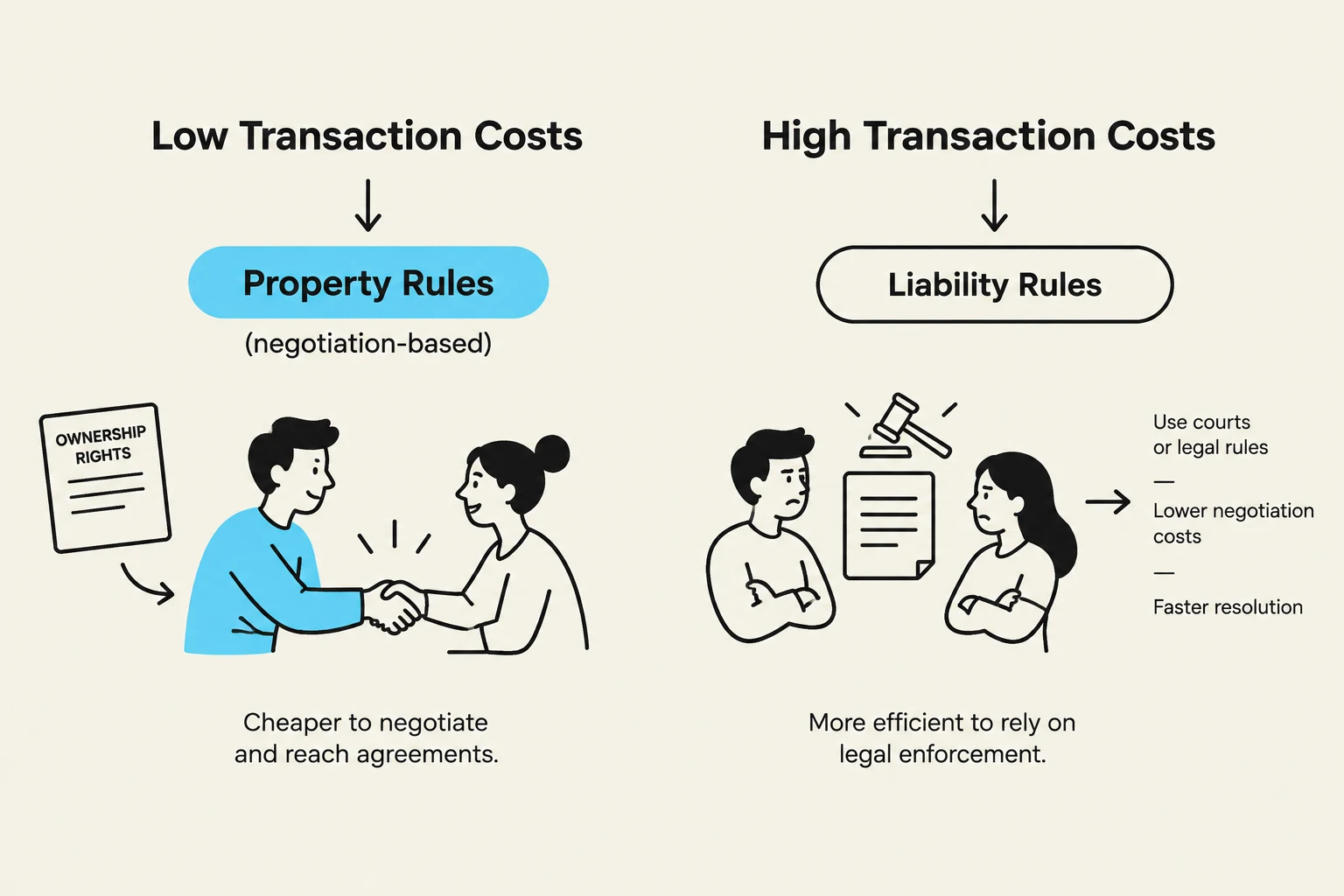
In the study of Law and Economics, one of the most fundamental questions is how a legal system should manage rights and entitlements. When two parties have conflicting interests over a resource—such as a piece of land, a patent, or even the right to quiet enjoyment of a home—how should the law intervene? Should the law strictly forbid one party from interfering with the other unless they reach an agreement? Or should the law allow the interference to happen, provided the interferer pays a price?
This distinction is captured by the framework of Property Rules and Liability Rules. Understanding these two mechanisms is essential for grasping how legal systems balance the competing goals of protecting individual rights and promoting economic efficiency.
The Property Rule: Protection via Consent
A property rule protects an entitlement by making any unauthorized interference a legal wrong. Under a property rule, if Party A has a right to a resource, Party B cannot use or infringe upon that resource unless Party A gives their explicit consent. If Party B proceeds without consent, they have committed a violation (such as trespass or infringement), and Party A is entitled to seek an injunction to stop the behavior.
The defining characteristic of a property rule is that the "price" of the resource is determined by the owner through negotiation. Because the owner has the power to say "no," they can hold out for a price that reflects their true valuation of the resource.
Key Concept: Property rules prioritize the sanctity of the entitlement. They are designed to prevent "hold-up" problems in certain contexts, but they can also lead to "hold-out" problems where a single owner prevents a highly efficient project from proceeding simply because they refuse to negotiate.

Keep reading for free.
Create an account to finish this reading and make it part of your study routine.
Continue reading freeAlready have an account? Log in
Updated