Examines the fundamental role of secure property rights in fostering economic growth, investment, and societal prosperity over historical periods. Discusses the pillars of ownership security, incentive structures, capital formation, and the rule of law.
The Foundation of Wealth: Analyzing Property Rights and 1,000 Years of Lessons
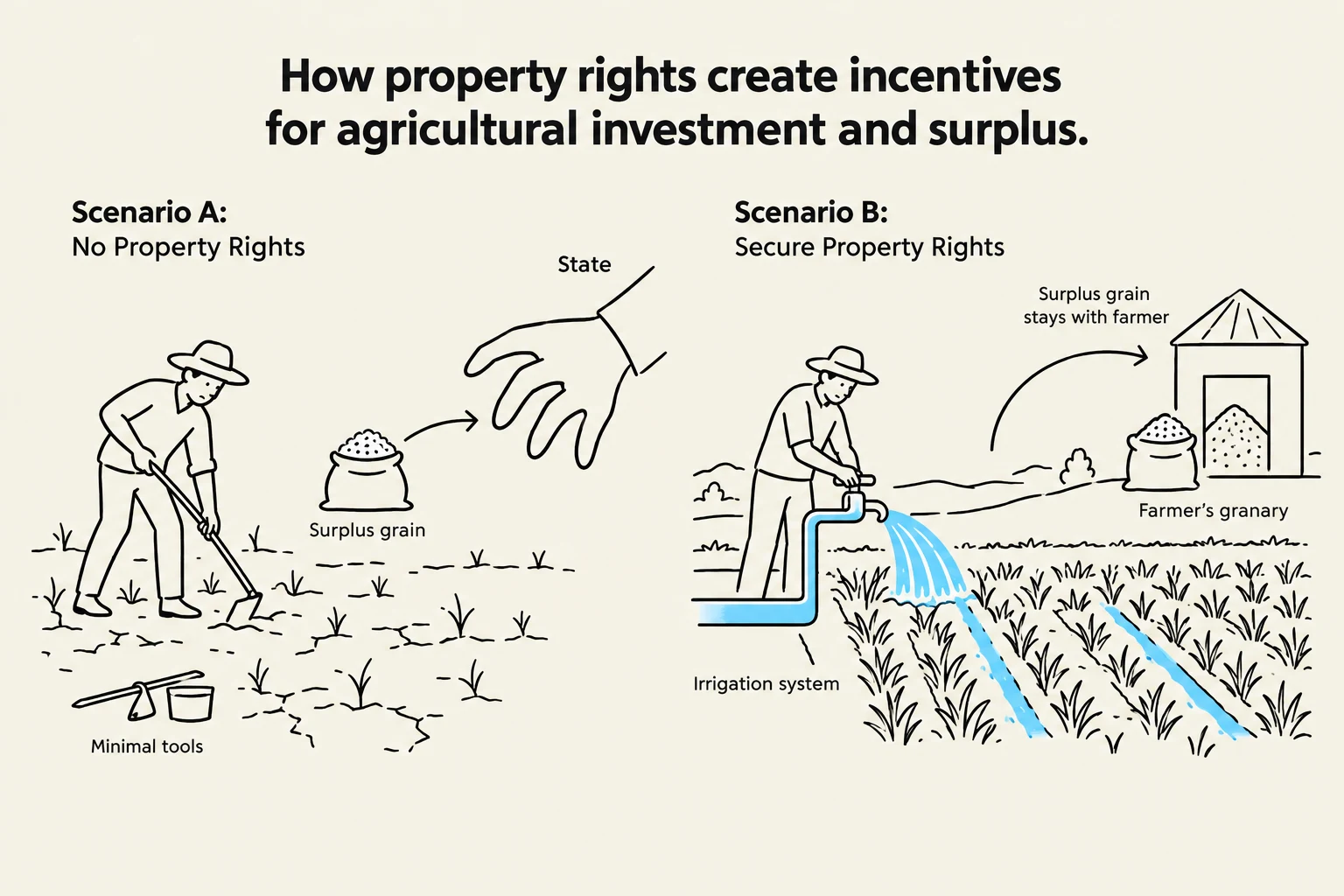
This illustration contrasts two scenarios of agricultural investment and surplus. Scenario A, with no property rights, shows a farmer using minimal tools and the state potentially taking surplus grain. Scenario B, with secure property rights, depicts a farmer investing in an irrigation system, leading to surplus grain staying with the farmer and being stored in their granary.
Why do some nations flourish with abundant technology and high living standards, while others remain trapped in cycles of systemic poverty? While geography, climate, and natural resources are often cited as the primary drivers of economic success, historical analysis suggests a more fundamental institutional driver: the existence and protection of property rights.
The relationship between property rights and prosperity is not merely a legal abstraction; it is a psychological and economic engine. Over a millennium of economic shifts, a clear pattern has emerged: societies that secure the rights of individuals to own, use, and transfer assets experience unprecedented growth, whereas those that erode these rights face inevitable decline.
The Pillars of Economic Security
To understand why property rights drive prosperity, we must look at the specific mechanisms that transform a legal concept into economic reality. There are four key pillars that support this relationship.
1. Security of Ownership
At its most basic level, prosperity requires the ability to plan for the future. If an individual or a business fears that their assets—be it a plot of farmland, a factory, or intellectual property—might be arbitrarily seized by the state or a more powerful private actor, they will not invest in them. Security of ownership ensures that the "fruits of labor" remain with the laborer, providing the stability necessary for long-term capital improvements.
2. Incentive Structures
Property rights act as a powerful signaling mechanism for human effort. When ownership is protected, the marginal benefit of additional effort is captured by the owner.
Consider this comparison:
Scenario A (No Property Rights): A farmer works harder to irrigate a field. However, because the state can seize any surplus, the farmer receives no extra benefit from the increased yield. The rational response is to do the bare minimum to survive.
Scenario B (Secure Property Rights): The farmer invests in irrigation, knowing the extra grain belongs to them. This creates an incentive for efficiency, technological advancement, and surplus production, which fuels the wider economy.
3. Capital Formation and "Dead Capital"
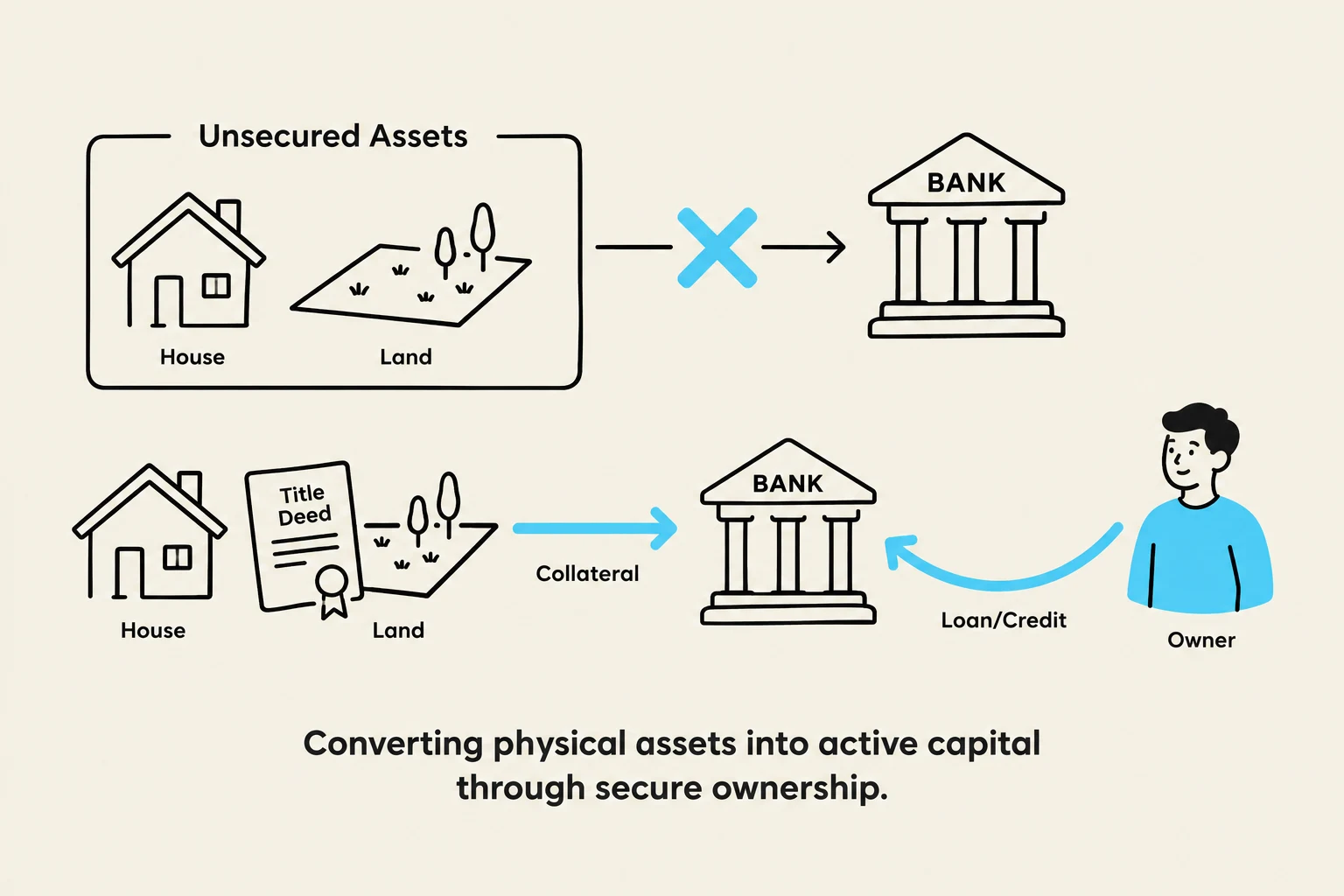
This diagram illustrates how unsecured assets like a house and land cannot be directly used to obtain a loan from a bank. However, by using the title deed to establish collateral, these assets can be converted into active capital through a loan or credit from the bank, with the owner receiving the loan/credit.
Economic growth is not just about working harder; it is about working smarter through the use of credit and leverage. For an asset to be useful in a modern economy, it must be able to serve as collateral for a loan.
Without clearly defined and enforceable rights, assets become what economists call "dead capital." This refers to wealth that exists in physical form (like a home or a piece of land) but cannot be leveraged to secure credit or facilitate complex commercial transactions. When property rights are weak, the engine of credit—and thus the engine of expansion—stalls.
4. The Rule of Law
Property rights cannot exist in a vacuum; they require a predictable legal framework. The effectiveness of these rights is inextricably linked to the rule of law. In a society governed by the rule of law, disputes are settled through established, transparent processes rather than through the whims of those in power. This predictability reduces the "risk premium" for both domestic and foreign investors, making it safer to commit capital to a specific region.
Study Tip: The Feedback Loop
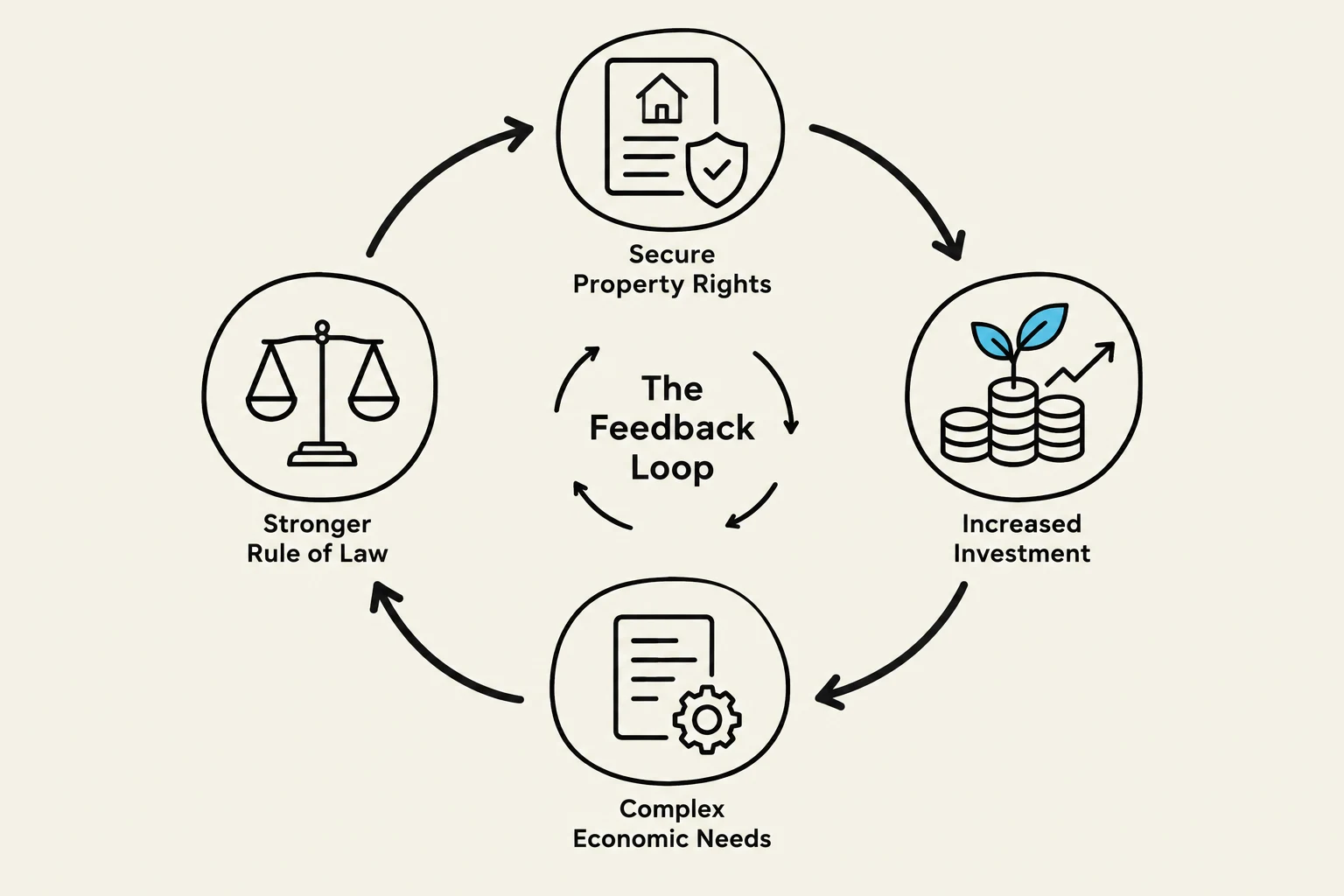
Remember that property rights and the rule of law create a positive feedback loop. Secure rights lead to more investment → more investment leads to more complex legal needs → more complex needs demand a stronger rule of law → a stronger rule of law further secures property rights.
Historical Lessons: A Millennium of Evidence
This diagram illustrates a feedback loop where stronger rule of law leads to secure property rights, which in turn encourages increased investment, ultimately addressing complex economic needs.
The historical record provides a stark contrast between systems of private property and those of communal or state-controlled models. A millennium of economic shifts shows that societies transitioning toward private property systems experience significant increases in living standards.
Conversely, the erosion of these rights is a precursor to economic decay. This erosion often manifests in three ways:
Expropriation: The direct seizure of private assets by the state.
Inflation: A "hidden" form of expropriation where the state devalues currency, effectively seizing the purchasing power of private savings.
Regulatory Instability: Constant, unpredictable changes in laws that make long-term planning impossible.
When these rights are undermined, the result is almost always capital flight—where the wealthy and the productive move their money and talent to more stable jurisdictions—leading to decreased productivity and systemic poverty.
Summary Table: Property Rights vs. Economic Outcomes
Feature
Strong Property Rights
Weak Property Rights
Investment Focus
Long-term improvements & innovation
Short-term extraction & survival
Capital Status
Active/Leverageable (Liquid)
"Dead Capital" (Illiquid)
Legal Environment
Predictable Rule of Law
Arbitrary Power/Corruption
Economic Trend
Prosperity and Growth
Capital Flight and Poverty
Ultimately, the protection of private property is not just a matter of legal fairness; it is the institutional foundation upon which complex, prosperous market economies are built.
Keep reading for free.
Create an account to finish this reading and make it part of your study routine.