Explores how sensory systems detect stimuli and encode information about modality, location, intensity, and duration through various receptor types and neural pathways.
Sensory systems serve as the vital interface between an organism and its environment. Their primary function is to detect various forms of environmental stimuli and transmit that information to an integrating center, such as the brain, for processing. To make sense of the world, these systems must perform a complex task known as encoding: translating raw physical energy (like light, pressure, or chemicals) into the universal biological language of action potentials. This process involves capturing the specific type of stimulus, its exact location, its intensity, and how long it lasts.
The Mechanics of Detection: Potentials and Receptors
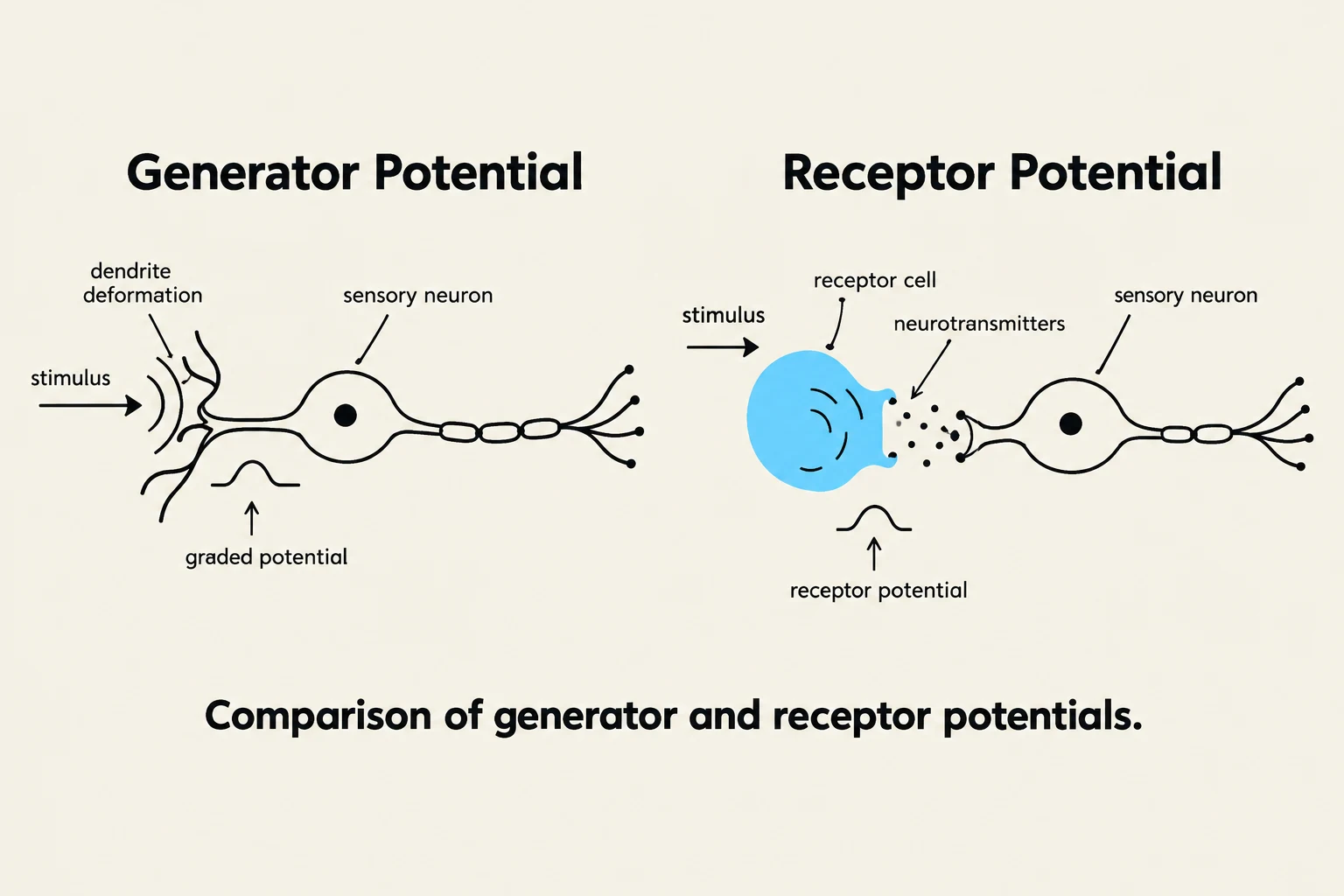
Comparison of generator and receptor potentials in neurons.
Before a signal can reach the brain, it must first be converted from energy into an electrical change in membrane potential. This initial electrical change is a "graded potential," meaning its magnitude varies depending on the strength of the stimulus. There are two primary ways this occurs:
Generator Potentials: These occur directly within a sensory neuron. In this case, the receptor is actually part of the dendrite of the afferent (sensory) neuron itself.
Receptor Potentials: These occur in an accessory receptor cell. The stimulus triggers a graded potential in this specialized cell, which must then transmit the signal to a separate sensory neuron.
Classification by Modality
Sensory receptors are categorized based on the type of stimulus they are specialized to detect, known as their modality:
Chemoreceptors: Detect chemical concentrations (e.g., smell, taste, or blood pH).
Mechanoreceptors: Detect physical deformation, such as pressure, movement, or vibration.
Photoreceptors: Detect light energy.
Thermoreceptors: Detect changes in temperature.
Electroreceptors: Detect electric fields.
Magnetoreceptors: Detect magnetic fields.
Exam Tip: Adequate Stimulus
Every afferent neuron is "tuned" to a specific type of stimulus, known as its adequate stimulus. While a neuron might respond to other stimuli if they are strong enough, it is most sensitive to its adequate stimulus. Perception is determined by which specific neural pathway is activated, not just the presence of the stimulus itself.
Encoding Stimulus Modality and Location
Modality
The nervous system identifies what kind of stimulus is occurring by observing which specific neural pathway is activated. For example, if light hits the eye, the visual pathway is activated, and the brain perceives "light" rather than "pressure."
Location and Spatial Acuity
This diagram illustrates the concept of receptive fields in neurons, comparing small receptive fields with high precision in pinpointing stimuli and large receptive fields with lower precision in stimulus localization.
To know where a stimulus is occurring, the system relies on the receptive field—the specific region of a sensory surface that, when stimulated, triggers a response.
The precision of this localization is called spatial acuity. Acuity is inversely related to the size of the receptive field:
Small Receptive Fields: Allow for high acuity (the ability to resolve fine detail) because the system can pinpoint exactly where the stimulus occurred.
Large Receptive Fields: Result in lower acuity, as the brain only knows the stimulus occurred somewhere within a broad area.
To further sharpen this perception, the nervous system uses lateral inhibition. In this process, neurons at the center of a receptive field send inhibitory signals to the neurons in the surrounding area. This reduces "noise," enhances contrast, and improves the detection of edges and boundaries.
Encoding Intensity: From Threshold to Saturation
The system must also communicate how strong a stimulus is. This is achieved primarily through action potential frequency. As the intensity of a stimulus increases, the frequency of the action potentials fired by the sensory neuron also increases.
The range of intensities a receptor can handle is known as its dynamic range. This range is defined by two boundaries:
Threshold: The minimum stimulus strength required to produce any response.
Saturation: The point at which the stimulus is so strong that the receptor has reached its maximal response and cannot increase its firing rate any further.
Sensory Discrimination and Range Expansion
A critical trade-off exists between dynamic range and sensory discrimination (the ability to tell the difference between two similar intensities):
A narrow dynamic range allows for excellent discrimination because a small change in stimulus leads to a large, noticeable change in firing frequency.
A large dynamic range often results in poor discrimination because the change in frequency per unit of stimulus is very small.
To overcome this, biological systems use two main strategies to expand their detectable range:
Range Fractionation: Different receptors are assigned to different parts of the intensity spectrum. By distributing the load, the total system can respond to a much wider range of intensities than any single receptor could.
Logarithmic Encoding: Used in systems like hearing and vision, this allows the system to maintain a massive dynamic range while still preserving the ability to discriminate between different levels of intensity.
Encoding Duration: Adaptation
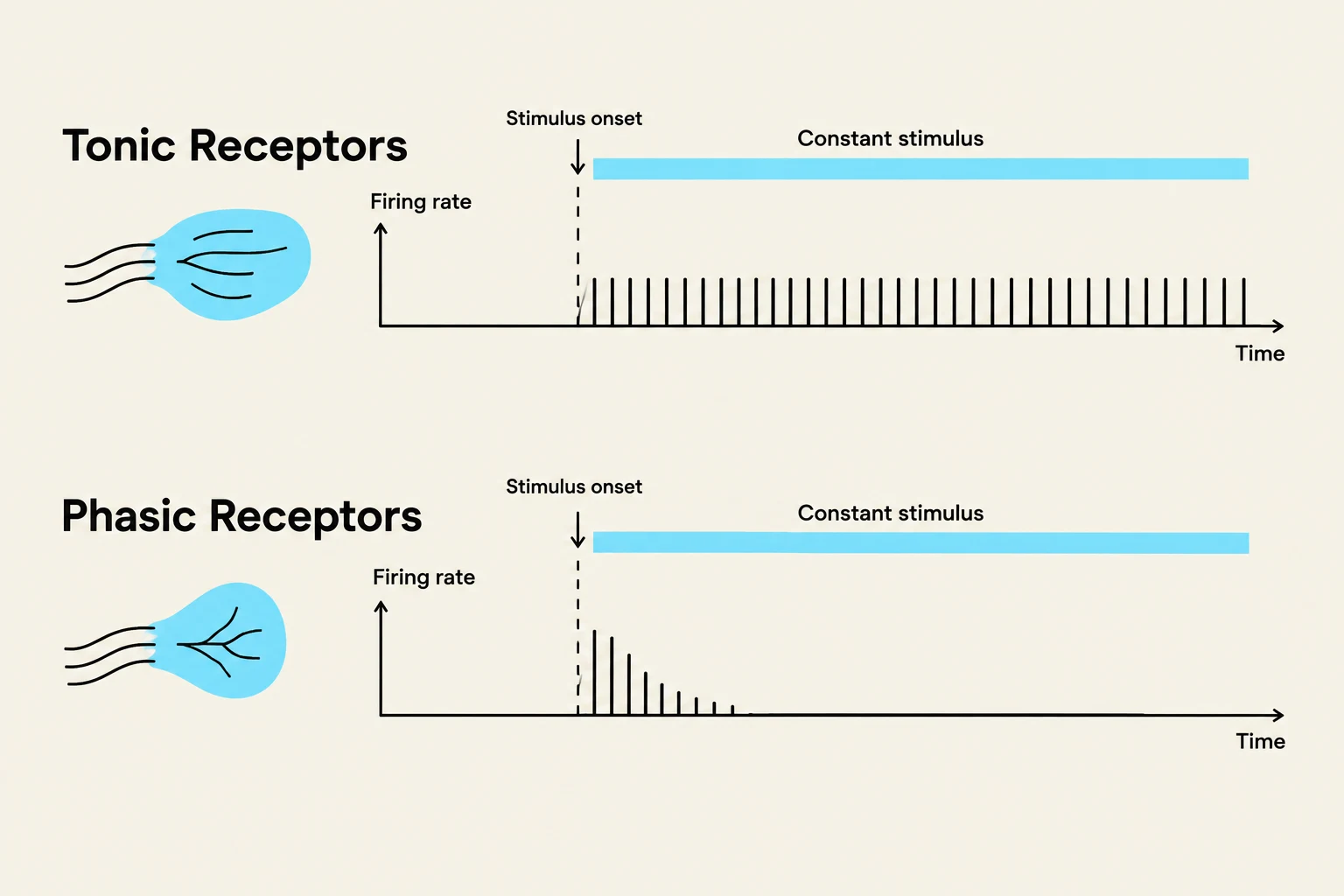
This diagram illustrates the difference between tonic and phasic receptors. Tonic receptors respond continuously to a stimulus, while phasic receptors respond only at the onset of a stimulus.
Finally, the system must encode how long a stimulus lasts. This is handled by the rate of sensory adaptation—the decrease in response to a stimulus over time. Receptors are classified into two types based on their adaptation rate:
Tonic Receptors: These are slow-adapting. They continue to fire for the entire duration of a stimulus, providing continuous information about its presence.
Phasic Receptors: These are fast-adapting. They respond primarily to changes in stimulus intensity (the onset or offset) and quickly decrease their response if the stimulus remains constant.
Example: Touch Receptors
In the skin, different mechanoreceptors exhibit different adaptation rates. Fast-adapting (FA) receptors are excellent for detecting movement or vibration, while slow-adapting (SA) receptors are better for sensing steady pressure.
Keep reading for free.
Create an account to finish this reading and make it part of your study routine.