An overview of soil colloids, their electrical charges, and the different types including crystalline silicate clays, noncrystalline silicate clays, iron/aluminum oxides, and organic matter (humus).
In the study of soil science, the most important fraction for chemical and physical activity is the soil colloidal fraction. Colloids are the smallest particles in the soil, typically having a diameter of less than 1μm. Because of their incredibly small size, they possess a very high surface area relative to their mass, which allows them to act as the "seat" of soil reactivity. These particles are electrically charged, enabling them to adsorb water, cations (positively charged ions), and anions (negatively charged ions).
Sources of Colloidal Charge
To understand how colloids interact with nutrients, we must first understand why they carry an electrical charge. There are two primary mechanisms that generate this charge: isomorphous substitution and pH-dependent charge.
Isomorphous Substitution (Permanent Charge)
Isomorphous substitution is a process that occurs during the formation of silicate clays. It involves the replacement of one ion by another of similar ionic radius but different valence within the crystal structure. Because the replacement ion has a different charge than the original ion, a net electrical charge is created within the mineral lattice.
For example:
In the octahedral sheet, an Al3+ ion might be replaced by a Mg2+ ion.
In the tetrahedral sheet, a Si4+ ion might be replaced by an Al3+ ion.
Because these substitutions are built into the crystal structure itself, this charge is considered permanent; it does not change regardless of the soil's pH.
pH-Dependent Charge
Unlike permanent charge, pH-dependent charge arises from the gain or loss of H+ ions on the surface of the colloid, specifically on hydroxyl (OH) groups.
Increasing pH (Deprotonation): As the soil becomes more alkaline, H+ ions are pulled away from the surface hydroxyl groups, leaving behind a negative charge.
Decreasing pH (Protonation): As the soil becomes more acidic, H+ ions are added to the surface, which can create a positive charge.
Exam Tip: If a question asks which type of charge is most prevalent in organic matter (humus) or highly weathered oxides, remember that these materials rely heavily on pH-dependent charge rather than isomorphous substitution.
Types of Soil Colloids
Soil colloids are categorized into four main groups based on their chemical composition and structural organization.
1. Crystalline Silicate Clays (Phyllosilicates)
These are the most dominant colloids in most soils. They consist of layered sheets made of tetrahedral sheets (composed of Si and O) and octahedral sheets (composed of Al, Mg, or Fe with O or OH). Based on how these sheets are stacked, they are divided into 1:1 and 2:1 clays.
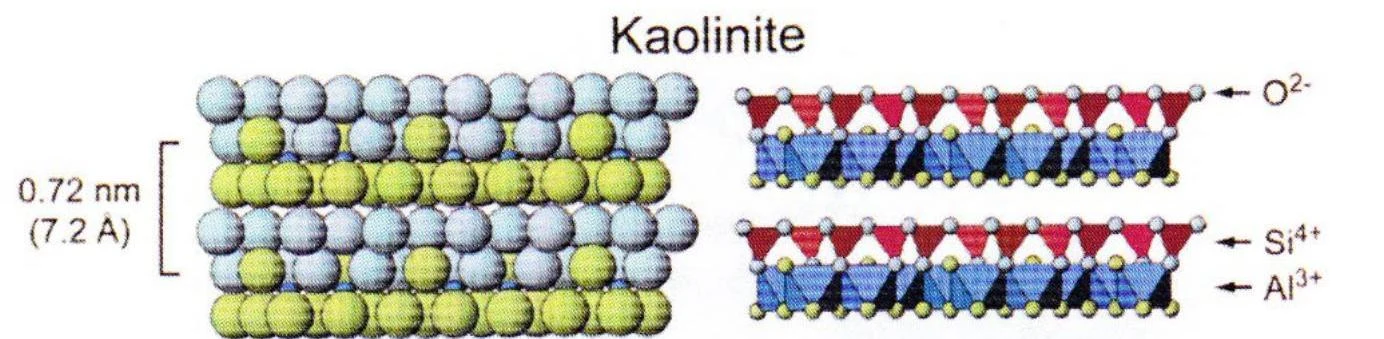
Diagram illustrating the layered structure of Kaolinite, showing the arrangement of oxygen, silicon, and aluminum atoms, with a scale bar indicating 0.72 nm.
1:1 Silicate Clays
A 1:1 clay consists of one tetrahedral sheet and one octahedral sheet per layer. These layers are held together by strong hydrogen bonding, which prevents water or ions from entering the space between layers.
Example:Kaolinite is the most common 1:1 clay.
Properties: Because the layers are so tightly bound, they do not expand when wet (non-expanding). They have low Cation Exchange Capacity (CEC) because they have very little isomorphous substitution and rely mostly on charge at the broken edges of the crystals.
2:1 Silicate Clays
A 2:1 clay consists of two tetrahedral sheets sandwiching one octahedral sheet. These are further divided into expanding and non-expanding groups.
Expanding 2:1 Clays:
In these minerals, the layers are loosely bound, allowing water and cations to enter the interlayer space. This leads to significant shrink-swell behavior.
Smectite (e.g., Montmorillonite): Known for very high CEC and high plasticity/stickiness.
Vermiculite: An alteration product of micas with very high CEC, making it one of the most nutrient-rich clays.
Non-expanding 2:1 Clays:
In these minerals, the layers are tightly bound, restricting the entry of ions or water.
Fine-grained Mica: Contains Al3+ substituted for Si4+ in the tetrahedral sheet, creating a strong charge that holds potassium (K+) tightly in the interlayer, making it nutrient-poor.
Chlorite: A 2:1:1 structure where a "hydroxy sheet" (containing Mg, Al, or Fe) sits in the interlayer, "locking" the structure and restricting swelling.
Diagrams illustrating the layered structures of various clay minerals, including Kaolinite, Smectite, Vermiculite, Fine-grained mica, and Chlorite, with their respective swelling properties and interlayer components.
2. Noncrystalline Silicate Clays
Unlike the neat, stacked sheets of crystalline clays, noncrystalline clays have an amorphous, poorly-structured arrangement of Si, Al, and O.
Examples:Allophane and Imogolite.
Properties: These often form from volcanic ash and possess high nutrient and water-holding capacities.
3. Iron and Aluminum Oxides
These colloids are essentially modified octahedral sheets that lack a tetrahedral Si sheet. They are common in highly weathered soils.
Examples:Gibbsite (Al oxide), Goethite (Fe oxide), and Hematite (Fe oxide).
Properties: They do not expand and can strongly adsorb anions.
4. Organic Particles (Humus)
Humus is the amorphous, non-crystalline fraction of organic matter produced during decomposition.
Properties: It is arguably the most chemically active fraction of the soil. It possesses a very large net negative charge and a massive potential for Cation Exchange Capacity (CEC), allowing it to adsorb vast amounts of nutrients and water.
Summary of Colloidal Properties
The following table summarizes the key differences between the major soil colloids:
Colloid
Type
Expansion
CEC (Net Charge)
Smectite
2:1 Silicate
High (Expanding)
High (−80 to −150 cmolc/kg)
Vermiculite
2:1 Silicate
Moderate (Expanding)
Very High (−100 to −200 cmolc/kg)
Fine Mica
2:1 Silicate
Non-expanding
Low (−10 to −40 cmolc/kg)
Kaolinite
1:1 Silicate
Non-expanding
Low (−1 to −15 cmolc/kg)
Fe/Al Oxides
Oxides
Non-expanding
Variable (can be positive)
Humus
Organic
N/A
Extremely High (−100 to −500 cmolc/kg)
Keep reading for free.
Create an account to finish this reading and make it part of your study routine.