An overview of lipids, including their general properties, the building blocks of fatty acids, and the three main structural forms: triglycerides, phospholipids, and sterols.
Lipids are a diverse group of organic compounds primarily composed of carbon, hydrogen, and oxygen. Unlike many other macronutrients, lipids are characterized by their hydrophobicity, meaning they do not dissolve in water. In the context of nutrition and food science, we often refer to lipids as either fats (which are solid at room temperature) or oils (which are liquid at room temperature).
Beyond their physical state, lipids are incredibly efficient at providing energy. They serve as a highly concentrated fuel source, providing approximately 9 kcal/gram. This high energy density makes them an essential component of the human diet for energy storage and cellular function.
The Building Blocks: Fatty Acids
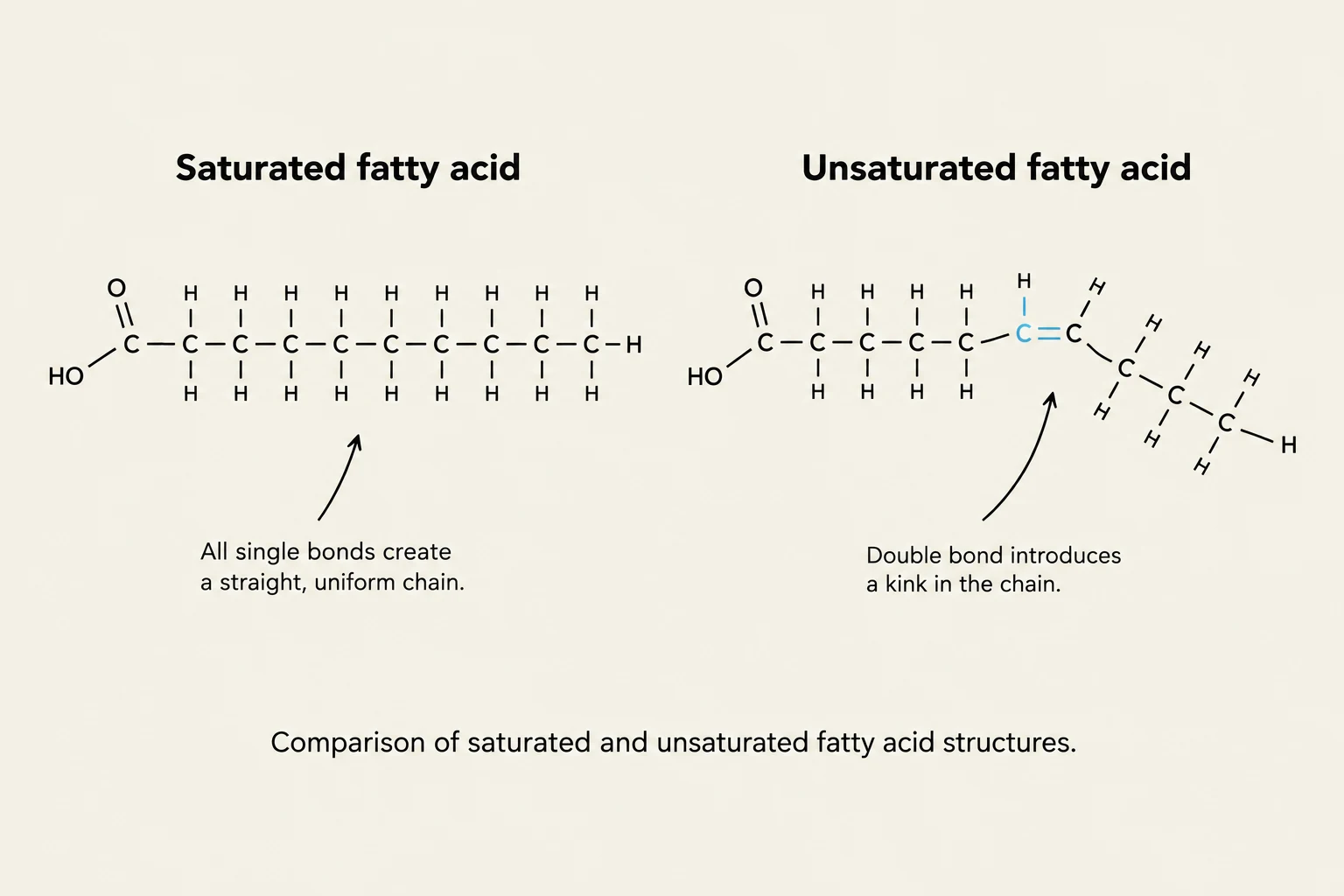
Comparison of saturated and unsaturated fatty acid structures.
To understand complex lipids, one must first understand fatty acids, which serve as the fundamental building blocks for many lipid structures. A fatty acid consists of a long chain of carbon atoms. This chain has two distinct ends:
The Alpha (α) end: The end containing the carboxyl group ($-COOH$).
The Omega (ω) end: The end containing the methyl group (−CH3).
The chemical behavior and physical properties of a fatty acid are determined by its degree of saturation—specifically, whether it contains double bonds between carbon atoms.
Saturated Fatty Acids
Saturated fatty acids contain only single carbon-carbon bonds. Because every carbon atom is "saturated" with the maximum number of hydrogen atoms possible, the structure is straight and can pack together tightly. This typically results in a solid state at room temperature.
Unsaturated Fatty Acids
Unsaturated fatty acids contain one or more double bonds between carbon atoms. These double bonds create "kinks" in the chain, preventing the molecules from packing tightly, which is why they are usually liquid at room temperature. They are subdivided into two categories:
Monounsaturated fatty acids: Contain exactly one double bond.
Polyunsaturated fatty acids: Contain two or more double bonds.
Exam Tip: Identifying Essential Fatty Acids
Not all fatty acids can be synthesized by the body. Polyunsaturated fatty acids like Omega-3 (alpha-linolenic acid) and Omega-6 (linoleic acid) are considered essential because the body can only create double bonds after the 9th carbon from the omega end.
Cis vs. Trans Configurations
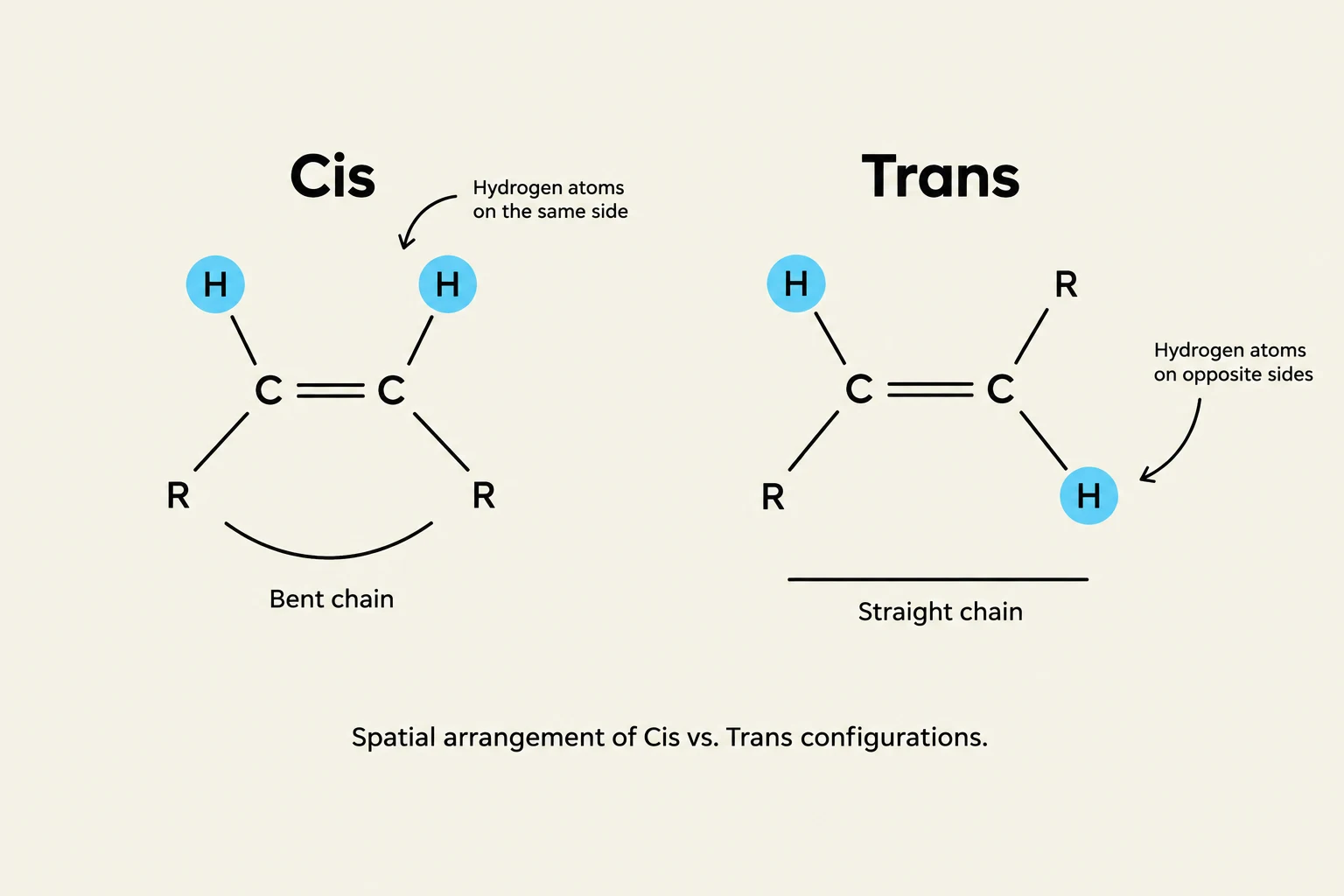
Diagram illustrating the spatial arrangement of cis and trans configurations in chemical compounds, showing the relative positions of hydrogen atoms and R groups around a double bond.
The spatial arrangement of atoms around a double bond significantly impacts the lipid's health effects and physical properties.
Cis form: The hydrogen atoms are located on the same side of the carbon-carbon double bond. Most naturally occurring monounsaturated and polyunsaturated fats exist in this configuration.
Trans form: The hydrogen atoms are oriented on opposite sides of the double bond. This change in shape makes the molecule behave more like a saturated fatty acid.
Trans fats are often created through hydrogenation, a food industry process used to turn liquid oils into solid fats to increase shelf life and improve texture. However, excess consumption of trans fats is harmful, as it raises LDL ("bad") cholesterol and lowers HDL ("good") cholesterol, increasing the risk of cardiovascular disease.
The Three Main Structural Forms of Lipids
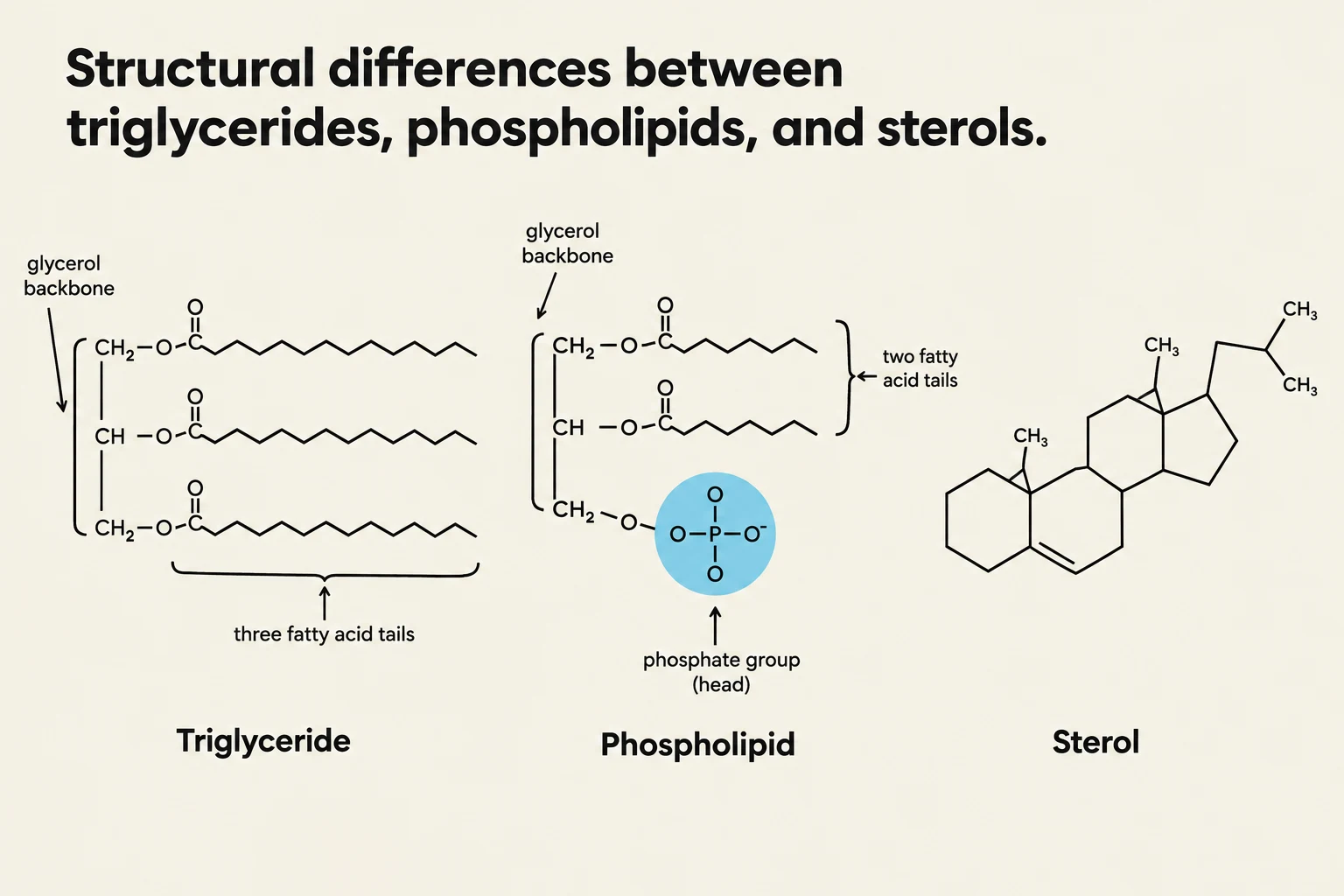
This illustration displays the structural differences between triglycerides, phospholipids, and sterols, highlighting their molecular components.
Lipids in our bodies and foods are organized into three primary structural categories: triglycerides, phospholipids, and sterols.
1. Triglycerides
Triglycerides are the most common form of lipids found in both foods and body structures. A triglyceride is composed of a glycerol backbone with three fatty acids attached to it.
In the body, triglycerides serve two major roles:
Energy Source: The breakdown of chemical bonds in fatty acids releases energy used to synthesize ATP.
Energy Storage: Excess energy is stored primarily as triglycerides within adipose (fat) cells.
2. Phospholipids
Phospholipids are also built on a glycerol backbone, but they contain a phosphorus compound. This unique structure allows them to perform two vital functions:
Cell Membrane Component: They form the phospholipid bilayer that makes up cell membranes.
Emulsifiers: They help mix fats with water. For example, lecithin is a phospholipid used in food products like mayonnaise to keep oil and water from separating.
3. Sterols
Unlike triglycerides and phospholipids, sterols do not have a glycerol backbone and do not consist of fatty acid chains. Instead, they have a multi-ringed, waxy structure.
Cholesterol: The most common sterol, produced by the liver in humans and animals. It is an essential component of cell membranes and a precursor for hormones (like estrogen and testosterone) and bile acids. Because the body can make its own, it is not an essential dietary component.
Phytosterols: These are plant-derived sterols found in nuts, seeds, and grains. They are beneficial because they can compete with cholesterol for absorption in the small intestine, helping to lower blood cholesterol levels.
Summary Table: Comparison of Lipid Types
Feature
Triglycerides
Phospholipids
Sterols
Structure
Glycerol + 3 Fatty Acids
Glycerol + 2 Fatty Acids + Phosphate
Multi-ringed structure
Primary Function
Energy storage & fuel
Cell membranes & emulsification
Hormones & cell membranes
Water Solubility
Hydrophobic (insoluble)
Amphipathic (can mix with water)
Hydrophobic (insoluble)
Keep reading for free.
Create an account to finish this reading and make it part of your study routine.