


In the high-stakes environment of healthcare, the ability to prevent the spread of disease is a fundamental pillar of patient safety. For nursing professionals, this responsibility begins even before a clinical procedure is performed. It starts with the establishment of trust through professional conduct and extends to a rigorous, scientific understanding of how microorganisms move through the environment and into the human body. By mastering the principles of asepsis and understanding the mechanics of the chain of infection, nurses can effectively mitigate risks and improve patient outcomes.
The Foundation: Asepsis and Infection
To understand infection control, one must first distinguish between the state of being aseptic and the process of infection itself. Asepsis refers to the condition of preventing infection. In clinical practice, nurses utilize medical asepsis (also known as "clean technique") to decrease the potential for the spread of pathogens. This includes essential habits such as hand hygiene, maintaining environmental cleanliness, and using Personal Protective Equipment (PPE).
An infection occurs when a pathogen—a microorganism capable of causing disease—invades and multiplies within the body. Pathogens are diverse, including bacteria, viruses, fungi (such as yeasts and molds), protozoa, helminths (worms), and prions.
In healthcare settings, infections are categorized by where they are acquired:
- Healthcare-associated infections (HAI): Infections associated with healthcare provided in any setting.
- Nosocomial infections: A more specific term for infections acquired specifically within a hospital setting.
Clinical Note: Exogenous healthcare-related infections are acquired from the healthcare environment, whereas endogenous infections arise from the patient's own normal flora.
The Chain of Infection
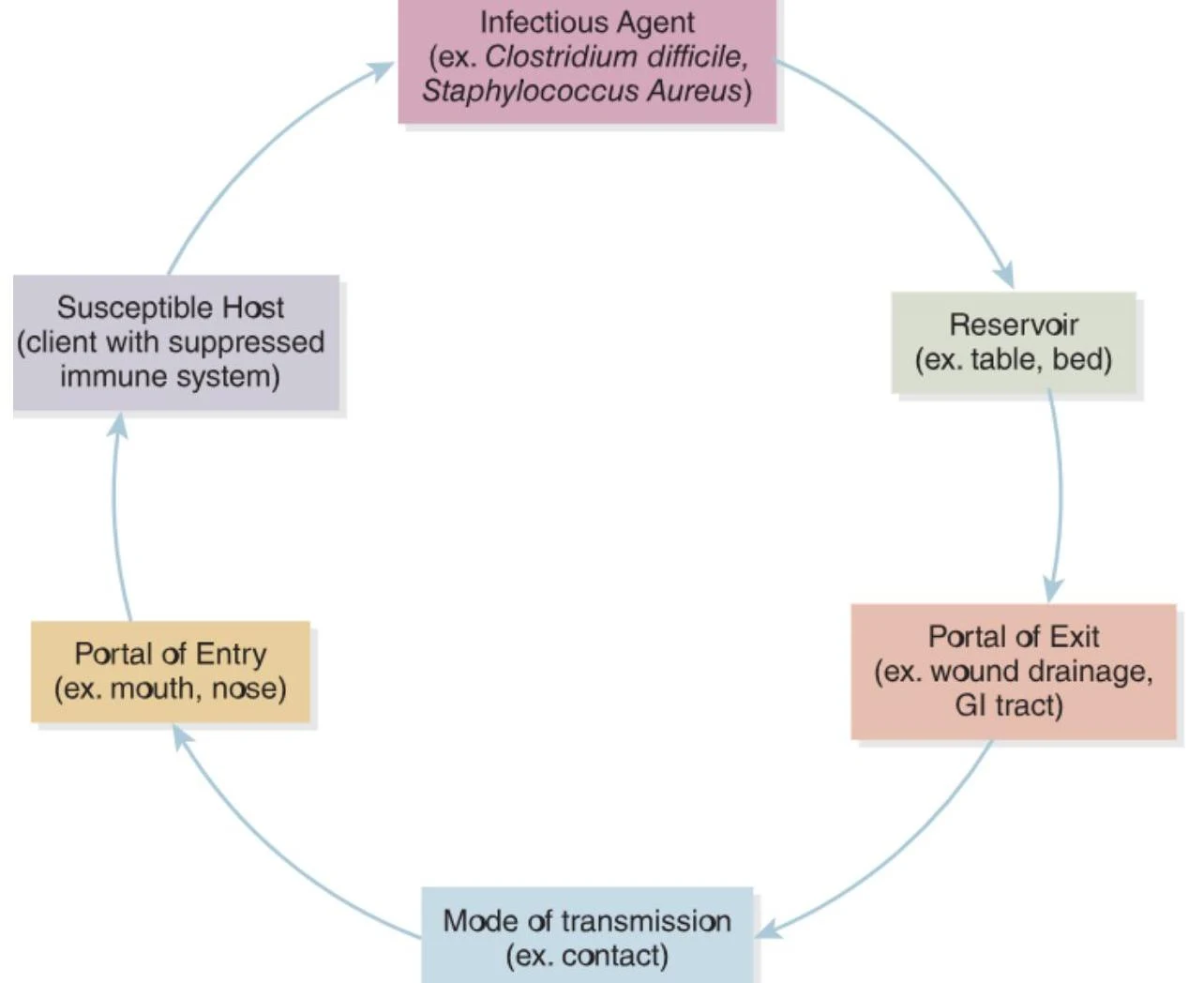
For an infection to spread from one individual to another, a specific sequence of events must occur. This is known as the chain of infection. If any one of these six links is broken, the transmission of the disease is halted.
Keep reading for free.
Create an account to finish this reading and make it part of your study routine.
Continue reading freeAlready have an account? Log in
Updated